GoDutch vs van Lanschot
We have listed the main differences for you, so that you can make the best choice.
€0 fixed costs per month
NL IBAN active in 1 day
Up to 1% cashback on every payment, unlimited
24/7 real people on the phone
Which one should you choose?
Is Van Lanschot or GoDutch better for your business account? I founded GoDutch because entrepreneurs want to be served differently from wealthy clients at Van Lanschot: high entry barrier, private banking fees, and limited digital tools. At GoDutch, a modern entrepreneur gets a business account in 1 day, free, with cashback and automatic administration. On this page, you can read the honest comparison.
Account
Dutch IBAN
Extra (virtual) IBANs
Free card
Free customer and company research
Open account / onboarding
Fully digital registration process
Registration time
Processing time KYC/KYB
Costs
Fixed costs p/m (starting price)
Cost per SEPA payment
Cost of additional payment account (IBAN)
Cost of additional payment card
Features
Real-time balance insight
Automated invoice processing
Automatic VAT recognition
Access for accountant / bookkeeper
Accounting integrations
Team card and expenditure management
International
Currency exchange at mid rate
Countries available
Currencies available
Security & Support
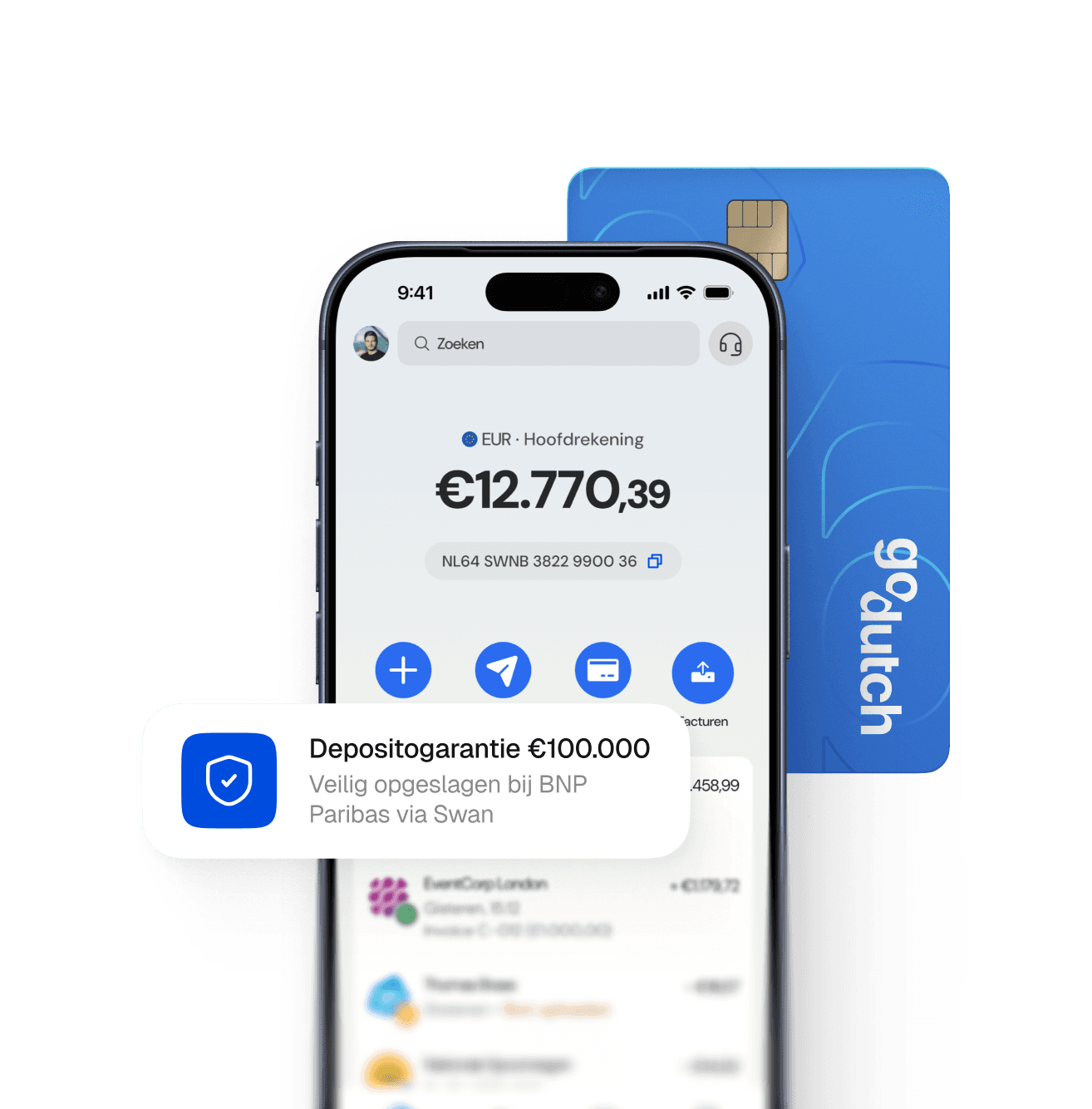
Deposit guarantee (covered up to)
24/7 telephone support
Multilingual customer support
Rewards
Cashback on card transactions
Up to 50
3 minutes
1 day
€0
€0.12
Included from Starter
Free
At cost
160+
20+
€100,000
Max up to 1.0%
 Up to 4.37% return
A few working days
Weeks to months
€12.83 p/m (€38.50 per quarter)
€0.12 outgoing / €0.18 incoming
€38.50 per quarter per account
€5.50 per quarter per card
~0.8% markup (card 1.25%)
Worldwide (€12.50 per payment)
EUR, USD, GBP, CHF, etc.
€100,000
Only in case of loss or theft
Dutch (also English)
Savings interest 1.20–1.70%
This comparison is based on publicly available information as of 12 October 2026. Prices, features and terms may change. Always check the provider's website for the most up-to-date information.
Useful features
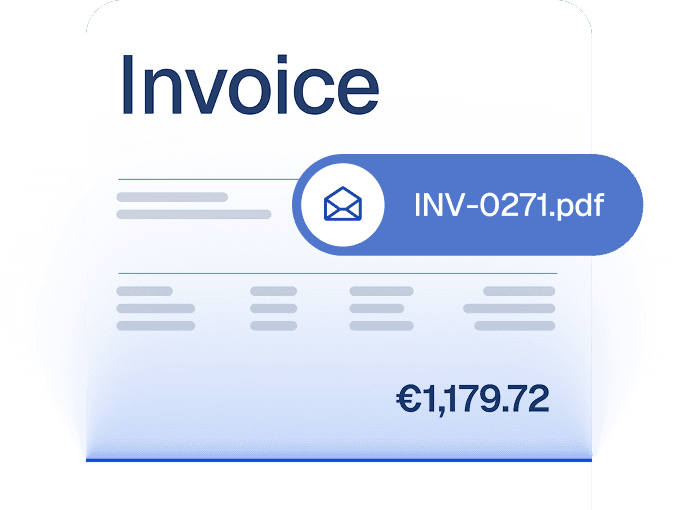
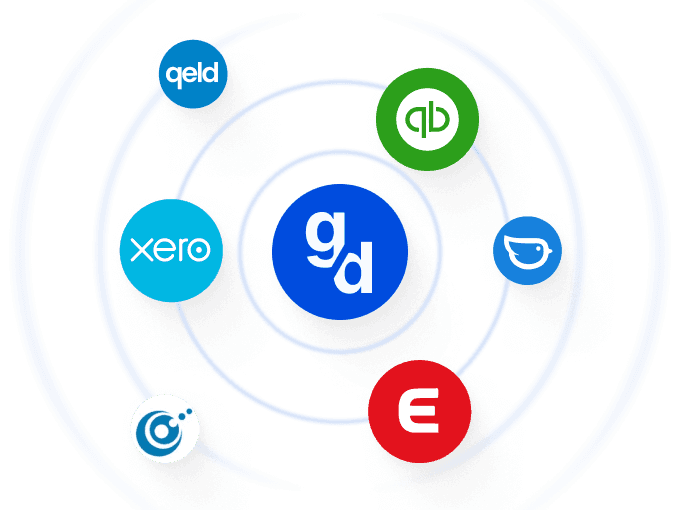
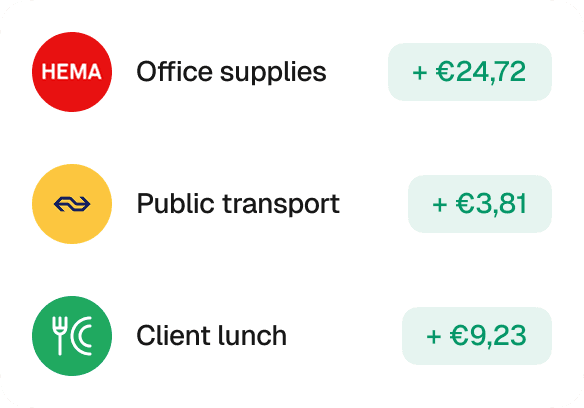
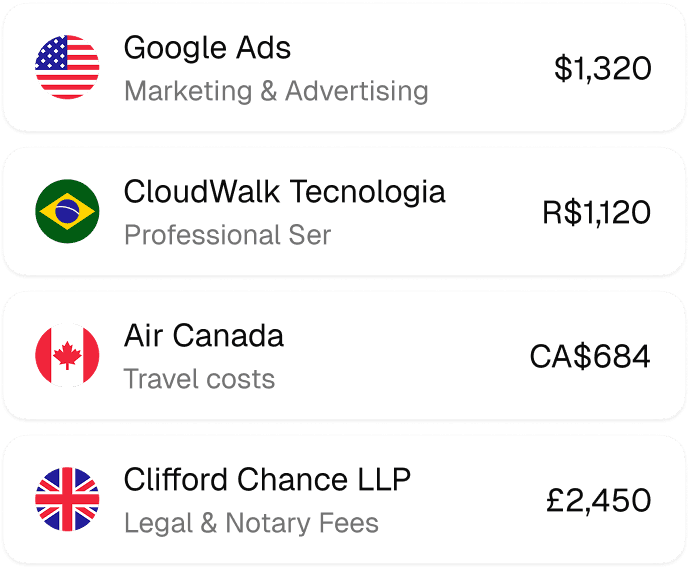
More than just a payment account
Everything you need to smartly manage your finances as an entrepreneur, from payments to insights.
FAQ
Frequently asked questions
Discover answers to frequently asked questions about our products and services.
What are the main differences between GoDutch and Van Lanschot for business owners?
The major differences between GoDutch and Van Lanschot for entrepreneurs lie in target audience, accessibility, cost structure and digitalisation. Van Lanschot is a private bank dating from 1737 that primarily focuses on wealthy entrepreneurs and family offices; a business account is often only opened if the entrepreneur is already a customer for wealth management or financing. GoDutch is a fully digital provider that is accessible to every Dutch entrepreneur, from sole trader to SME.
At the cost level, Van Lanschot applies a base rate of €25 per quarter (€100 per year) plus separate charges for online banking (€13.50 per quarter), extra IBANs (€25 per quarter per IBAN) and extra debit cards. GoDutch starts at €0 per month with an unlimited number of IBANs, free debit cards and no separate modules.
On digitalisation, the approach differs fundamentally. At Van Lanschot, the application goes via a personal adviser and the turnaround time can extend to months; features such as automatic invoice processing, VAT recognition and team cards are lacking. GoDutch opens an account fully digitally within three hours and offers these automated features as standard.
Which entrepreneurs is Van Lanschot intended for compared with GoDutch?
Van Lanschot, by comparison with GoDutch, focuses on a specific target group: affluent entrepreneurs, family offices and managing directors-major shareholders with a holding structure, who want to place wealth management, investing or financing with the same provider as their banking. Van Lanschot explicitly sees the Business Current Account as a basic product within the broader private banking offering, not as a standalone business solution.
GoDutch, by contrast, is designed for the broader business market: sole traders, freelancers, sole proprietorships, general partnerships, private limited companies, holdings, foundations, associations and owners' associations. There are no asset thresholds, no requirements regarding existing customer contact and no mandatory link to other financial products.
For entrepreneurs with a holding structure who do not automatically want to take out private banking services, a GoDutch business account for holdings offers a more direct route: a Dutch IBAN, deposit protection, low costs and modern automation, without a mandatory link to wealth management or advice. For entrepreneurs who are instead looking for an integrated wealth approach and are prepared to pay the associated fees, Van Lanschot may be a suitable choice.
What conditions does Van Lanschot set for an application compared with GoDutch?
Van Lanschot sets significantly stricter conditions for a business account than GoDutch. The Business Current Account is offered by Van Lanschot exclusively to customers who already have a broader relationship with the bank, for example through wealth management, investing or business financing. Without that broader relationship, an application is not possible in practice; the account is therefore not a standalone product.
In addition, the entire application process is handled in person via a Van Lanschot adviser. There is no online application form; you make an appointment, discuss your situation and requirements, provide documentation and wait for manual acceptance and KYC processing. Depending on the complexity of your company structure, this process can take weeks to months before the account is operational.
At GoDutch, there are no asset thresholds, no existing customer relationship required and no mandatory adviser. Any Dutch entrepreneur can submit an application online, regardless of turnover, assets or company age. The full application takes three minutes and the account is operational within three hours. More details about the Van Lanschot application process are on the page about the Van Lanschot business account.
How long does it take to open an account with Van Lanschot compared with GoDutch?
With GoDutch, your account is operational within three hours of the online application; registration itself takes three minutes and KYC processing is completed within one working day. At Van Lanschot, opening a business account can take days to months, depending on the complexity of your business structure and the scheduling of the advisory process. For entrepreneurs who want to be able to invoice or make payments straight away, that difference is significant.
At Van Lanschot, the process goes as follows. You make an appointment with an adviser, have an intake interview, submit company documents and identification, and wait for manual verification by the Van Lanschot acceptance team. For more complex structures such as holdings with multiple directors or international shareholders, processing can take up to several months. Only after approval does your Dutch IBAN become active, and you can use Van Lanschot Online Banking (available separately on request for €13.50 per quarter).
With GoDutch, KYC is fully automated via passport- or driving licence identification in front of the camera, followed by automatic verification within three hours. The Dutch IBAN, virtual Mastercard and online banking are then active immediately, without separate module fees. For entrepreneurs who want to get started straight away or switch in parallel, that means the difference between doing business the same day or waiting weeks for approval.
How much does a Van Lanschot business account cost compared with GoDutch?
Van Lanschot uses a quarterly pricing model with separate rates per service. The basic fee for the Business Current Account is €25 per quarter (€100 per year). In addition, you pay €13.50 per quarter for Online Banking, €5.50 per quarter per WorldPass (debit card), €25 per quarter per extra IBAN and transaction fees from €0.12 per SEPA payment. GoDutch starts from €0 per month, including online banking, virtual Mastercard and unlimited extra IBANs.
For an entrepreneur with one debit card and standard online banking, Van Lanschot's fixed costs come to €44 per quarter or €176 per year, excluding transaction and exchange rate surcharges. GoDutch comes to €0 per year on the Free package or €144 per year on the Pro package (€12 per month) including all functionality. With comparable functionality, GoDutch is structurally below Van Lanschot in annual costs.
Then there is the cashback difference. GoDutch pays up to 1% cashback on all card spending; Van Lanschot offers no cashback programme. For an entrepreneur with €4,000 monthly card spending, that means a difference of €480 per year in favour of GoDutch. The full GoDutch pricing page is transparently online without hidden modules or quarterly surcharges.
Do I get cashback with GoDutch and not with Van Lanschot?
Yes, GoDutch pays cashback on business card spending; Van Lanschot offers no cashback programme on the Business Current Account. At GoDutch, you get cashback on the Pro (0.5%) and Max (1%) packages, with no cap.
In practice, this means that an entrepreneur with €4,000 monthly card spending via GoDutch Max earns €480 cashback per year (1% × €48,000). The same entrepreneur at Van Lanschot receives €0 cashback, regardless of spending volume or the number of cards. For SMEs with several spending employees, the difference is substantial.
For a GoDutch business account for your BV where a lot of business expenses go through the card (software, hardware, travel expenses, online advertising), the cashback alone offsets a significant part of the subscription costs. At Van Lanschot, card use remains purely transactional, with no reward. The structural cashback difference clearly tips the balance in GoDutch's favour on an annual basis.
What automations does GoDutch offer compared with Van Lanschot?
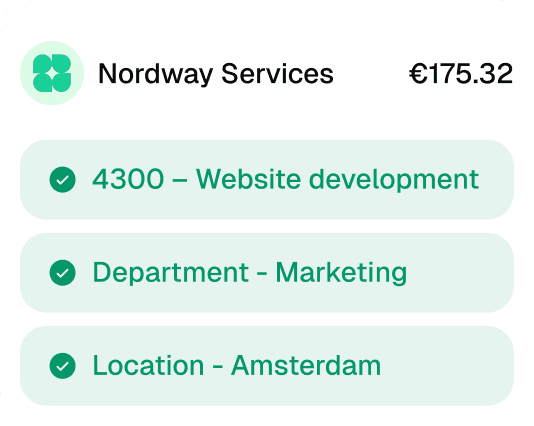
GoDutch offers a number of automations for Dutch accounting practices that Van Lanschot does not offer: automatic invoice processing, automatic VAT recognition, integrated accounting integrations and expense management with team cards. Van Lanschot's Business Current Account offers limited basic functionality that fits its positioning as a basic product within private banking, but it lacks these modern automations.
The automations that GoDutch provides as standard, where Van Lanschot falls behind:
Automatic VAT recognition: GoDutch recognises the VAT amount on transactions for your records; Van Lanschot does not offer this function
Automatic invoice processing: incoming invoices are recognised by GoDutch and prepared for approval; with Van Lanschot this must be done manually
Real-time accounting integrations: direct API integrations with Moneybird, e-Boekhouden, Exact, Visma and 25+ other Dutch packages
Team cards and expense management: virtual and physical cards with limits per employee and a real-time dashboard; not supported by default by Van Lanschot
Real-time balance insight: continuously updated overview in the app; with Van Lanschot via a separate Online Banking module
For entrepreneurs who want to automate their administration without combining external tools with their bank account, GoDutch offers a broader and more modern platform. Van Lanschot's strength lies elsewhere (in advice, wealth management and personal contact), but it lacks the operational automation that saves time in day-to-day business operations. A complete overview can be found on the page with GoDutch accounting integrations.
How does GoDutch's customer service differ from Van Lanschot's?
GoDutch is available 24/7 via chat, email and telephone with its own staff, in both Dutch and English. Van Lanschot works with personal advisers and is available during office hours (primarily Dutch-speaking), without weekend support, in-app chat or a 24/7 helpdesk. Both models have their own merits.
Van Lanschot’s strength lies in expert personal advice from a dedicated adviser, especially relevant for wealth matters, complex corporate structures or advice on investment and financing issues. For entrepreneurs who need this expertise on an ongoing basis, the Van Lanschot model adds value. The trade-off is accessibility: an urgent question on Saturday evening, a blocked card while on holiday or a failed payment during a trading moment cannot always be fitted into office hours.
GoDutch combines digital ease of use with traditional accessibility in Dutch and English, including at weekends and in the evenings. Pro and Max customers receive priority support, and Max customers also get a dedicated account manager. For entrepreneurs who expect direct operational support and do not primarily need integrated wealth advice, GoDutch is a better fit for the day-to-day realities of Dutch entrepreneurship.
How international does Van Lanschot work versus GoDutch?
Van Lanschot supports international payments primarily within the Netherlands, Belgium and Switzerland (the core markets of Van Lanschot Kempen) and offers accounts in EUR, USD, GBP and CHF. For foreign exchange transactions, a currency surcharge of around 0.7% applies. GoDutch supports international payments in 60+ countries outgoing and 150+ countries incoming, with 20+ currencies at the official mid-market rate without markup.
For entrepreneurs who structurally operate outside the European core markets (for example, a software company with customers in America, Asia or Africa, or a trading company with global suppliers), GoDutch offers a considerably wider reach and more favourable exchange rates. On a foreign exchange transaction of €10,000, the difference between 0% and 0.7% means an immediate saving of €70.
For entrepreneurs with international ambitions within Van Lanschot's core regions (Benelux, Switzerland), the bank is functional, provided the other drawbacks (manual onboarding, higher fixed costs, lack of automation) are acceptable. For entrepreneurs with broader international traffic and multi-currency cash flow, GoDutch offers structurally more flexibility without extra costs.
Which accounting integrations does Van Lanschot offer compared with GoDutch?
Van Lanschot offers limited direct integrations with Dutch accounting packages; account export is possible via CAMT or MT940 files, but real-time API synchronisation with popular Dutch accounting software is not a standard part of the offering. GoDutch offers direct API integrations with more than 30 Dutch accounting packages including Moneybird, e-Boekhouden, Exact, Visma, Asperion, Clearbooks and DigiBTW.
For Dutch entrepreneurs who work with a typical Dutch accounting package, the Van Lanschot offering in practice means that transactions end up in the accounts manually or via periodic file exports. This requires extra administrative time and results in delays in the VAT overview and profit and loss information.
At GoDutch, the bank account synchronises in real time with your Dutch accounting package, including automatic VAT recognition and categorisation. For self-employed professionals and small business owners who want to streamline their administration, a business account for freelancers via GoDutch provides direct value through this integrated approach. For SMEs, the same direct integration works with enterprise tools such as Exact or Visma.
Which legal entity types does Van Lanschot accept, unlike GoDutch?
Van Lanschot accepts sole traders, general partnerships (VOF), private limited companies (BV), public limited companies (NV), holding companies, foundations and associations, but only via the private banking route with a personal adviser. The actual acceptance depends heavily on the broader relationship with Van Lanschot (wealth management, financing) and the type of company; for small sole traders or start-ups without wealth management, the chance of acceptance is limited. GoDutch accepts the same legal forms without wealth thresholds or conditions, plus owners’ associations (VvE) and cooperatives.
For boards of non-profit organisations, GoDutch offers practical advantages that Van Lanschot does not have. With GoDutch, a GoDutch business account for foundations falls under a 0% VAT regime on the subscription, while Van Lanschot applies standard VAT rates to all modules and quarterly fees.
Additionally, GoDutch offers dedicated functionality for specific legal forms. For VOF partners, a GoDutch business account for your VOF provides standard equal access for both partners without extra modules or costs. At Van Lanschot, this has to be arranged via separate powers of representation in the personal advisory process.
How is Van Lanschot's quarterly fee model structured?
Van Lanschot uses a pricing model with separate quarterly fees per service, rather than an integrated monthly package. The base fee for the Business Current Account is €25 per quarter, but that only covers the account itself; additional modules and cards are charged separately.
The main items on Van Lanschot's tariff sheet for business customers:
Base fee Business Current Account: €25 per quarter (€100 per year)
Online Banking: €13.50 per quarter (€54 per year)
Worldpas (debit card): €5.50 per quarter per card (€22 per year per card)
Extra IBAN: €25 per quarter per IBAN
SEPA payment via Online Banking: €0.12 per transaction
World transfer outside the EEA: €12.50 per transaction
Payment instruction submitted by phone: €35.00 per transaction
Paper account statement (daily): €2.50 per statement
In practice, for an entrepreneur with one debit card and online banking, that comes to €44 per quarter in fixed costs, excluding transactions and additional services. A detailed analysis of transaction cost structures is set out in the background article on the difference in transaction costs between business providers. At GoDutch, all basic functionality is included free of charge in the Free package, without separate modules or paper surcharges.
How do I switch from Van Lanschot to GoDutch?
Switching from Van Lanschot to GoDutch can be arranged in four steps. Within one working day you have an operational account with GoDutch and you only close your Van Lanschot account as the final step, so you can switch over calmly without missing payments. Please note that closing with Van Lanschot often takes place via a personal conversation with the adviser and may take some time.
Step-by-step plan for the switch:
Open your account with GoDutch: complete the online application in three minutes, identify yourself with a passport or driving licence and wait for the KYC processing (three hours). Your Dutch IBAN and virtual Mastercard are active immediately afterwards, and your account falls under the Dutch deposit guarantee scheme.
Inform contacts about your new IBAN: send customers and suppliers a short email with your new account number. In the GoDutch app, you can download a bank statement with your IBAN for your records and any connection to the Switching Service.
Move direct debits and subscriptions: adjust recurring payments for energy, software subscriptions, suppliers and periodic invoices. At Van Lanschot you would normally work with your adviser for this, which may require extra time.
Close your Van Lanschot account: transfer the remaining balance to GoDutch and close the Business Current Account via your regular Van Lanschot adviser. A detailed route and key points can be found in the step-by-step guide on closing a Van Lanschot business account.
Keep both accounts running in parallel for the first month, so any forgotten direct debits are not rejected. For questions during the switch, GoDutch's support team is available 24/7, including at weekends and in the evenings. Ready to switch to a Dutch provider without quarterly surcharges and with direct digital onboarding? You can open a business account online with GoDutch straight away and get started today.
Published 28 Nov 2025 · Updated 12 Oct 2026

The account that saves you time and money
