
As a founder, you don’t want to wait
Everything your startup needs to manage payments, cards, and expenses easily - all in one place.
Startup account within 1 day
Open a business account within 1 day, then send payments in seconds.
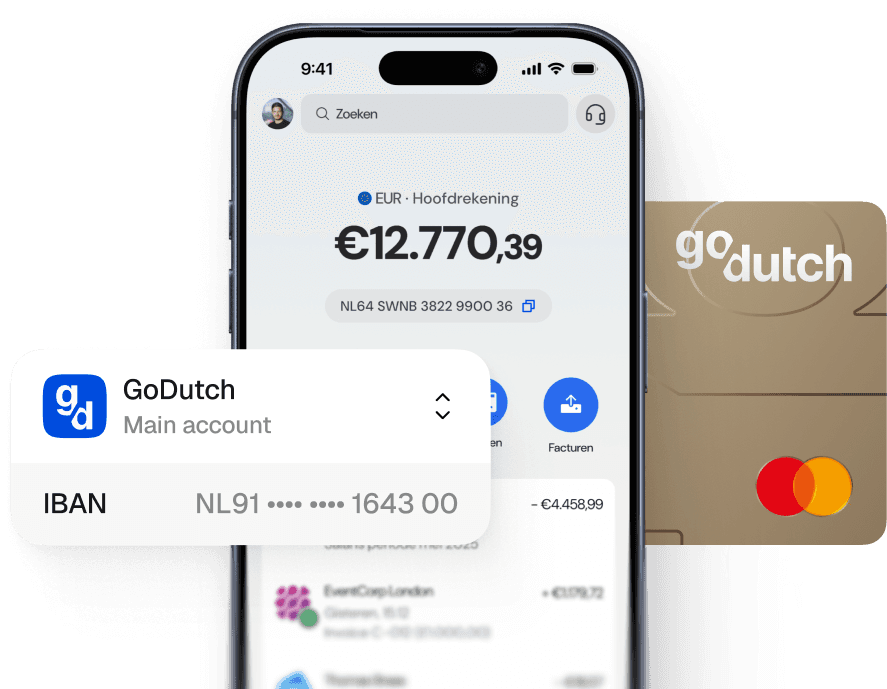
Let your account do the work
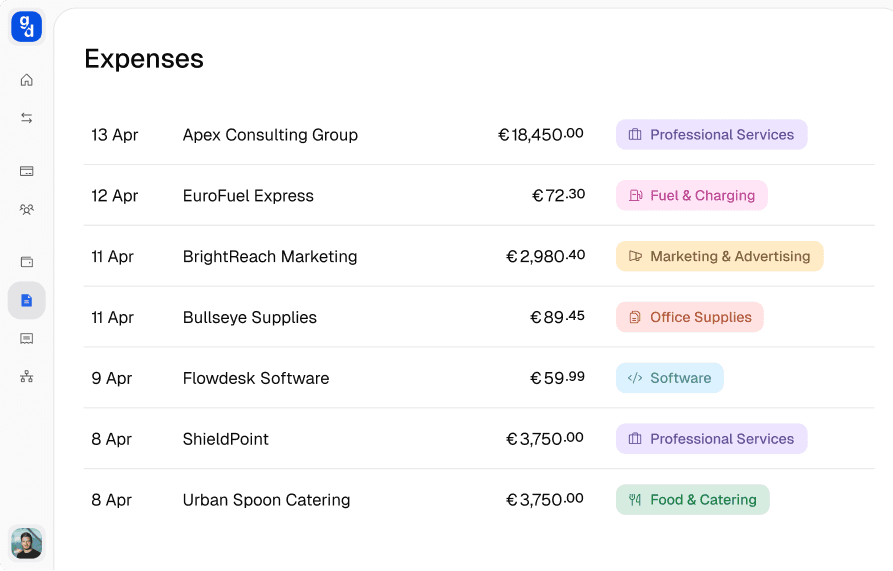
GoDutch automates your financial administration, from incoming invoices to expense management. You focus on doing business, we take care of the rest.
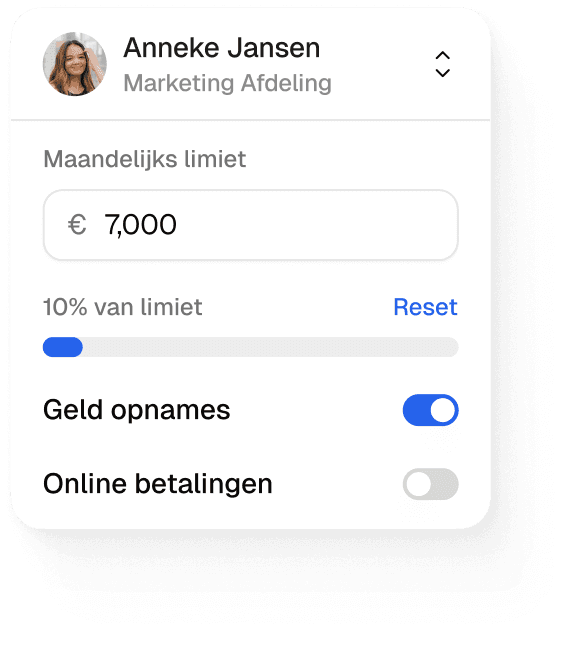
Team roles and cards
Issue cards to your colleagues and keep control of company spending, without the hassle of expense claims.
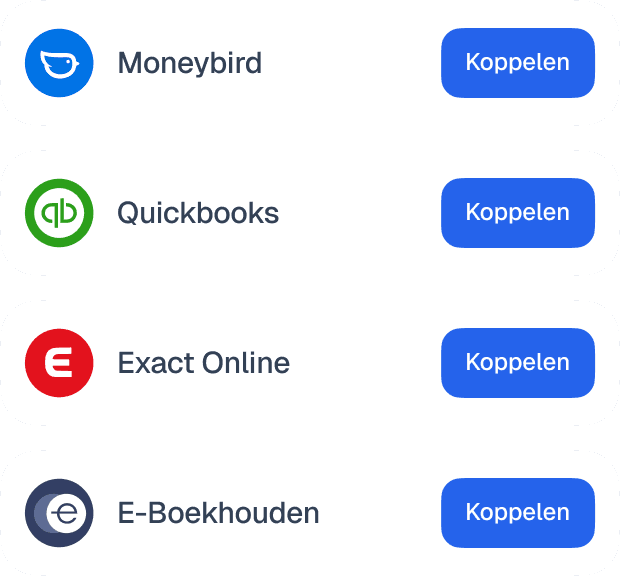
Link your accounting software
Connect GoDutch to your accounting software and automate your admin. Fewer errors, less work, more clarity.


Lightning-fast payments and collections
With SEPA Instant, you can quickly and reliably manage all your payments, including bulk payments and direct debits, in one place.
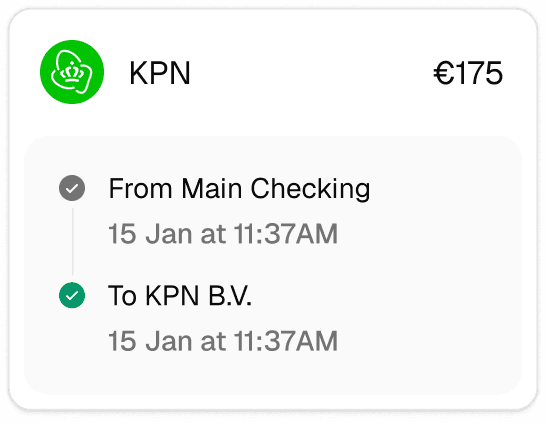
SEPA Instant
With GoDutch, your payments are transferred in a matter of seconds. No more waiting times, instant transfers ensure that your money is directly in the right account.
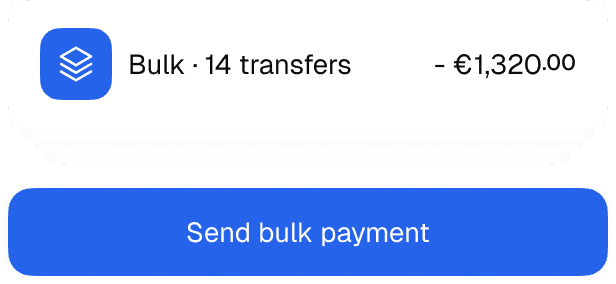
Upload payment files
Bulk transfers with up to 1,000 transactions per file, ideal for salary runs or processing payouts from your accounting software.
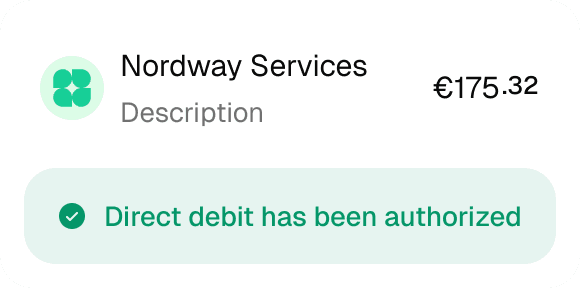
Direct debits
GoDutch supports automatic direct debits, both B2B and Core. Simple, secure and reliable for all your business collections.

Why does your startup need its own business account?
Your startup needs its own business account, because the company's money does not belong in a founder's account. A startup is a company that wants to grow and therefore usually chooses a BV (private limited company): a legal entity of its own, with money in the name of the company.
The parties around you count on that too. Investors pay their contribution into a business account of your startup, payment services pay out to an IBAN in the name of the company, and your accountant wants records without personal items from the very first transaction.
What do you need to open a startup account?
To open a startup account you need the KVK number of your startup and a valid passport or driving licence. Because a startup often has several founders, a provider mainly looks at who holds the shares. So have these documents ready:
KVK number: you have this as soon as the notary has registered your startup.
Passport or driving licence: of the founder who applies, who verifies their identity via the camera.
Articles of association and shareholder register: these show how the shares are divided among the founders.
UBO details: of every founder with more than 25% of the shares.
Organisation chart: only needed if founders hold their shares through their own holding company, because then the UBO sits one layer higher.
If the split in the shareholder register matches what you fill in on the application, the check is done quickly. If a founder holds their shares through a holding, that holding also needs its own business account.
How do you open a business account for your startup?
You open a business account for your startup in four steps, from registering the company to the first payment:
Have your startup registered: the notary registers your startup with the KVK, after which you have the KVK number.
Start the application: one of the founders fills in your startup's details and verifies their identity with a passport or driving licence.
Have the details checked: the review team checks your startup and the UBOs and gets in touch if anything is missing.
Invite your co-founders: you give your co-founders their own access and create the first cards.
How do you receive investments on your startup's account?
You receive investments on your startup's account, in the name of the company, and not on a founder's personal account. That way it stays visible to everyone that the money belongs to the company. What else is involved depends on where the money comes from and who looks at it later.
Capital from founders and investors
Since 2012 there is no minimum capital for a BV, so founders often pay only a small amount on their shares at incorporation. If an investor comes in later, you issue new shares through the notary and the investor pays the nominal amount plus the share premium into your startup's account.
If you work with a convertible loan, the money first comes in as a loan and is only converted into shares later. For large amounts the review team may ask about the source, so keep the deed or the loan agreement to hand.
Your figures ready for due diligence
In an investment round, investors scrutinise your figures, and what counts most is whether every transaction can be explained. That works best if all money flows run through your startup's account and every receipt sits with its payment.
With a connection to your accounting software, transactions are already in your records, and your accountant can deliver reports without hunting for statements.
How do you keep your runway in view with your startup's account?
Your runway is the number of months your startup can keep going on the money it has: your balance divided by your burn rate, the amount you spend net per month. If you set nothing aside, that runway looks longer than it is. These habits keep the picture honest:
Pot for VAT: you pay the VAT on your invoices with the return, so you set it aside straight away.
Pot for corporate income tax: as soon as your startup makes a profit, the company pays corporate income tax on it.
Pot for salaries: with employees on the payroll you set aside payroll tax as well as wages.
One card per tool: with a separate virtual Mastercard per subscription you see per tool what it costs, and you block the card as soon as you cancel a tool.
That way you see every month what your burn rate really is, and not only when the tax return comes in.
What card arrangements do you make with your startup's first employees?
With your startup's first employees, you agree what their card is for before they start using it. A developer who only pays for tools needs a different limit from someone who travels or buys materials for your startup. These three arrangements prevent discussions afterwards:
A limit per card: match the limit to what someone really uses the card for.
A card per person: do not share cards, so for every expense you know who made it.
Blocking on departure: block the card on an employee's last working day, so nothing more can be charged to it after that.
What does a startup account at GoDutch give you?
A startup account at GoDutch gives you one place where founders, team and accountant see the same figures. You start without fixed costs, give each co-founder their own access and track per tool and per pot where your runway goes. As the team grows, you switch plans without opening a new account.
The moment you notice this is the day your first investment comes in: the money is in your startup's name, the split matches the shareholder register and your investor sees tidy records from the very first euro.
FAQ
Frequently asked questions
Discover answers to frequently asked questions about our products and services.
Can I open an account before my startup is registered?
No, you only open an account for your startup after registration with the KVK, because the account is in the name of the company. Costs you incur in the meantime you pay yourself as a founder. As soon as the company has been incorporated, it can ratify those acts and take over the costs from you, so they still end up in your startup's records.
Can I open accounts for several entities?
Yes, at GoDutch you open accounts for several entities, for example for your startup and for the holding through which you hold your shares. In the app you switch between them without logging in again. Each entity has its own IBAN and its own users, so your co-founders only see the startup's account.
What is the difference between a startup account and a starter account?
A startup account is meant for a company that wants to grow, with several founders, investors and later a team, and is usually in the name of a company with shareholders. A business account for starters suits someone who is just starting out in business and mainly works alone. So the difference lies in ambition and structure, not in how long you have existed.
What do you arrange on the account when your startup hires its first employee?
With your first employee you become an employer, so you register your startup with the Belastingdienst (Dutch Tax Administration) and get a payroll tax number. You pay the salary from your startup's account, and the payroll tax you withhold you pay with the payroll tax return. Set that payroll tax aside straight away, so it does not seem to be part of your runway.
How is your startup's money protected?
GoDutch holds your money in full in a segregated account, set up in a foundation. If anything were to happen to GoDutch, your money is separate from our own assets. That account is held at our partner bank, BNP Paribas. In the unlikely event that BNP Paribas itself failed, the funds in that account qualify for deposit guarantee protection of up to €100,000.