One place for your money, expenses, and administration.
GoDutch helps you not only pay and receive but also ensures that your financial matters are automatically in order. Without extra tools. Without extra work.
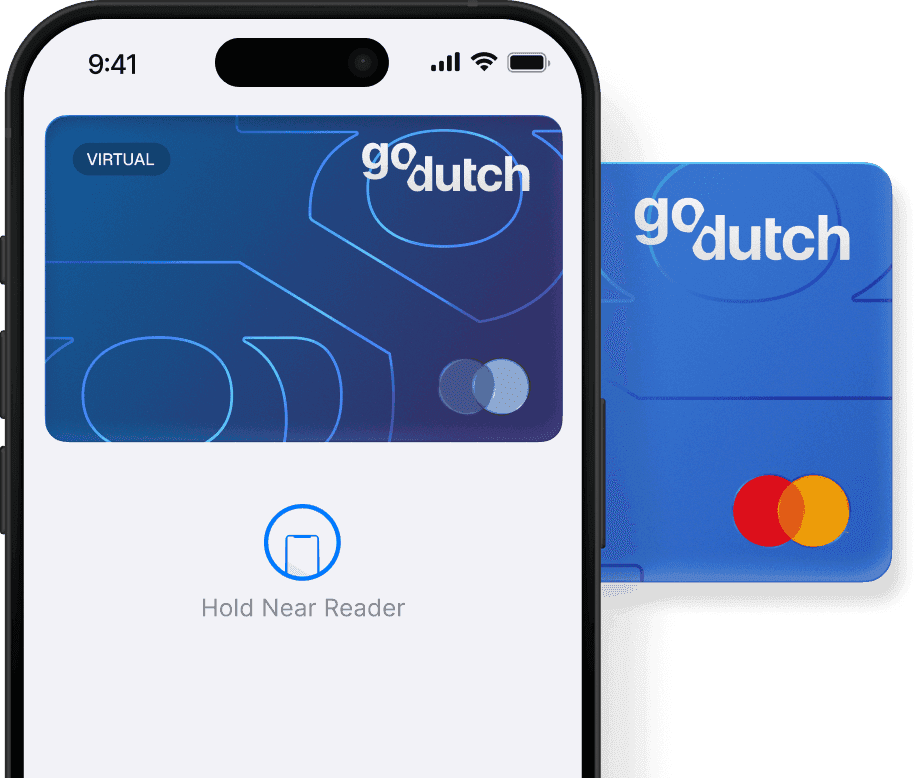
Get free digital maps
Get a free digital card. Choose a paid subscription and also enjoy a free physical card.
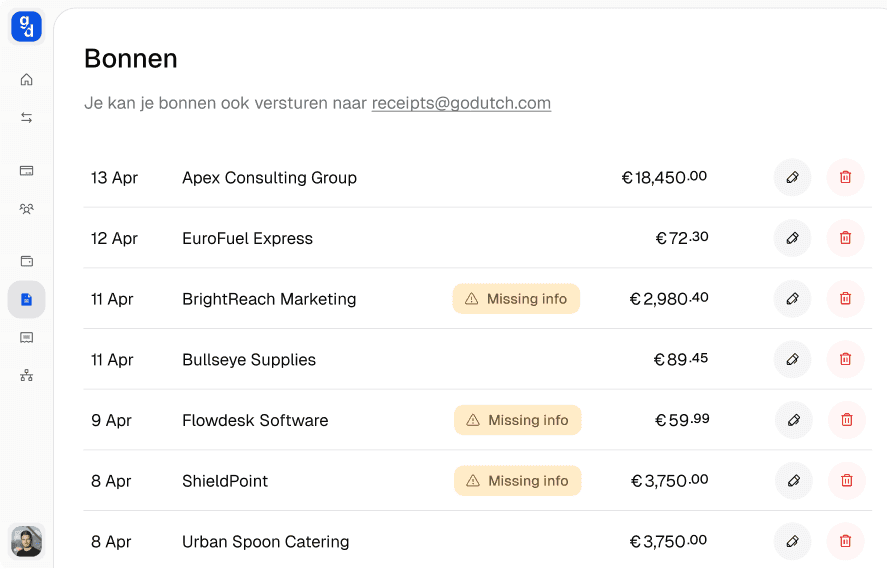
No more receipts lost
GoDutch automates your financial administration, from incoming invoices to expense management. You focus on doing business, we take care of the rest.
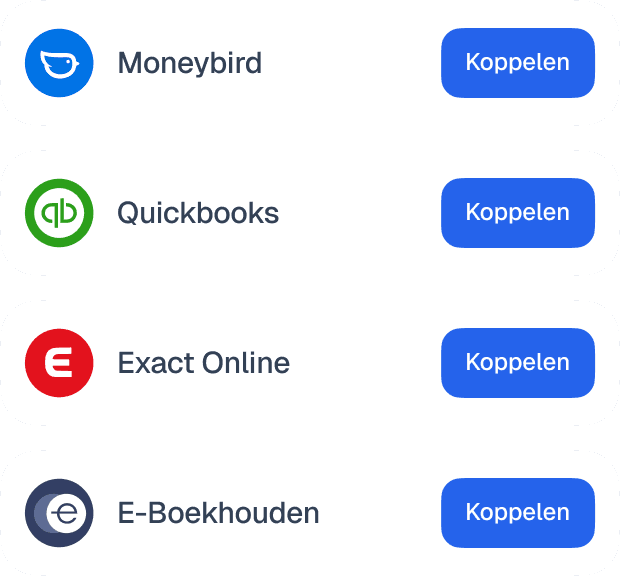
Automate your accounting
Link your GoDutch self-employed account to your accounting software and let transactions be passed on automatically. Fewer errors, less manual work and always up-to-date insight.
Do you need a business account as a ZZP'er (freelancer)?
As a freelancer you need a business account in practice, even though it is not required by law. The Tax Administration (Belastingdienst) does not demand a separate account, but many providers do not allow business use of a personal account in their terms.
On top of that, payment services and sales platforms often ask for a business account in your company's name before you can receive payments through them. If you sell online or let customers pay via a payment link, you quickly run into this without a business account.
How do you open a freelancer (ZZP) account?
You open a freelancer account with your KVK number and a valid passport or driving licence, in four steps:
Register with the KVK: without a KVK number (Chamber of Commerce number) you cannot open a business account.
Start the application: you answer a few questions about your business and verify your identity via the camera.
Receive your IBAN: after the check you get your IBAN and card; if anything is missing, we contact you.
Set up the account: you create your pots, put your new IBAN on your invoices and connect your accounting software, for example Moneybird or e-Boekhouden.
How do you keep personal and business separate as a freelancer?
As a freelancer you keep personal and business separate by running everything to do with your business through your business account. If you have been using your personal account so far, give your new IBAN to your customers and the Tax Administration straight away. After that you keep the separation with a few fixed habits:
Business IBAN on your invoices: customers only pay into your business account, never into your personal account.
Fixed costs from the business account: subscriptions, software and insurance for your business are debited from your business account.
Card for business only: you only pay business expenses with your business card, so you don't have to sort anything out afterwards.
Fixed amount to personal: at a fixed moment, for example monthly, transfer a fixed amount to your personal account as your own income.
Receipt with the payment: store your receipt with the transaction straight away, so your records are complete when your accountant asks for them.
What do you set money aside for in your freelancer business account?
In your freelancer business account you set money aside for VAT, income tax and your pension. As a freelancer nobody withholds tax for you and nobody builds up a pension for you, so you reserve that money yourself. With one pot per purpose you see what you can really spend.
VAT on your invoices
The VAT on your invoices is not yours: you pay it with your VAT return, usually every quarter. On an invoice with 21% VAT, 21/121 of the amount received is VAT, roughly 17%. Set that part aside as soon as it comes in. If you use the small business scheme (kleineondernemersregeling), you charge no VAT and this pot is not needed.
Income tax on your profit
Nobody withholds payroll tax on your profit, the way an employer does on a salary. The Tax Administration sends you an assessment, sometimes as a provisional assessment that you pay in monthly instalments. How much you reserve depends on your profit and your deductions.
Agree the amount with your accountant, so the assessment doesn't catch you out all at once. If you work as a freelancer through your own BV, the BV pays corporate income tax on the profit and withholds payroll tax on your salary.
Pension
As a freelancer you don't automatically build up a pension through an employer, besides the AOW (state pension). So whatever you want to have later, you set aside yourself. A fixed amount per month in a separate pot makes that visible, even in months when your assignments bring in less.
What mistakes do freelancers make when choosing a business account?
The mistakes freelancers make when choosing a business account lie less in the price than in what the account doesn't do. These four mistakes cost you time later.
1. Choosing on the monthly price alone
If you choose on the monthly price alone, you often only notice at the first VAT return that there are no pots or connection to your accounting. So also look at what you pay per transaction and what the account does besides payments, for example by comparing business accounts on features.
2. Continuing to use your personal account
A new business account only helps if you let go of the old habit. If you still let some of your customers pay into your personal account, your business income sits in two places and your accountant still has to piece it together.
3. Not setting money aside for VAT
An account without pots makes it easy to spend the VAT you received by accident. At the return you then have to find that amount somewhere else, at the moment you can least afford it.
4. Not connecting your accounting
Without a connection to your accounting software you download statements and retype amounts, with a risk of errors. An account with connections to your accounting software puts your transactions in the right place automatically and saves you time every quarter.
What changes for your freelancer account if you hire staff?
If you hire staff, what mainly changes is what runs through your freelancer account, because you are then no longer a ZZP'er: ZZP stands for zelfstandige zonder personeel, self-employed without staff. You become an employer, get a payroll tax number and pay salaries and payroll tax from your business account.
Your account simply keeps working, but you often need extra users and cards for your employees. What that involves is explained under the business account for SMEs.
Why do freelancers choose a business account at GoDutch?
Freelancers choose a business account at GoDutch because you start for free and keep personal, business and tax separate in one app. Your pots fill up with every payment that comes in, and your accounting software gets your transactions without you having to export anything.
The first moment you notice this is your first invoice with your own business IBAN: your customer pays into your company's account, and the VAT part is already set aside before you see it.
FAQ
Frequently asked questions about the self-employed account
From fees and speed to accounting integrations and cashback: here you'll find answers to the most frequently asked questions about GoDutch's business account for self-employed professionals.
Can I open a freelancer account without registering with the KVK?
No, you only open a freelancer account after registering with the KVK, because you need your KVK number for the application. So register first and apply for your business account straight afterwards. That way your first invoice shows a business IBAN right away.
Can I open an account for another business alongside my freelancer account?
Yes, alongside your freelancer account you can also open an account for another business at GoDutch. In the app you switch between the accounts without logging in again. Each account has its own IBAN, its own users and its own settings, so the money flows of both businesses stay separate.
How long do you keep the statements of your freelancer account?
You keep the statements of your freelancer account for 7 years, because they fall under the Tax Administration's statutory retention obligation. This also applies if you stop or switch during that period. So download your statements before you close an account, so you can show them if the Tax Administration asks for them.
What do you do with your freelancer account when you stop freelancing?
If you stop freelancing, you only close your freelancer account after all business payments have been completed. Deregister with the KVK, file your last VAT return and wait until outstanding invoices have been paid. Then close your business account.
How is the money in your freelancer account protected?
GoDutch holds your money in full in a segregated account, set up in a foundation. If anything were to happen to GoDutch, your money is separate from our own assets. That account is held at our partner bank, BNP Paribas. In the unlikely event that BNP Paribas itself failed, the funds in that account qualify for deposit guarantee protection of up to €100,000.
I work as a freelancer through a BV: which account do I need?
If you work as a freelancer through a BV, you need a business account in the BV's name, because a BV is a separate legal entity. You open that account with the BV's KVK number. What else is involved is explained under the business account for your BV.