Registering a sole trader business


You register a sole trader business yourself online with KVK, using your DigiD and a registration fee of € 85.15. No notary is involved and you do not need any start-up capital. Below you can read what the legal form involves, how registration works and what you need to arrange afterwards.
What is a sole trader business?
A sole trader business is a legal form in which you are the only owner of the business. You are responsible for everything that happens in the business and you are liable for business debts with your own money. According to figures from Statistics Netherlands (CBS), the sole trader business is the most widely used legal form in the Netherlands.
You can have a maximum of one sole trader business. That single business may, however, run several trade names, activities and branches, so a second business idea does not call for a second registration.
At registration you record your trade name and your visiting address. After that comes the practical part, where a business account for starters keeps your business payments separate from your private money: legally the two run together in a sole trader business, but in your records you do not want that.
Is a sole trader business a legal entity?
No, a sole trader business is not a legal entity. You do business as a natural person, which means there is no legal separation between you and your business. That is the main difference from a private limited company or a foundation, which do have legal personality.
The consequence hits your wallet. Business debts are your debts, and everything you own counts towards paying them: your savings, your car and your own home. A contract you enter into on behalf of your sole trader business legally binds you as a person.
What is the difference between a sole trader business and being a freelancer?
The difference between a sole trader business and being a freelancer is that the sole trader business is a legal form and freelancing is a way of working. Ondernemersplein is clear about it: freelancer or self-employed person is not a legal form. Most freelancers choose the sole trader business, but a freelancer can just as easily have a private limited company.
The confusion arises because the two almost always coincide. In Dutch, zzp stands for self-employed person without staff and describes your position in the labour market. Sole trader business describes how your business is legally structured and is registered as such in the Commercial Register.
Practical difference: with a sole trader business you can certainly take on staff, and then you are no longer a self-employed person without staff while your legal form stays the same. If you are still hesitating between legal forms, first look at which legal form suits you before you register, because switching later costs time and money.
What are the advantages of a sole trader business?
A sole trader business has three advantages you will not find as complete in any other legal form:
Quick and cheap to start: no notary, no deed, no start-up capital and a single registration fee of € 85.15.
Tax schemes for entrepreneurs: the self-employed person's allowance, the starter's allowance and the SME profit exemption reduce your taxable profit.
Full control: you always have signing authority and do not have to consult a board or shareholders.
On top of that comes an administrative advantage that is rarely mentioned: you do not have to file your annual accounts with KVK. You do draw them up for your own tax return, but they never become public, unlike those of a private limited company.
What are the disadvantages of a sole trader business?
The biggest disadvantage of a sole trader business is personal liability: your private assets stand behind your business debts. On top of that you build up no employee rights, because you are not entitled to sickness, unemployment or disability benefit.
Your tax advantage is also less certain than it looks. You only get the self-employed person's allowance and the starter's allowance if you meet the hours criterion, and the self-employed person's allowance has been phased down in stages since 2020.
What are you liable for with a sole trader business?
With a sole trader business you are liable for all your business's debts, with both your business and your private assets. If you cannot pay a business invoice, you have to use your own money for it.
Your partner may share the liability. Ondernemersplein distinguishes five situations, where your wedding date and your prenuptial agreement determine what applies:
Cohabitation agreement: your partner is not liable.
Married under a prenuptial agreement: it depends on what you agreed in that agreement.
Married before 2018 in a general community of property: your partner is liable.
Married after 2018 and business started before the marriage: your partner is not liable.
Married after 2018 and business started after the marriage: your partner is liable.
The same rules apply to a registered partnership as to a marriage. If you want to nail this down, set out in your prenuptial agreement that your partner is not liable for business debts.
How do you register a sole trader business with KVK?
To register a sole trader business with KVK you go through four steps. Only the owner can complete the registration, so a bookkeeper or family member may help but not register:
Log in with DigiD: you start the online registration form on kvk.nl with your personal DigiD.
Fill in the registration form: you enter your trade name, activities, start date and visiting address, and logging out midway does not erase your details.
Check your details: you go through everything before the registration becomes final.
Complete the identity check: you usually make an online appointment for this at a KVK office of your choice, and sometimes the registration runs entirely digitally.
Bring valid proof of identity to the appointment, plus the documents from your confirmation email. After registration you receive your KVK number and KVK automatically passes your details on to the Dutch Tax and Customs Administration.
Within two weeks of your start date a letter follows with your turnover tax number and your VAT identification number, if the Dutch Tax and Customs Administration considers you an entrepreneur for VAT purposes.
What does registering a sole trader business cost?
Registering a sole trader business costs € 85.15 in registration fees, and nothing else. KVK indexes that amount annually and as an entrepreneur you may deduct it. A certified extract from the Commercial Register is optional, although some providers and wholesalers ask for it.
You do not need to buy eHerkenning either. The Dutch Tax and Customs Administration links a sole trader business's VAT return to your personal DigiD, so you log in to Mijn Belastingdienst Zakelijk free of charge. Legal entities do pay for that annually.
When do you have to register your sole trader business?
You register your sole trader business within one week before or after the start of your business activities. You then receive your KVK number immediately. You may come in for the check up to three months before your start date; your KVK number then arrives by post in the week you start.
You do not register a hobby. With a hobby KVK assumes you earn little or no money, or spend a lot of time on something that yields little, and under the Commercial Register Act that is not a business. If you do earn something on the side, you usually declare that income to the Dutch Tax and Customs Administration.
Discuss your plans with UWV first if you receive unemployment benefit. If you receive social assistance, do that with your municipality.
How much tax do you pay with a sole trader business?
With a sole trader business you pay income tax on your profit, not the corporate income tax that applies to a private limited company. If the Dutch Tax and Customs Administration considers you an entrepreneur for income tax purposes, three schemes reduce your taxable profit:
Self-employed person's allowance: € 1,200 in 2026, for which you have to meet the hours criterion of 1,225 hours.
Starter's allowance: € 2,123 in 2026, which can be applied a maximum of three times in your first five years.
SME profit exemption: 12.70% of your profit after the entrepreneur's allowance, with no hours criterion.
The self-employed person's allowance has been more than halved this year, from € 2,470 in 2025 to € 1,200 in 2026. The Dutch Tax and Customs Administration has already announced a further reduction to € 900 in 2027, so check your provisional assessment against that.
VAT is a separate calculation. If you are an entrepreneur for VAT purposes, you pay VAT over on your turnover. If your turnover stays below € 20,000 per calendar year, you can opt for the Small Businesses Scheme and no longer charge your customers VAT.
Can you take on staff with a sole trader business?
Yes, with a sole trader business you can take on staff, and there is no maximum number of employees. The Dutch word eenmanszaak refers to the legal form and to the number of owners, not to the number of people working in your business.
If you take someone on for the first time, you become an employer. You register with the Dutch Tax and Customs Administration, withhold payroll taxes and social security contributions, and tell KVK how many people you employ.
What obligations do you have after registration?
After registering your sole trader business you have four ongoing obligations:
Keep records: income, expenses, invoices and quotations, to be retained for seven years.
File VAT returns: monthly, quarterly or annually, depending on what the Dutch Tax and Customs Administration determines.
File an income tax return: on the profit from your business, annually.
Report your changes: you report a new address, different activities or an extra trade name in Mijn KVK.
You arrange insurance yourself. You build up state pension through the national insurance schemes, but supplementary pension and disability insurance fall outside that cover. In the event of pregnancy you are entitled to at least 16 weeks of benefit through UWV.
According to KVK, mandatory disability insurance will arrive in 2030 at the earliest. The Basic Disability Insurance for Self-Employed Persons bill has been tabled, with a premium of up to around € 171 per month and a waiting period of two years, but both houses of parliament still have to vote on it. In the meantime, choose cover yourself that suits your risk.
How do you arrange your sole trader business finances?
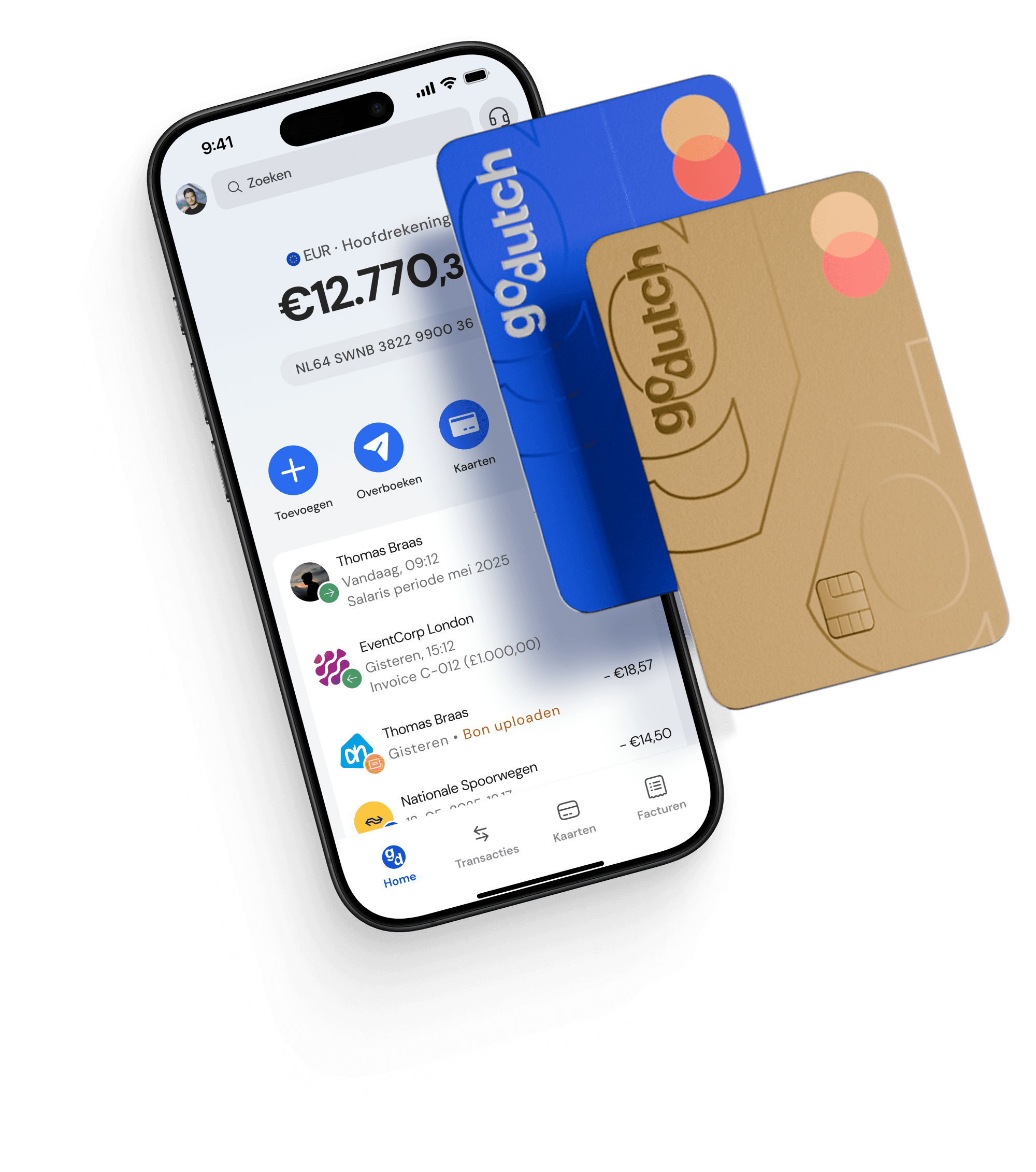
You arrange your sole trader business finances with an account in your business's name, so that your business and private spending stay separate. At GoDutch you apply for that account in 3 minutes and have your IBAN and card within 1 day, exactly when your KVK number has come through and you want to send your first invoices.
With a sole trader business that separation is not a legal one but a practical one. Because you have a seven-year retention obligation and pay VAT over each quarter, it saves hours if income and expenses come in already sorted rather than mixed in among your private transactions.
You connect the account to your bookkeeping in Exact, Moneybird or Twinfield, set aside what you need to hold back for VAT and income tax, and start free with the entry-level package. If you get stuck, the support team helps you 24/7, with real people.
Open a business account for your sole trader business
You are registered with KVK and your VAT numbers are on their way. Then open a business account for your sole trader business at GoDutch: free to start, applied for in 3 minutes and operational within 1 day, so you keep an overview from your very first assignment.
FAQ
Frequently asked questions about registering a sole trader business
How many sole trader businesses may you have?
You may have a maximum of one sole trader business. Registering a second one is not possible, not even for a completely different business idea. One sole trader business does run several trade names, activities and branches, so you separate your businesses by name without needing a second legal form.
Do you need eHerkenning for a sole trader business?
No, you do not need eHerkenning for a sole trader business. You log in to Mijn Belastingdienst Zakelijk with your personal DigiD and the VAT return is linked to your sole trader business automatically. If you also have a private limited company or a general partnership, you do need eHerkenning for that legal form.
Do you have to register a hobby with KVK?
You do not have to register a hobby with KVK. If you earn little or nothing, or spend a lot of time on something that yields hardly anything, then under the Commercial Register Act there is no business. If you do earn something on the side, you usually declare that income to the Dutch Tax and Customs Administration.
Is your home address public in the Commercial Register?
Your visiting address is public in the Commercial Register by default, and for a business run from home that is your home address. You can have it shielded, provided you register a different postal address such as a PO box. You arrange that at registration or at a later point through Mijn KVK.
Can you have someone else sign on behalf of your sole trader business?
Yes, you can have someone else sign on behalf of your sole trader business by granting a power of attorney. As the owner you always have full signing authority yourself. You register that authorised representative with KVK, which is not mandatory but does make visible who may act on behalf of your business.
Does a sole trader business need a separate account?
A separate account is not a legal requirement for a sole trader business, because your business and you are legally the same person. In practice it makes your VAT return and your retention obligation a lot easier to manage. Read why and when a business account as a sole trader is still sensible.