From freelancer to BV


You go from freelancer (zzp'er) to private limited company (BV) as soon as your profit is structurally high enough to make the corporate income tax rate more favourable than income tax, or as soon as you want to shield your personal assets from your business risk.
Converting your sole proprietorship can be done via three routes, each with its own costs and deadlines. The date on which you start often matters more than the route itself.
What does switching from freelancer to BV mean?
Switching from freelancer to BV means that a legal entity runs the business from then on instead of you as a natural person. Your sole proprietorship disappears from the Business Register and the BV takes its place, with its own KVK number and its own VAT number.
That difference affects everything: you are no longer an entrepreneur for income tax, but the director-major shareholder (dga) of a company that pays tax itself. You receive a salary from your own BV and can also pay out dividends. Incidentally, the choice itself comes earlier in the process than the conversion; if you are still weighing up which legal form suits your business, it is wise to answer that question first.
So the conversion is not a change of name but a transfer of your business to a new legal owner. That is why both the civil-law notary and the Dutch Tax Administration are involved.
When does switching to a BV make sense?
Switching to a BV makes sense as soon as the tax advantage outweighs the extra costs and obligations, as soon as liability becomes your biggest risk, or as soon as your clients ask for it. These reasons are independent of each other and weigh differently for each entrepreneur.
When does a BV become more tax-efficient?
A BV becomes more tax-efficient when your profit is so high that you structurally end up in the highest income tax bracket. In 2026 you pay 35.75% in box 1 up to € 38,883, 37.56% up to € 78,426 and 49.50% above that. A BV pays 19% corporate income tax on the first € 200,000 of profit and 25.8% above that.
That difference looks large, but you are not comparing two rates. As a freelancer, you lose your entrepreneur's deduction when you switch: the self-employed deduction of € 1,200 in 2026 and the SME profit exemption of 12.70%, both still deductible at a maximum of 37.56%.
On top of that, as a dga you must pay yourself a customary salary (gebruikelijk loon) of at least € 58,000 in 2026, on which you simply pay income tax. If you then pay out the profit as dividend, box 2 comes on top: 24.5% up to € 68,843 and 31% on the excess.
So the real calculation is corporate income tax plus customary salary plus dividend, set against your current tax burden. Have that calculation made on your own figures before you commit to anything. Keep an eye on the direction things are moving: the self-employed deduction drops to € 900 in 2027, making the sole proprietorship slightly less attractive every year.
When is liability the deciding factor?
Liability is the deciding factor as soon as your sole proprietorship exposes you to risks that could affect your personal assets. As a freelancer, you are liable with your personal property for your business's debts; with a BV, that liability in principle lies with the company.
That separation is not absolute. In the case of improper management or a personal guarantee, you can still be held liable as a director. Entrepreneurs with staff, long-term obligations, large assignments or investments in equipment make this trade-off most often.
When is the DBA Act the reason?
The DBA Act (Wet DBA) is the reason when clients ask you to work through a BV because they fear an additional tax assessment for false self-employment. Since enforcement resumed, larger clients have been actively pushing for this.
However, a BV does not solve that issue on its own. The Dutch Tax Administration assesses the actual working relationship and not your legal form, so a dga can also be in an employment relationship. Since the legal presumption of an employment contract for rates below € 38 per hour, adopted by the Dutch Senate (Eerste Kamer) on 16 June 2026, the core of the assessment is even more explicitly the way you work. So do not switch on the assumption that a BV makes the issue go away.
What changes when you are no longer a freelancer?
When you are no longer a freelancer, what mainly changes is your position towards the Dutch Tax Administration and towards your own business. Your company pays corporate income tax on its profit and you pay income tax on the salary your BV pays you.
These are the changes entrepreneurs notice most in practice:
Entrepreneur's deduction no longer applies: the self-employed deduction, the starter's deduction and the co-working partner deduction (meewerkaftrek) only apply to income tax and not to a BV.
Customary salary: you employ yourself and pay payroll tax, even in a year when profit is disappointing.
Dividend in box 2: what you take out of the BV on top of your salary is taxed at 24.5% or 31%, with the 15% dividend tax withheld being offset.
Heavier administration: you draw up annual accounts and file them with KVK, and you file a corporate income tax return alongside your own tax return.
Borrowing from your own BV: above € 500,000 of debt to your own company, you pay box 2 tax on the excess.
Everything in the BV's name: contracts, permits, insurance and your business account are from then on in the name of the company.
How do you convert your sole proprietorship into a BV?
You convert your sole proprietorship into a BV via three routes, which differ in how you settle with the Dutch Tax Administration on the value in your business. Which route fits depends on your hidden reserves, your goodwill and your plans for the business.
1. Asset-liability transaction
In an asset-liability transaction (activa-passivatransactie), you sell all the assets and liabilities of your sole proprietorship to a newly incorporated BV. The BV puts those assets on its balance sheet at their market value at that moment and therefore starts with new book values.
This is the fastest and simplest route: you do not need a deed of contribution and you do not have to agree anything with the Dutch Tax Administration. Because you are ending your sole proprietorship, however, you will have to deal with cessation profit (stakingswinst). Retroactive effect is not possible with this route.
2. Tax-free contribution
In a tax-free contribution (geruisloze inbreng), you contribute your entire business to the BV and the BV continues with the same book values. You do not settle on the added value of your business assets at that moment; the tax is deferred until you sell or dissolve the BV.
This route pays off when there are hidden reserves or goodwill in your business. The price for it is a restriction: you may not sell the shares you receive in return for three years. The conditions are set out in article 3.65 of the Income Tax Act 2001 (Wet inkomstenbelasting 2001), elaborated in a policy decree that was renewed in October 2025 and replaces the decree from 2010.
3. Taxable contribution
In a taxable contribution (ruisende inbreng), you sell your sole proprietorship to the newly incorporated BV and you do settle on the added value. Just as with an asset-liability transaction, the BV starts with new book values at market value.
The difference lies in the freedom afterwards and in the time beforehand. You do not have to wait three years to sell your shares, and you can get up to three months of retroactive effect. Here too, cessation profit applies, because you are ending your sole proprietorship.
What deadlines apply for retroactive effect?
For retroactive effect from 1 January, the deadline depends on your route: with a tax-free contribution you send the letter of intent (intentieverklaring) to the Dutch Tax Administration before 1 October of that year, with a taxable contribution before 1 April. That is nine months compared with three months of leeway.
After that registration, you still have time for the visit to the civil-law notary. If you register for the tax-free route, you have until 1 April of the following year to incorporate the BV and actually contribute the business. If you register for the taxable route, you have until 1 October of the same year. You register using the Dutch Tax Administration's Geleideformulier Voorovereenkomst of intentieverklaring (cover form for a preliminary agreement or letter of intent).
Update: for the 2026 financial year, the taxable route from 1 January is no longer achievable, because that deadline was 1 April 2026. Anyone who still wants the full 2026 profit to fall within the BV must submit the letter of intent for the tax-free route before 1 October 2026. After that, the tax starting point moves to 1 January 2027.
What does it cost to go from freelancer to BV?
Going from freelancer to BV costs you a one-off amount for the incorporation and, on top of that, structurally more per year than a sole proprietorship. Incorporation always goes through a civil-law notary, who draws up the deed of incorporation and arranges the registration with KVK.
With the two contribution routes, there are additional costs for a contribution balance sheet (inbrengbalans) and a contribution description (inbrengbeschrijving), drawn up by your bookkeeper or tax adviser, plus the deed of contribution at the notary. The asset-liability transaction has the lowest costs on this point, because those documents are not needed.
Also count on recurring costs you did not have as a freelancer: annual accounts that must be filed, a corporate income tax return and payroll administration for your own customary salary. With low profits, that item often weighs more heavily than the rate advantage.
What steps do you take to switch to a BV?
You arrange the switch to a BV in six steps, where the order matters because the tax registration comes before the notary. Go through them in this order:
Decide on your route: have your bookkeeper or tax adviser calculate whether an asset-liability transaction, a tax-free contribution or a taxable contribution suits you best.
Draw up the letter of intent: for a contribution, you record that you are contributing your business to a BV yet to be incorporated and send it to the Dutch Tax Administration in time.
Have the value determined: your bookkeeper prepares the contribution balance sheet and the contribution description, which the notary uses to draw up the deed of contribution.
Incorporate the BV at the notary: the notary executes the deed, registers the BV with KVK and deregisters your sole proprietorship.
Transfer your business affairs: notify the Dutch Tax Administration, your insurer, your clients and your suppliers of the new legal form, and update your contracts and permits.
Open an account in the name of the BV: the BV is a new legal entity with its own KVK number, so your sole proprietorship's account does not carry over.
That last step is the one most often underestimated. Without an account in the name of the BV, you cannot collect invoices, pay salaries or run direct debits, while the notary has often already set a date.
How does GoDutch help you start your BV?
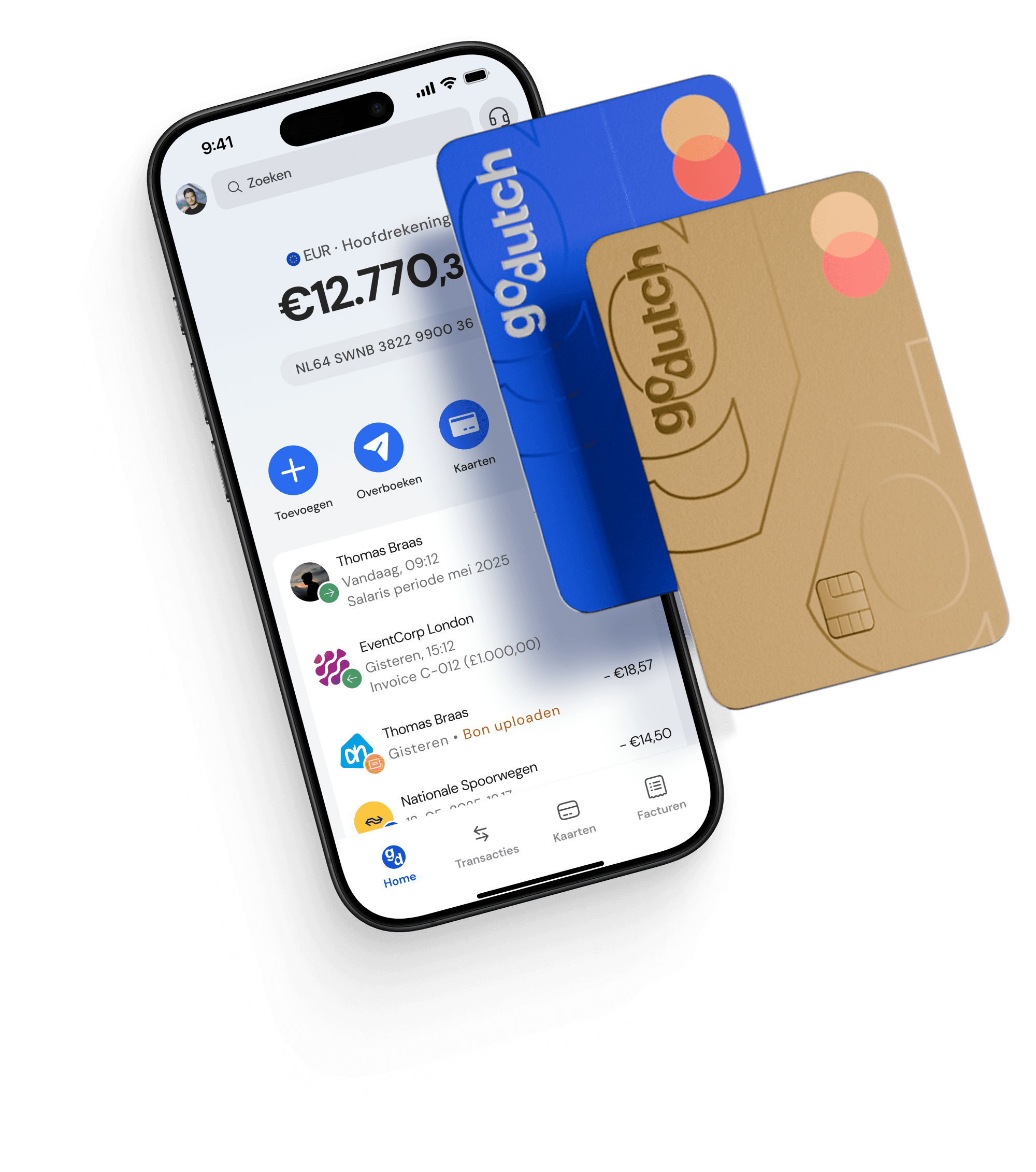
GoDutch helps you start your BV with a business account that you apply for in 3 minutes, with your IBAN and card within 1 day. That speed is exactly what you need in the weeks around the deed, when the BV already exists legally but payments still need to get going.
GoDutch is not a bank, but an all-in-one business account for entrepreneurs. You manage your payments, your cards, your expenses and the connection to your bookkeeping in the same app, which helps now that you have to deal with annual accounts and a corporate income tax return.
You can open a business account for a BV with us on any plan, including the free entry plan with no fixed monthly fees. Want everything ready on the day your BV is registered? Apply for your account before you sit down with the notary.
FAQ
Frequently asked questions about switching from freelancer to BV
How much profit do you need before a BV pays off?
How much profit makes a BV worthwhile depends on your customary salary and on what you pay out as dividend, not on one fixed amount. The rule of thumb is that it tips over as soon as you structurally fall into the highest bracket of box 1, so above € 78,426 of taxable income. Have it calculated on your own figures.
Can you keep your sole proprietorship alongside your BV?
You can keep your sole proprietorship alongside your BV, as long as both genuinely run their own business with their own activities and their own bookkeeping. This happens with entrepreneurs who split off part of their work. The Dutch Tax Administration takes a critical look at structures that are mainly intended to retain the entrepreneur's deduction.
What happens to your VAT number when you convert to a BV?
Your VAT number lapses when you convert to a BV and the company receives a new number, just like a new KVK number. So update your invoices, your webshop, your quotes and your bookkeeping at the moment the BV is registered, and pass the new number on to your clients.
Do you need to set up a holding company when you start a BV?
Setting up a holding company is not required, but it is common as soon as you want to reserve profit or sell your business later. You then hold the shares of your operating company through a second BV. You can read exactly what the difference between a holding company and a BV means in our article on the subject.
How long does it take to convert a sole proprietorship into a BV?
Converting a sole proprietorship into a BV often takes a few weeks with an asset-liability transaction, because only the incorporation at the notary is needed. With a tax-free or taxable contribution the process takes longer, because the valuation, the letter of intent and the deed of contribution are added.
Do you need a civil-law notary to go from freelancer to BV?
Yes, to go from freelancer to BV you always need a civil-law notary, because a BV only comes into existence through a notarial deed of incorporation. The notary registers the company with KVK and deregisters your sole proprietorship. For a contribution, the notary also draws up the deed of contribution.