Starting your own business


Starting your own business rarely begins with the paperwork, but that is the first thing you get stuck on. Which legal form, when to go to KVK, what has to go to the tax authorities and what does it all cost? Below you work through all the steps in the right order, with the amounts and rules that apply in 2026.
What is involved in starting your own business?
Starting your own business comes down to three things that are required by law and a series of choices that determine how smoothly your start goes. Required are a legal form, a registration with KVK and records you keep for seven years.
The rest, from your business plan to your insurance, you arrange because it helps you along. This step-by-step guide is the starting point for everything else you need to know as a new entrepreneur.
You are in good company. In the second quarter of 2026, 56,331 new businesses registered with KVK, almost 5 per cent more than a year earlier, while the number of closures actually fell. Of all those starters, almost 8 in 10 are self-employed without staff.
The step-by-step guide to starting your own business
The ten steps below are in the order in which they are most convenient to work through. The first five are about preparation, the last five about making it official. You do not have to do them strictly one after the other, but do not skip any.
Step 1: test your idea and your market
Before you arrange anything, check whether there is demand for what you are going to offer. Who exactly is your customer, what problem do you solve and what is that worth? The fastest test is not a spreadsheet but a conversation: call three to five people from your target group and ask what they do now to solve that problem and what they pay for it.
Also look at who is already active in your sector and region. Not to put you off, but to work out how you are different. A market without competition is usually a market without customers.
Step 2: write a business plan
A business plan is not mandatory, but it forces you to put your assumptions on paper. What are you selling, to whom, at what price, and how much turnover do you need to live on? That last one is often skipped.
If you are looking for funding you will need a plan anyway, because investors and lenders ask for one. If you start with your own money, keep it short: five pages that add up are more useful than thirty you never open again.
Step 3: make a financial plan
Set out what you need to start and what you spend each month. For a sole trader business the start-up costs are often limited: the KVK registration, a domain name, a bookkeeping package and perhaps some tools or equipment. With a BV, notary fees are added.
Also calculate how much turnover you need to get by. Do not forget that you have to arrange tax, pension and a buffer for leaner months yourself. A common mistake among starters is to work from turnover rather than from what is left after tax.
Step 4: choose a business name
You need a business name before you can register. A good name is unique, easy to remember and not already in use by someone else.
So first check the KVK name checker and the Benelux Office for Intellectual Property, so that you do not have to switch later because someone else got there first. At the same time secure your domain name, even if you do not have a website yet.
That costs a few euros a year and prevents your name turning out to be taken online. If you really want to protect your name against use by others, register it as a trademark with BOIP; a registration in the Commercial Register alone does not give you that protection.
Step 5: choose your legal form
Your legal form determines who is liable for debts and how you are taxed. More than 7 in 10 starters choose a sole trader business, because you set that up without a notary and have tax advantages in the first years.
If you run a lot of risk or expect a high profit, a BV becomes more interesting. Incidentally, self-employed and freelancer are not legal forms but ways of working; as a freelancer you choose one too. Which form suits your situation depends on your liability, your expected profit, whether you work with others and how fast you want to grow.
In the overview of all legal forms you can read which legal form to choose as an entrepreneur and where the tipping point towards a BV lies.
Step 6: register with KVK
As soon as you independently supply goods or services and charge more than a symbolic amount for them, you are required to register in the Commercial Register. You do that from one week before to no later than one week after the start of your activities. Registration runs in five steps:
Make an appointment: you book an appointment online at a KVK office near you.
Fill in the form in advance: you provide your business name, activities, legal form and registered address. That address may be your home address.
Bring your ID: during the appointment a member of staff checks your proof of identity and your details.
Pay the registration fee: that is a one-off € 85.15, paid by card, because cash is not accepted. The amount is tax-deductible and there are no annual costs to stay registered.
Receive your KVK number: you get that straight away. If you want a certified extract, for instance to open your account, you buy that separately.
KVK passes your details on to the tax authorities automatically, so you do not have to register your business there separately. The registration fee is adjusted for inflation each year, so the amount may be slightly higher next year.
Step 7: sort things out with the tax authorities
After you register, the Dutch Tax and Customs Administration assesses whether you are an entrepreneur. That happens on two fronts that are independent of each other: for VAT and for income tax.
So you can be an entrepreneur for VAT purposes without counting as an entrepreneur for income tax. If the Dutch Tax and Customs Administration considers you an entrepreneur for VAT, you receive two numbers by post within about two weeks: a turnover tax number for your return and a VAT identification number that you put on your invoices and your website.
If you expect a low turnover, see whether the Small Businesses Scheme is something for you. How the return itself works is set out in the step-by-step guide to your business VAT return.
Step 8: open a business account
For a sole trader business or a general partnership a separate account is not a legal requirement, but in practice you want it from day one. Running everything through your personal account means that at every tax return you have to fish your own groceries out of your business spending, and that at an audit you cannot easily demonstrate your records.
A legal entity such as a BV or foundation has its own assets and therefore almost always uses its own account in the business's name. What is involved in opening one is set out on the page about a business account for starters.
Step 9: set up your bookkeeping
You are legally required to keep records, and you have to retain them for seven years. That sounds heavier than it is: it concerns your sales invoices, your purchase invoices and receipts, your account transactions and your hours record. Arrange this from your very first invoice, because reconstructing six months after the fact costs far more time.
Choose a bookkeeping package that fits your size and connect it to your account, so that transactions come in automatically. Make sure your invoices are right from the start; what exactly has to be on them can be found in the overview of the mandatory details on an invoice. Also keep track of your hours, because you need those for the deductions further on.
Step 10: arrange insurance and terms and conditions
As an entrepreneur you carry the risks an employer would otherwise absorb. If you fall ill, there is no continued pay, and if you make a mistake with a client, you are liable for it yourself.
Which insurance policies make sense depends strongly on your trade and your risk. The most common are public and professional liability insurance and disability insurance.
The difference between those first two is explained in the article on professional indemnity insurance for freelancers. Also draw up terms and conditions, so that what you and your client can expect from each other is set out in advance.
What tax benefits do you get as a starter?
If you are an entrepreneur for income tax purposes, three schemes apply that reduce your taxable profit:
Self-employed person's allowance: € 1,200 in 2026, provided you spend at least 1,225 hours a year on your business and had not yet reached state pension age on 1 January.
Starter's allowance: € 2,123 on top of the self-employed person's allowance, which can be applied a maximum of three times in your business's first five years. If you qualify for it, you may use the full self-employed person's allowance even if your profit is lower.
SME profit exemption: 12.7 per cent of the profit remaining after the two allowances above. You do not have to meet the hours criterion for this and the tax authorities apply it automatically.
Be realistic about what that delivers. The self-employed person's allowance has been cut back sharply: in 2025 it was still € 2,470 and in 2024 € 3,750. What is more, in 2026 the benefit is calculated at a rate of 37.56 per cent, which leaves about € 450 of tax benefit from that € 1,200 allowance. Keep a tight record of your hours, because at an audit the burden of proof for those 1,225 hours rests entirely with you.
What should you watch out for as a new freelancer?
If you are going to work mainly for one client, false self-employment is the subject to get to grips with. That is the case when you are self-employed on paper but in practice work like an employee: fixed hours, direction from the client and no real entrepreneurial risk.
The Dutch Tax and Customs Administration has been actively enforcing the DBA Act again since 1 January 2025 and can impose additional assessments on both you and your client.
Update: since June 2026 there is a new law as well. On 21 April 2026 the House of Representatives passed the Act introducing a presumption of an employment contract based on hourly rate, and the Senate followed on 16 June 2026.
If you work for less than € 38 per hour, you can argue that you are in fact an employee, and your client has to demonstrate that this is not the case. The original clarification part of the VBAR bill has been dropped; that will return later in a separate Self-Employed Persons Act.
So assess your working relationship together with your client from the outset and record what demonstrates your independence: several clients, your own rates, your own materials and freedom in how you carry out the work. That is not only sensible for tax purposes, it also makes your business a genuine business.
How many people start their own business?
The business climate clearly picked up in 2026. According to the KVK trend report for the second quarter of 2026, the number of starters rose by 4.8 per cent compared with a year earlier, the number of closures fell from 40,809 to 37,076 and bankruptcies also declined.
On 30 June, more than 2.6 million establishments were registered in the Commercial Register, including 1,805,194 self-employed people without staff, the highest number ever.
One nuance there, because you will come across other reports too. KVK counts registrations, including people running a business alongside a job. Statistics Netherlands (CBS) counts people whose main job is being self-employed, and by that count the number of self-employed people is actually falling. Both figures are correct; they simply measure something different.
Starting out with a GoDutch business account
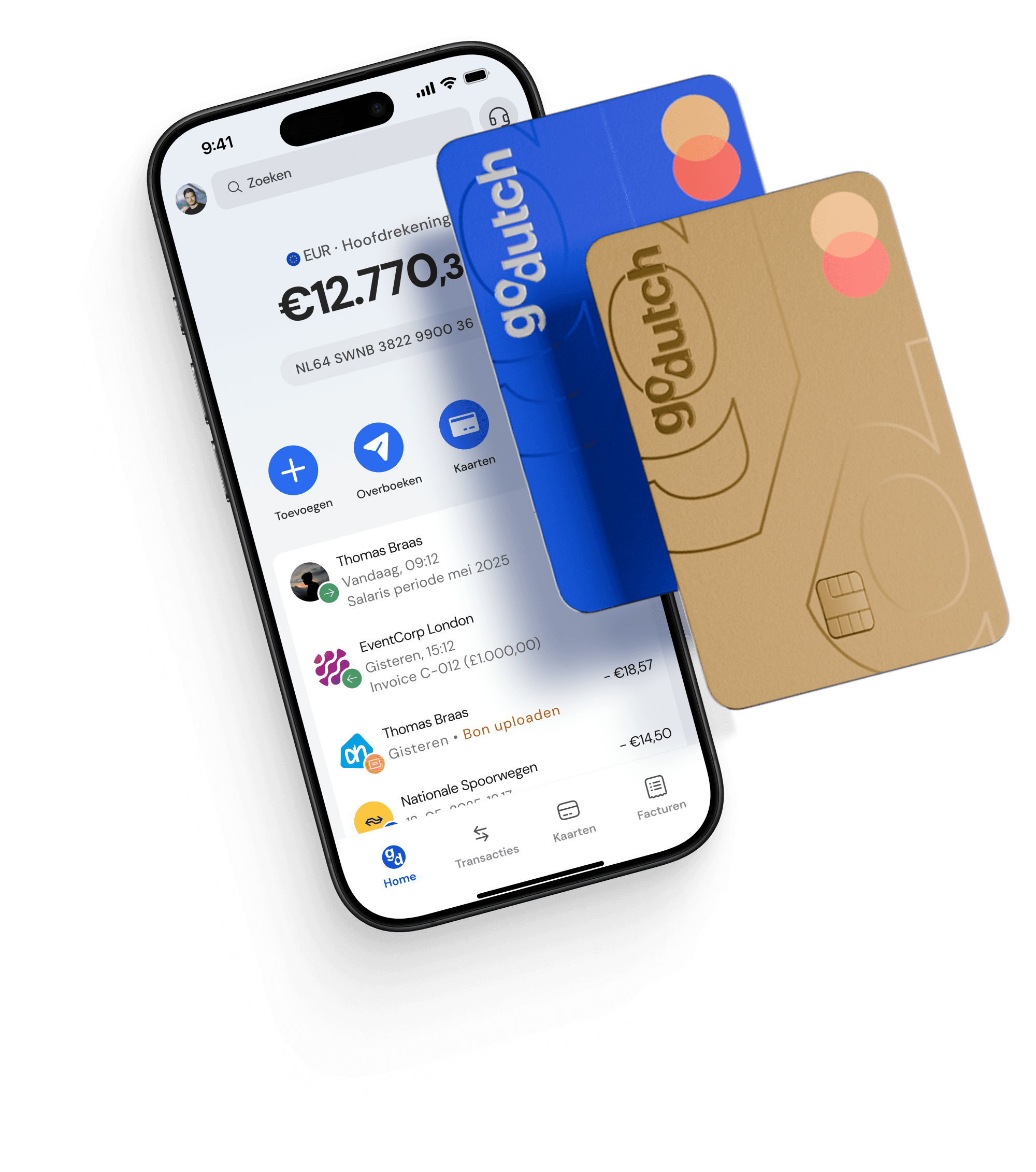
Once your KVK number has come through, you want to be able to invoice and pay quickly. GoDutch is not a bank, but an all-in-one business account that automates your bookkeeping. You apply for it in 3 minutes and have your Dutch IBAN and Debit Mastercard within 1 day, with a free entry-level package without fixed monthly costs.
After that you connect your account to virtually every Dutch bookkeeping package, so that your transactions land in the right place automatically and you have nothing to reconstruct at the end of the quarter.
On top of that you get unlimited cashback on every payment with your GoDutch card, and if you run into something, a Dutch service team is available for you 24/7. All common legal forms are accepted, from sole trader business to BV, foundation and homeowners' association.
FAQ
Frequently asked questions about starting your own business
What do you need to start your own business?
To start your own business you need a business idea, a business name, a legal form and a registration with KVK. In practical terms, records, a business account and usually one or more insurance policies are added to that. Start-up capital is not a legal requirement, not even for a BV.
Can anyone start a business?
Virtually anyone can start a business, as long as you are 18 or older and legally competent. If you are younger, it is possible with permission from your parents or guardians. Additional requirements apply to some professions and sectors, such as a qualification or a permit.
Can you start your own business alongside your job?
You can start your own business alongside your job, and many entrepreneurs do. Do check your employment contract first for a non-compete or secondary-activities clause and discuss it with your employer. Bear in mind that the hours you work in employment do not count towards the hours criterion.
What does it cost to start a business?
Starting a business as a sole trader costs only the KVK registration of € 85.15 at its most basic. Practical costs are added to that, such as a domain name, a bookkeeping package and insurance. If you opt for a BV, foundation or public limited company, you also pay notary fees for the deed of incorporation.
When are you an entrepreneur in the eyes of the tax authorities?
You are an entrepreneur in the eyes of the tax authorities if you work independently, run entrepreneurial risk and can expect a profit. The Dutch Tax and Customs Administration assesses that separately for VAT and for income tax, with its own conditions per tax type. So a registration with KVK does not automatically mean you count as an entrepreneur for both.