What is an IBAN number?


An IBAN number is the international code that uniquely identifies your payment account worldwide. The abbreviation stands for International Bank Account Number, and thanks to this fixed structure, a transfer arrives at exactly the correct account. Below you can see what an IBAN number means exactly, how it is structured, and where you can find your own IBAN.
What does the abbreviation IBAN stand for?
IBAN stands for International Bank Account Number. It is a globally agreed standard that makes your account recognisable across national borders, so that payments between different countries run smoothly. The standard is defined in the ISO 13616 norm and was originally established by the European banking sector.
Every current account in the Netherlands has an IBAN, including a business account for entrepreneurs. Your IBAN works as the address of your account: the number that others use to pay you and that you provide when you receive a transfer yourself.
The structure of an IBAN number
The structure of an IBAN number follows a fixed sequence of letters and numbers in every country. Four components always return, regardless of which bank the account is held with:
Country code: two letters indicating the country, such as NL for the Netherlands.
Check digit: two digits directly after the country code used to detect typing errors.
Bank code: a code identifying the bank, which is four letters for Dutch IBANs.
Account number: the actual account number, ten digits in the Netherlands.
Together, these parts form a single code that is read the same way all over the world. An example of a Dutch IBAN is NL91 ABNA 0417 1643 00, where NL is the country code, 91 is the check digit, ABNA is the bank code, and 0417 1643 00 is the account number.
A Dutch IBAN has 18 characters
A Dutch IBAN always has 18 characters: the country code NL, two check digits, a bank code of four letters, and an account number of ten digits.
If the original account number is shorter, leading zeros are added to reach ten digits. The bank code immediately shows which bank the account belongs to, for example INGB, RABO, or ABNA.
The check digit in an IBAN prevents typing errors
The check digit in an IBAN prevents typing errors because it is mathematically linked to the rest of the number. Those two digits are calculated using a fixed formula (the so-called modulo 97 check).
This allows a bank to see immediately whether an IBAN is mathematically correct. If you accidentally swap two digits, the number will almost always fail that check.
Is an IBAN the same as your account number?
An IBAN is not the same as your account number, but it does contain it. Your old account number forms the last part of your IBAN, preceded by the country code, a check digit and the bank code. These extra characters turn a local account number into an internationally recognisable code.
In the past, you only used that short account number in the Netherlands. Since 1 August 2014, the IBAN has been mandatory for all payments, as part of the European SEPA agreements. For daily transfers, you therefore always use the full IBAN, even though you can still recognise your own account number in it.
The difference between IBAN and BIC
The difference between an IBAN and a BIC is that an IBAN identifies an account and a BIC identifies a bank. The BIC, also known as a SWIFT code, consists of eight or eleven characters and identifies the bank within the international payment network. The two complement each other: the IBAN points to the account, the BIC to the bank where that account is held.
Within Europe, you usually only need an IBAN and the name of the recipient. You only need a BIC when you transfer money to an account outside the SEPA zone or in a currency other than the euro.
Where do I find my IBAN number?
You can find your IBAN number in your online banking, in your bank's app, on your bank statement and on your debit card. In the app or online banking environment, it is usually located with the account details, ready to be copied.
If you receive a payment from abroad, you sometimes also provide your bank's BIC in addition to your IBAN. You can find someone else's IBAN on their invoice, or you can request it directly from the recipient. If you are not sure if a number is correct, always check it before you transfer any money.
For which countries do you need an IBAN?
For all countries within the Single Euro Payments Area, you need an IBAN, in short the SEPA zone. 41 countries participate in SEPA, including all EU countries and a number of countries outside it such as Norway, Switzerland and the United Kingdom. Within that zone, you pay in euros using only an IBAN and the recipient's name.
Outside Europe, more and more countries are also using the IBAN system, such as Turkey, Ukraine and the United Arab Emirates. If you, as an entrepreneur, want to transfer money abroad, you check in advance whether the country uses an IBAN and whether you also need a BIC.
Is it safe to share your IBAN?
Sharing your IBAN is safe enough for normal payment transactions: with just your IBAN, no one can withdraw money from your account. An extra confirmation is always required for a transfer or a direct debit, such as logging into your banking environment or a valid authorisation that you have issued.
Nevertheless, caution is advised. Scammers can abuse an IBAN by sending fake invoices with their own number on them, hoping that you will pay without suspicion. Therefore, only share your IBAN with parties you trust and, if in doubt, always check whether an invoice is genuine.
The IBAN-Name Check against invoice fraud
The IBAN-Name Check protects against invoice fraud by verifying whether the recipient's name and IBAN match. Since 9 October 2025, this check has been mandatory for every digital euro transfer in all 41 SEPA countries. Internationally, the check is called Verification of Payee, part of the European Instant Payments Regulation.
If you enter a name and IBAN in your banking environment that do not match, you will receive a warning before the payment is finalised. If they do match, you will see a confirmation. Especially for entrepreneurs who pay many invoices, this reduces the risk of sending money to an incorrect or fraudulent account.
A business account with a Dutch IBAN
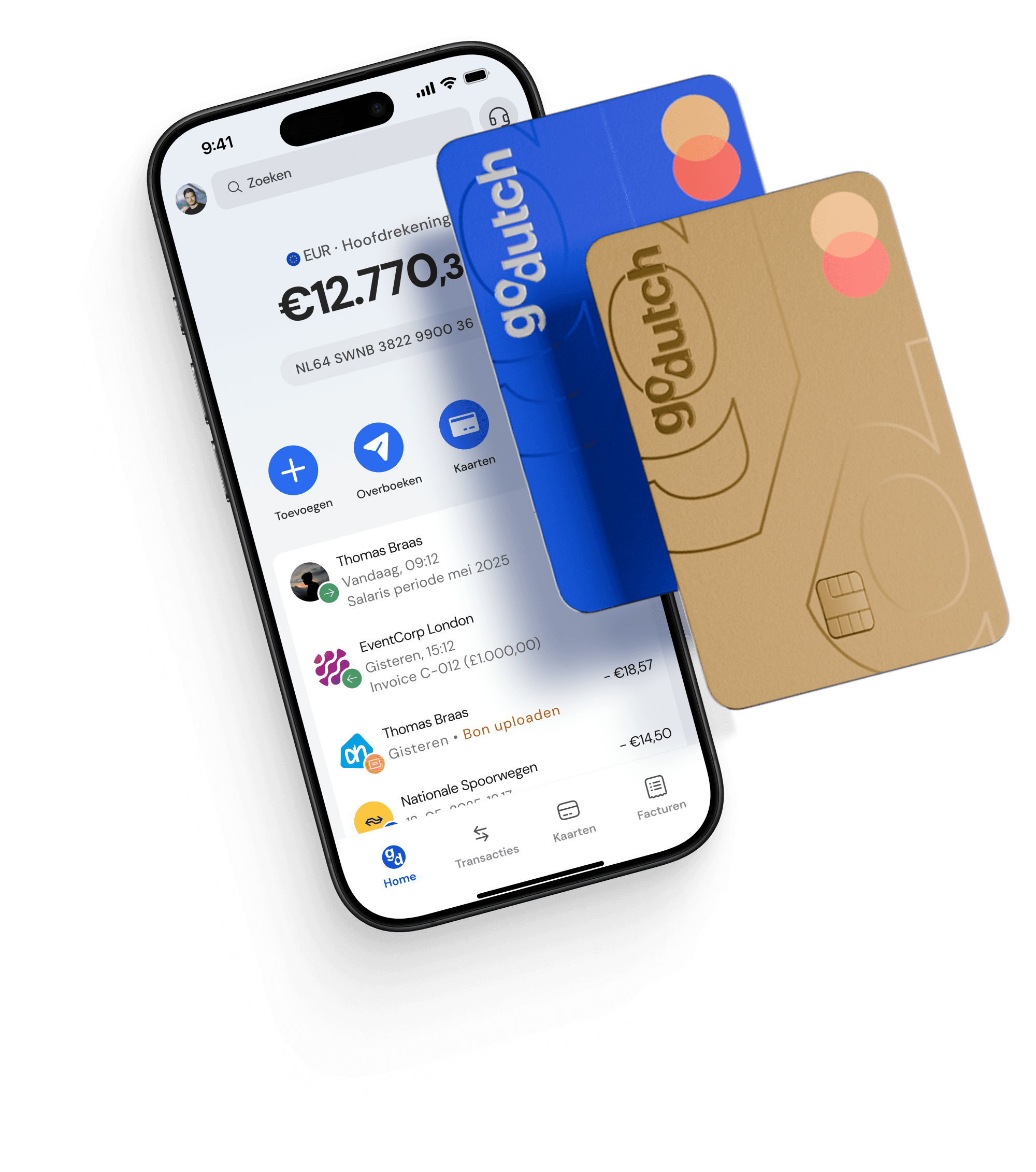
With a business account from GoDutch, you get a Dutch IBAN starting with NL, exactly what you expect for your business transactions. You can apply for the account in 3 minutes and have your IBAN and Mastercard within 1 day, without any hassle beforehand.
In addition to your main IBAN, you can create extra virtual IBANs yourself to keep income and projects separate. You can arrange international payments from the same app, and thanks to built-in fraud prevention with the IBAN-Name Check, you can pay with more peace of mind. If anything gets stuck, a real person is available for you 24/7.
FAQ
Frequently asked questions about IBAN numbers
Are all IBANs the same length?
No, IBAN numbers are not the same length everywhere: the length varies by country. A Dutch IBAN has 18 characters, a German IBAN has 22 characters, and worldwide an IBAN can be up to 34 characters. The country code and control number at the beginning are, however, always structured in the same way.
How do I check if an IBAN is correct?
You can check an IBAN number using the built-in check digits or with an online IBAN checker. Thanks to the check digit, a system immediately sees whether an IBAN is mathematically correct, which catches most typing errors. To be absolutely sure whether the number belongs to the correct recipient, you should check it with the person or the company itself.
What is a virtual IBAN?
A virtual IBAN is an additional IBAN linked to your existing account, without you having to open a new account. Entrepreneurs use virtual IBANs to receive payments separately per customer, project or brand. The money ultimately ends up in the same underlying account.
Do I need an IBAN for a business account?
For a business account, you automatically have an IBAN, because every current account in the Netherlands is assigned one. You use that IBAN to receive business payments and pay invoices, just like with a personal account. This way, you keep your business finances separate from your personal ones, with its own number.
What happens in the event of an incorrect IBAN?
With an incorrect IBAN, your payment is usually not processed or the amount is returned to your account. The check digit already catches most typos, and since the IBAN-Name Check, your bank also warns you if the name and IBAN do not match. If you notice an error, contact your bank immediately.
Why does a Dutch IBAN start with NL?
A Dutch IBAN starts with NL because that is the fixed country code for the Netherlands. Each country has its own two-letter code in the IBAN according to an international standard, so that it is immediately clear in which country the account is held. For example, a Belgian IBAN starts with BE and a German IBAN with DE.