Which legal form do I choose?

Which legal structure you choose depends on three things: how you want to arrange liability, how much tax you pay, and with how many people you do business. The sole proprietorship is the most frequently chosen form, but not automatically the right one for your situation. In this article, we list the nine legal structures and go through the questions that determine your choice.
What is a legal form?
A legal form is the legal structure of your business, which you register in the KVK Business Register. Your legal form determines, among other things, who is liable for debts and how your business is taxed.
By the way, sole trader (zzp'er) and freelancer are not legal forms, but working methods: even as a sole trader you choose a legal form, usually a sole proprietorship (eenmanszaak). As soon as you are registered, you arrange the practical side of your business, such as your administration and a business account that suits your legal form.
Legal forms without legal personality
Legal forms without legal personality are the sole proprietorship (eenmanszaak), the general partnership (vof), the professional partnership (maatschap) and the limited partnership (cv). With these forms, there is no legal separation between you and your business, so creditors can also claim your personal assets.
Sole proprietorship (eenmanszaak): you are the sole owner and fully liable with your personal assets for the debts.
General partnership (vof): two or more partners run a business together, whereby each partner is jointly and severally liable for all debts, including those of a co-partner.
Professional partnership (maatschap): several professionals work together under a common name, with each partner liable for an equal share.
Limited partnership (cv): in addition to a managing partner, there is a silent partner, who can only lose their contribution.
Legal forms with legal personality
Legal forms with legal personality are the private limited company (bv), the public limited company (nv), the association (vereniging), the foundation (stichting) and the cooperative (coöperatie). With these forms, the legal entity itself is liable for the debts and your personal assets remain protected, except in the event of mismanagement.
Private limited company (bv): a private company with shares, suitable for a profit-making business and protected personal assets.
Public limited company (nv): a public company with freely tradeable shares, intended for larger enterprises.
Association (vereniging): a collaboration of members with a common goal, without profit distribution to the members.
Foundation (stichting): an organisation with a board and no members, aimed at a societal or social purpose.
Cooperative (coöperatie): an association that represents the collective interests of its members, for example in purchasing or cooperation.
Which legal structure is right for me?
Which legal structure suits you best is determined on the basis of four questions: about liability, tax, collaboration, and your plans to grow. There is no structure that works best for everyone; it is about your situation and your risk. The following four points will help you make a decision.
Liability: are you personally liable?
You are personally liable as soon as your legal structure does not have corporate status, as is the case with a sole proprietorship, general partnership (vof), or professional partnership (maatschap). If your business goes bankrupt, you will also lose your personal assets in that case.
If you run a lot of risk in your work, for example with large assignments or expensive investments, then a private limited company (bv) shields your personal assets. In addition, you can cover many risks with good contracts and liability insurance for self-employed professionals.
Tax: how are you taxed?
How you are taxed depends on your legal structure. With a sole proprietorship, vof, or professional partnership, you pay income tax on the profit, with deductions such as the self-employed deduction, the start-up deduction, and the SME profit exemption.
With a bv, the company first pays corporate income tax, and you only pay income tax when you pay yourself a salary or dividend. These deductions have been phased down in recent years, which shifts the comparison between the two structures.
Are you doing business on your own?
If you are doing business on your own, you usually choose a sole proprietorship or a bv. If you collaborate with others, then the vof, the professional partnership, and the limited partnership (cv) come into play, or you set up a bv together.
The difference: you use a vof for a business, while practitioners such as dentists or lawyers often choose a professional partnership. Always record collaboration agreements in a contract.
How big are your growth plans?
How big your growth plans are is a factor because some structures grow more easily than others. If you want to attract investors, hire staff, or come across as professional to large clients, then a bv offers more possibilities.
A bv also continues to exist independently of the owners, which is useful for continuity and transfer. If you start small and straightforward, then a simple structure like a sole proprietorship is often enough.
What is the difference between a sole proprietorship and a private limited company (bv)?
The difference between a sole proprietorship and a private limited company (bv) mainly lies in liability and tax. With a sole proprietorship, you are personally liable and pay income tax on the profits, with deductions that are beneficial at lower profit levels.
A sole proprietorship is quickly set up with a registration at the Chamber of Commerce (KVK) and without a notary, and you can easily arrange a business account for freelancers for it. With a bv, your personal assets are protected and the company pays corporate income tax, after which you pay yourself a salary and potentially dividends.
A bv requires more administration and incorporation through a notary, but gives you more control over when your profits are taxed. You open a separate business account for your bv.

At what profit level does a BV become more advantageous?
The level of profit at which a bv (private limited company) becomes more advantageous varies per entrepreneur, but in 2026 the tipping point lies roughly between 90,000 and 120,000 euros of structural annual profit.
A fixed amount does not exist, as it highly depends on how much profit you need privately and on your mandatory dga (director-major shareholder) salary, which in 2026 is at least 58,000 euros. If you leave your profits in the bv, you benefit from the lower corporate tax rate, which starts at 19 per cent.
If you withdraw everything immediately, a sole proprietorship is often still more advantageous. The tipping point has decreased in recent years because the tax deductions for sole proprietorships have been phased down.
What are the costs of setting up a legal entity?
The cost of setting up a legal form depends on the form you choose. You can set up a sole proprietorship, general partnership (vof), or professional partnership (maatschap) with just a registration in the Business Register of the KVK, without the intervention of a notary.
For a private limited company (bv), public limited company (nv), or foundation, a notarial deed is compulsory, meaning you should take into account notary fees of usually several hundred euros. In addition to the incorporation, a bv entails more ongoing costs, such as for the annual accounts and administration.
Can I change my legal structure later?
Yes, you can change your legal form later, for example from a sole proprietorship to a private limited company (bv) as your business grows. Such a transition does take time and money: you must register the new form with the KVK (Chamber of Commerce) and the Tax and Customs Administration, and for a bv, you must record this with a notary.
When converting a sole proprietorship to a bv, under certain conditions you can opt for a silent conversion, so that you do not have to pay tax on the hidden reserves immediately. So, think through your choice in advance, but know that nothing is set in stone.
A business account that suits your legal form
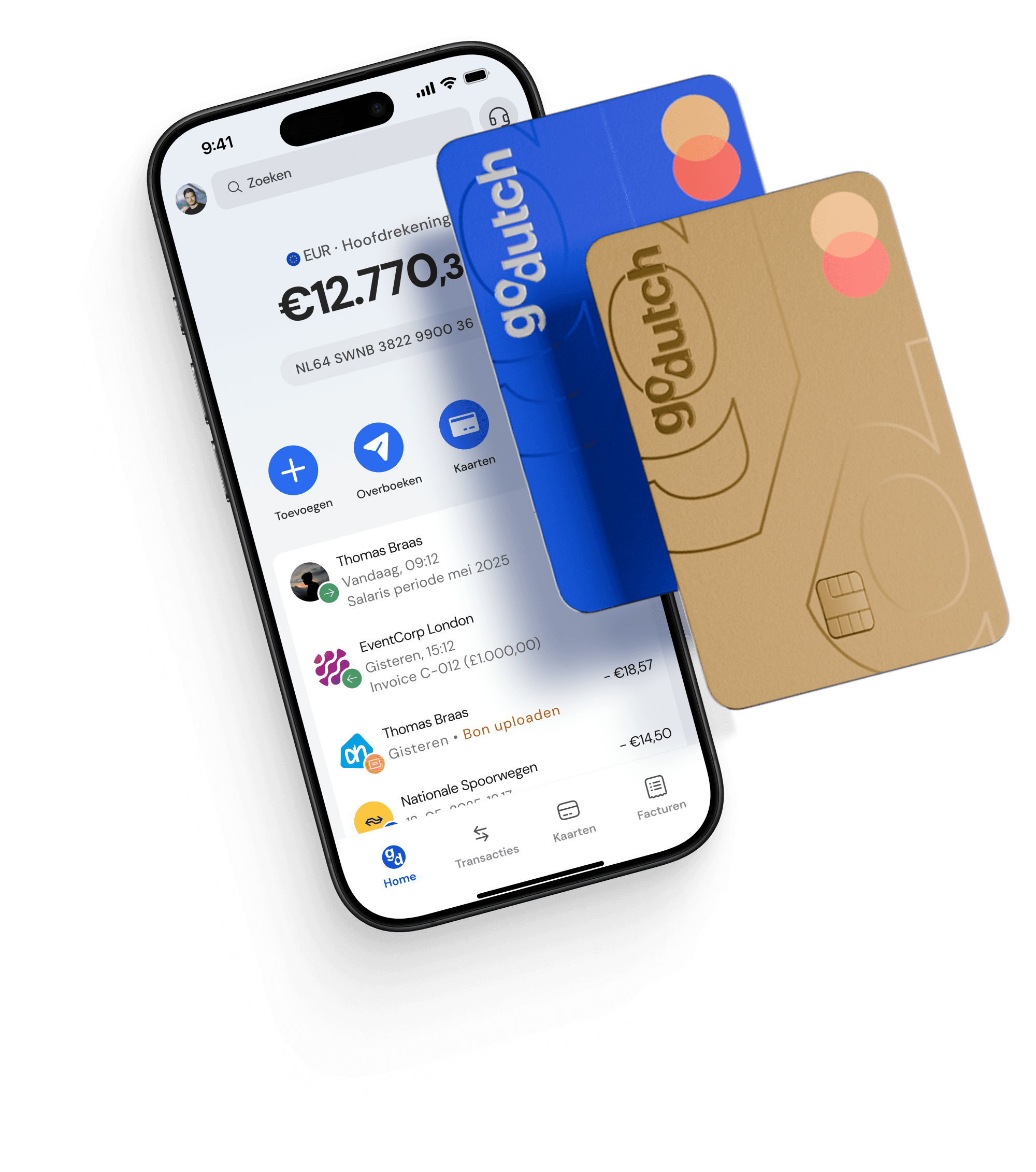
Whichever legal form you choose, you need a business account that fits it, and GoDutch offers this for every form. GoDutch is not a bank, but an all-in-one business account that automates your administration and brings your payments, cards, and expenses together in a single app.
You can apply for the account in 3 minutes and have your IBAN and Debit Mastercard within 1 day, with a free starter package with no fixed monthly fees. All common legal forms are accepted, including sole proprietorships, private limited companies (bv), foundations, associations, and homeowners' associations (vve), and for partnerships, there is a business account for your vof with shared access for both partners.
Additionally, you get unlimited cashback on every payment with your GoDutch card, and if you run into any issues, a Dutch service team is available for you 24/7.
Quickly open your business account with GoDutch
Once you have chosen your legal form, you can quickly open the matching business account with GoDutch. You can arrange the application in 3 minutes and have your IBAN and card within 1 day, so you can start doing business right away.
FAQ
Frequently asked questions about choosing a legal form
Which legal form do most start-ups choose?
Most start-ups choose a sole proprietorship because you can set it up quickly and without a notary, and tax deductions such as the start-up deduction apply in the early years. However, a sole proprietorship is not automatically the best choice: in the case of higher profits or greater risk, a private limited company (bv) can be more advantageous and safer.
Which legal form does my business have?
You can see which legal form your business has on your extract from the Chamber of Commerce (KVK) Business Register. The legal form was registered when you set up your company, and you can request that extract online from the KVK. If you are not sure, the extract also shows your position and signing authority.
Can I combine multiple legal structures?
Yes, you can combine multiple legal forms. A commonly used structure is a holding company with one or more operating BVs underneath, which allows you to spread risks and distribute profits flexibly. You can also set up a separate BV alongside your sole proprietorship for a different activity. For a complex structure, seek advice from an accountant.
How long does it take to set up a legal entity?
A sole proprietorship, general partnership (vof) or professional partnership (maatschap) is often set up within a day, as you only need to register with the KVK. For a private limited company (bv) or foundation, it usually takes a few days to a couple of weeks, because a notary has to draft and execute the deed.
Which legal form suits a charity?
A foundation or an association is usually suitable for a good cause, because both serve a social purpose and do not distribute profit among the founders. A foundation has a board and no members, whereas an association does have members. For the management, you then arrange a business account for a foundation or association.
Is a business account mandatory for my legal form?
A business account is not legally required for every legal form. For a sole proprietorship or general partnership (vof), you may make business payments through a private account, although a separate account is clearer. A legal entity such as a private limited company (bv) or foundation has its own capital and therefore almost always uses its own account. Whether a business account is mandatory thus differs per legal form.