

Are you a small business owner with a low turnover, wondering if all that VAT hassle is really necessary? The small businesses scheme (KOR) can save you a lot of administration, but it is not suitable for every entrepreneur.
When do you qualify, what are the benefits, and how do you apply for the KOR scheme? In this article, you will read exactly how it works in 2026, what has changed since 2025, and what you should look out for before you sign up.
What is the small businesses scheme?
The small businesses scheme (KOR) is an exemption from VAT for entrepreneurs with a low annual turnover. If you remain below the threshold, you do not charge VAT to your customers and you no longer have to file VAT returns.
Since 2020, the scheme has operated based on your turnover, rather than the VAT amount you pay. This makes the KOR simple: you no longer have periodic returns and your invoices become simpler. The downside is that you can no longer reclaim the VAT on your business expenses and purchases.
The Tax and Customs Administration designed the scheme to reduce administration for small businesses. Participation is never compulsory; it is a choice that works out differently depending on the situation.
When do you qualify for the KOR?
You are eligible for the KOR if your business is established in the Netherlands and your annual turnover remains below €20,000. Since 2025, this turnover limit applies not only to the year in which you participate, but also to the year before.
The scheme is open to virtually any legal form: a sole proprietorship, a general partnership (vof), a private limited company (bv), a foundation, or an association. Entrepreneurs who process their turnover and payments through a business account can more easily keep track of that €20,000 limit.
If you run a foundation or association with low turnover, the KOR can be just as suitable. Directors managing a business account for a foundation can participate under the same conditions, as long as they are VAT entrepreneurs.
To participate in the KOR, the following conditions apply:
Establishment in the Netherlands: your business is established in the Netherlands.
Turnover under €20,000: your turnover remains below €20,000 per calendar year, both in the year of registration and in the year before.
Taxable supplies: you supply goods or services on which VAT is normally calculated.
Which turnover counts towards the KOR?
For the KOR (small businesses scheme), all turnover on which you would normally calculate VAT is included, excluding the VAT itself. In addition, part of your VAT-exempt turnover is included: turnover from real estate, from means of payment and securities, and from financial and insurance services in the Netherlands. Other exempt turnover is not taken into account.
If you purchase goods from another EU country, that intra-Community acquisition does not count towards your turnover limit. If you are unsure whether you will remain below € 20,000, the Dutch Tax and Customs Administration (Belastingdienst) offers a tool to help you estimate your turnover in advance.
What are the benefits of the KOR?
The biggest advantage of the KOR (small businesses scheme) is less administration, and also a more favourable price for private customers. This is what the scheme offers you:
No VAT and no tax return: you do not charge VAT to your customers and no longer file periodic VAT returns.
Less administration: this saves you work every quarter and makes your bookkeeping a lot lighter.
Simpler invoices: you do not mention VAT and do not even have to put your VAT number on them; you do, however, keep your purchase invoices.
More attractive for private individuals: without VAT on your invoice, your price for consumers is lower, as they cannot reclaim VAT anyway.
What are the disadvantages of the KOR?
The main disadvantage of the KOR is that you can no longer reclaim the VAT on your expenses and investments. In addition, pay attention to these points:
No VAT deduction: you can no longer reclaim the VAT on your expenses and investments, which is annoying in the event of major expenses or shortly after you start.
Adjustment of previous VAT: if you reclaimed VAT shortly before on, for example, equipment, inventory or a company car, part of it may be adjusted; the adjustment period runs for five years for movable property and ten years for immovable property, and you do not pay anything back below €500 per financial year.
Less favourable for business clients: clients who are themselves liable for VAT cannot reclaim your VAT.
Not always possible: if you let a property with VAT, you cannot use the KOR.
Sometimes a return is still required: if you buy or sell within the EU or if you have reverse-charged VAT, you may occasionally still need to file a VAT return.
Does the KOR affect your income tax?
No, the KOR (small businesses scheme) has no influence on your income tax. The scheme only concerns VAT, i.e. turnover tax.
You simply report your business profits on your income tax return, and your entrepreneur deductions, such as the self-employed deduction, continue to apply. The KOR only changes whether you calculate and pay VAT, not how much income tax you pay.
Many entrepreneurs search for the KOR scheme and income tax and think they are one and the same scheme. They are two separate taxes, each with its own tax return, and the KOR only affects the VAT side.
How do you apply for the KOR?
You apply for the KOR (small businesses scheme) via Mijn Belastingdienst Zakelijk. For this, you need a registration with the KVK (Chamber of Commerce) and a VAT number, so you only register after you have been registered as a VAT entrepreneur.
Make sure your application is received at least four weeks before the desired start date, as the scheme takes effect as of a new tax return period, usually a quarter. Allow for a few weeks of processing time; after that, you will receive a letter with the final start date of your participation.
This is how you approach the application:
Determine your start date: choose from which quarter you want to use the KOR and take the processing time into account.
Register online: fill in the notification at Mijn Belastingdienst Zakelijk with your KVK and VAT details.
Wait for confirmation: you will receive a letter with the date on which your participation starts.
What has changed in the KOR since 2025?
Since 2025, the KOR (small businesses scheme) has been eased in a few areas. The most important change: the mandatory participation of three years has been abolished. Previously, you were tied to the scheme for at least three years after registration; now you can opt out at any time via Mijn Belastingdienst Zakelijk.
Rejoining is also quicker than before, although a short exclusion period still applies. In addition, foreign entrepreneurs with only a permanent establishment in the Netherlands can no longer use the Dutch KOR since 2025.
Useful to know: signing up and opting out is now done entirely online, whereas this used to be done via a paper form.
Get a grip on your turnover with the business account from GoDutch
With the KOR (small businesses scheme), you want to keep a close eye on your turnover, because the €20,000 limit determines whether you can use the exemption. GoDutch is not a bank, but an all-in-one business account that helps you with this.
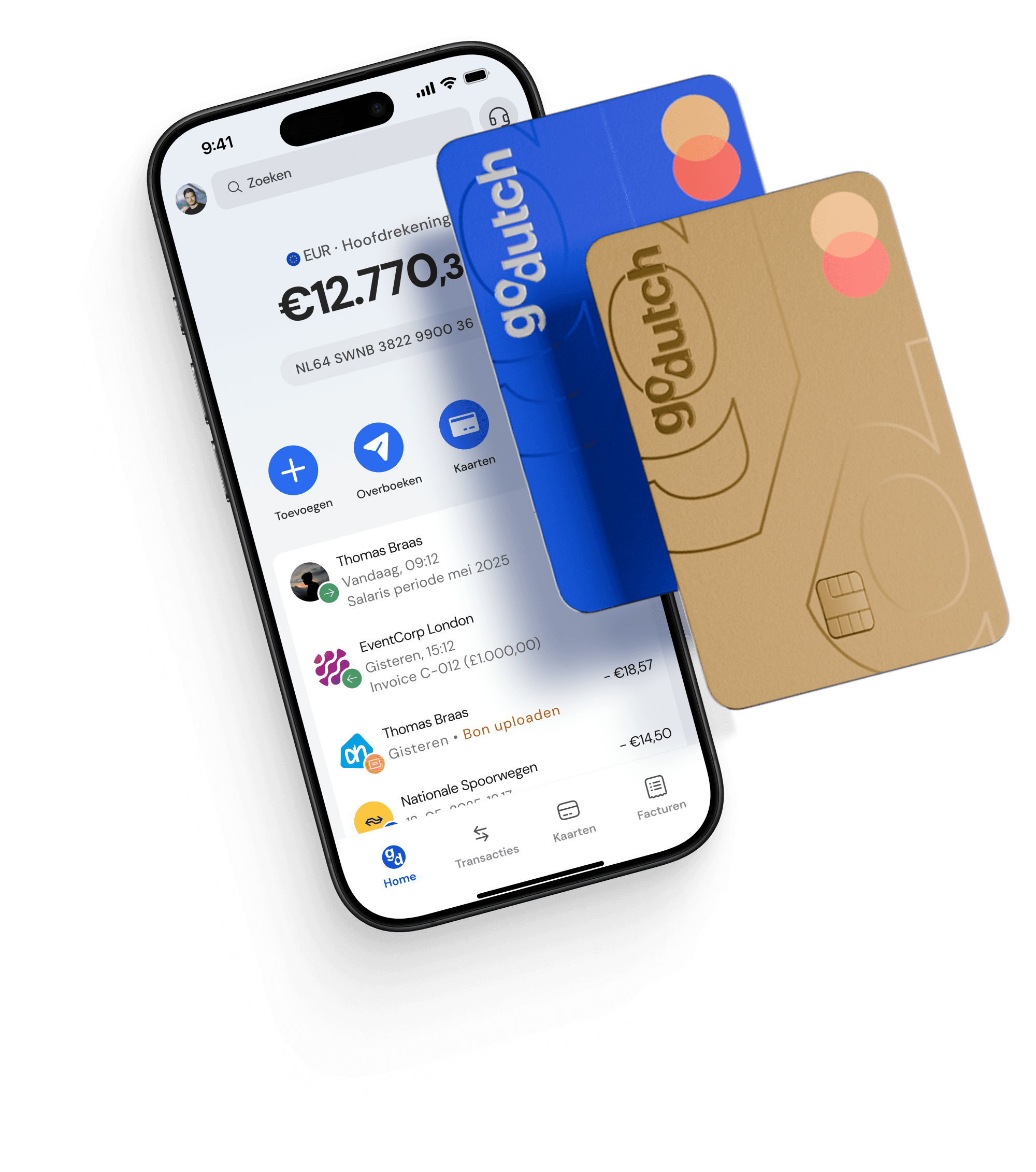
You can see your income and expenses in real-time, scan receipts in seconds, and link your bookkeeping to software such as Exact or Snelstart. Especially as a self-employed professional or starter, a business account for freelancers makes it easy to keep your business and personal expenses separate.
You apply for your account in 3 minutes and have your IBAN and card within 1 day, without paperwork and without appointments at the office.
Easily open your business account with GoDutch
Want to start faster and spend less time on your administration? See what the GoDutch business account does for you, applied for in 3 minutes and ready to use within 1 day. If you are mainly looking at the costs, you can easily compare the cheap business account that fits your situation.
FAQ
Frequently asked questions about the small businesses scheme
Is the KOR mandatory?
No, the KOR is not compulsory. You choose yourself whether you participate, even if your annual turnover remains below € 20,000. For one entrepreneur, the exemption provides a benefit, for another it does not, for example with a lot of VAT on investments or many business clients. Calculate this before you apply.
Do you need to be registered with the KVK (Chamber of Commerce) for the KOR (small businesses scheme)?
To register for the KOR (small businesses scheme), you need a KVK registration and a VAT number. If your turnover remains below € 2,200 per year and you do not need to register with the KVK, you will automatically use the KOR without registering. Whether a business account is mandatory also depends on your legal form.
Does the small businesses scheme also apply to a private limited company (bv)?
Yes, the small businesses scheme (KOR) also applies to a private limited company (bv). The KOR is open to all legal forms, so in addition to a sole proprietorship or vof, also for a bv, foundation or association. The condition remains that your annual turnover stays below €20,000. For a bv, you arrange this from your business account for your bv.
Can you sign up for the KOR again after opting out?
After opting out, you can register for the KOR again, but not immediately. If you opt out, an exclusion applies for the remainder of that calendar year and the following year. After that, you can participate again, as long as you meet the conditions. As of 2025, you therefore no longer have to wait three years.
What happens if your turnover exceeds €20,000?
If your turnover exceeds €20,000 in a calendar year, the KOR (small businesses scheme) will lapse immediately. From that moment on, you will charge VAT again and file VAT returns. The sale with which you exceed the threshold is also fully taxed with VAT. You are then required to deregister via Mijn Belastingdienst Zakelijk.
Is there also a KOR (small businesses scheme) for other EU countries?
Yes, since 2025 there is also an EU-SME scheme (EU-KOR) for entrepreneurs doing business in other EU countries. This grants you a VAT exemption in one or more EU countries, as long as your total turnover in the EU remains below €100,000. You apply for the EU-SME scheme via Mijn Belastingdienst Zakelijk (My Tax Administration for Businesses) and will receive a separate identification number for this.