What is a BV? The Dutch private limited company explained


A BV is a legal form in which your business is a separate legal entity, distinct from you as a person. The BV itself owns the money, enters into contracts and is liable for its own debts. Below you can read how a private limited company (besloten vennootschap) is structured, what the advantages and disadvantages are, which taxes you pay and what a BV requires of you every year.
What does BV stand for?
BV stands for besloten vennootschap, in full besloten vennootschap met beperkte aansprakelijkheid: a private limited company. "Private" (besloten) refers to the shares: they are registered and not freely transferable, so you can only transfer them with the consent of the other shareholders.
"Limited liability" means that, as a shareholder, you are in principle not liable for debts beyond the amount you have put into the BV. This legal form has existed in the Netherlands since 1971.
That separation is not only legal. The assets of the BV belong to the BV and not to you, which is why you also need a business account for your BV in the company's name. You must be able to account for any private payments made for the BV, or the other way round, later on, so the more cleanly you keep the two apart, the simpler your bookkeeping stays.
How is a private limited company structured?
A private limited company is structured as a business with two layers: the shareholders who own it and the board of directors that runs it day to day. Both roles can be held by the same person.
If you start on your own, you are both the sole shareholder and the sole director, and the distinction feels theoretical. As soon as a second party joins, the difference immediately becomes practical.
Shares and shareholders
The shares represent ownership of the BV and are divided among the shareholders. Anyone who holds shares has voting rights at the general meeting and shares in the profits.
Shares are transferred through a civil-law notary, because the shares are registered. The articles of association (statuten) set out how many shares there are, which classes exist and which rights are attached to them.
The board of the BV
The board manages the BV and represents it externally. A BV can have one director or several, and a director may also be another legal entity.
You often see the latter in a holding company structure. What directors may and may not decide independently is laid down in the deed of incorporation and the articles of association.
When are you a director-major shareholder (dga)?
You are a director-major shareholder (directeur-grootaandeelhouder) if you are a director of the BV and own at least 5% of the shares.
You will come across the abbreviation dga everywhere, because that 5% has tax consequences: you hold a substantial interest (aanmerkelijk belang) and you are formally employed by your own BV. If you own more than 50% of the shares, you are not insured under the WW, WIA and ZW employee insurance schemes.
What are the advantages of a BV?
The advantages of a BV lie mainly in liability, tax and flexibility. These are the points that carry the most weight in practice:
Your personal assets stay out of reach: if things go wrong with the BV, creditors in principle cannot touch your savings, your car or your home.
Profit can keep working untaxed for longer: profit that stays in the BV is initially taxed only with corporate income tax, and personal tax only follows when it is distributed.
You can expand more easily: you can bring in an investor or co-founder by issuing or transferring shares.
Selling becomes simpler: you sell shares instead of individual assets and contracts, which makes a takeover considerably smoother.
You can spread risk: with a second BV as a holding company, you keep the business premises or accumulated profit outside the operating company.
What are the disadvantages of a BV?
The disadvantages of a BV lie mainly in costs and obligations. They are rarely a reason not to go ahead, but you do need to know them in advance:
Setting up costs more: you need a civil-law notary and you also pay the registration fee at the Chamber of Commerce (KVK).
The administration is heavier: preparing annual accounts is mandatory and every year you file a balance sheet with notes at the KVK.
You lose entrepreneur deductions: the self-employed deduction (zelfstandigenaftrek), starter deduction (startersaftrek) and SME profit exemption (mkb-winstvrijstelling) do not apply to a BV.
You have to pay yourself a salary: as a dga, a statutory minimum amount applies, even in a year when things are not going well.
Your figures become public: anyone can view the filed annual accounts at the KVK, competitors included.
What are the characteristics of a BV and a sole proprietorship?
The characteristics of a BV and a sole proprietorship (eenmanszaak) differ on almost every point, from incorporation to the tax return. The sole proprietorship is the legal form most entrepreneurs start with, and the BV is usually the next step. The table below sets out the key characteristics side by side, so you can see where the two forms really differ.
Characteristic | BV | Sole proprietorship |
Legal personality | Yes, the BV is itself a legal entity | No, you and the business are legally the same |
Liability | In principle limited to the capital contributed | Personally liable with all your assets |
Incorporation | Notarial deed with articles of association, then registration with the KVK | Registration with the KVK, no notary needed |
Starting capital | Minimum € 0.01 | No minimum |
Ownership | Divided into shares among shareholders | One owner, no shares |
Tax on profit | Corporate income tax, 19% up to € 200,000 and 25.8% above that | Income tax in box 1 |
Entrepreneur deductions | Not applicable | Self-employed deduction, starter deduction and SME profit exemption at 1,225 hours |
Entrepreneur's pay | Salary as a dga, at least € 58,000 in 2026 | No salary, you draw money from the profit |
Annual accounts | Mandatory, plus filing with the KVK and public | No annual accounts and no filing obligation |
Hiring staff | Possible | Possible |
Selling the business | By transferring the shares | By selling individual assets and contracts |
The table shows the differences, but not when switching pays off for you. That depends on your profit, your risk and your longer-term plans, and that trade-off is covered in the separate article on sole proprietorship or BV.
How far does limited liability really go?
Limited liability goes a long way, but it is not unlimited. The BV protects your personal assets as long as you behave properly as a director and as long as nobody has asked you for a personal guarantee. In three situations you are still personally on the hook:
Improper management: if you did not report payment problems to the Dutch Tax Administration (Belastingdienst) in time, or entered into obligations you knew the BV could not meet, you can be held personally liable.
Personal guarantee: for a business loan or a lease, the other party often asks you to co-sign personally, and the protection then no longer applies to that debt.
The period before incorporation: you are personally liable for everything you agree on behalf of a BV in formation until the BV exists and ratifies the agreement.
So it is wise not to choose a BV purely to avoid liability. The KVK points this out itself: with a sole proprietorship or general partnership (vof), you can often limit your risks just as well with liability insurance and good terms of delivery and payment.
Which taxes does a BV pay?
A BV pays corporate income tax on its profit, and you also pay personal tax on what you take out of the BV. That distinction is the big difference from a sole proprietorship, where the profit goes straight into your income tax return.
Then there is VAT: after registration, the Dutch Tax Administration issues you a VAT identification number and you usually file a return every quarter.
Corporate income tax on profit
The BV pays corporate income tax (vennootschapsbelasting) on its taxable profit, meaning turnover minus purchases, costs and salaries. In 2026 the rate is 19% on the first € 200,000 of profit and 25.8% on everything above that.
For profit that demonstrably comes from innovation, there is the innovation box with a reduced rate of 9%. Whatever remains after corporate income tax can be left in the BV as a reserve.
Customary salary for the dga
The customary salary (gebruikelijk loon) is the minimum salary your BV must pay you as a dga. In 2026 the standard amount is € 58,000 per year. If someone in a comparable position earns more, or your best-paid employee earns more, that higher amount applies.
If the BV is making a loss or you work part-time, you can agree a lower amount with the Dutch Tax Administration in advance, provided you substantiate it properly.
Update: as of 1 January 2026, the standard amount for the customary salary rose from € 56,000 to € 58,000. Many articles and knowledge bases still mention the old amount.
Dividend and box 2
Dividend is the profit distribution that the shareholders' meeting can decide on and that is taxed in your hands in box 2. In 2026 you pay 24.5% on the first € 68,843 of income from a substantial interest and 31% on the excess.
If you have a tax partner, the lower rate applies jointly up to € 137,686. When paying out, your BV first withholds 15% dividend tax, which you later offset as a prepayment in your tax return.
What do you need to arrange every year with a BV?
With a BV you have more to arrange every year than with a sole proprietorship, and you would do well to plan that rhythm from day one. This is what comes back regularly:
Keeping your bookkeeping up to date: all invoices, receipts and bank transactions of the BV, separate from your personal expenses.
Preparing annual accounts: an overview of the BV's income and costs, which you also use for the tax returns.
Filing with the KVK: after the end of the financial year you submit a balance sheet with notes, and those documents are public.
Filing a corporate income tax return: on the profit of the past financial year.
Running your own payroll: the BV withholds payroll tax on your dga salary and pays it over.
Filing VAT returns: usually every quarter, based on your sales and purchase invoices.
What types of BV are there?
Legally, there is only one type of BV. Terms such as holding BV, management BV, savings BV and pension BV are not separate legal forms, but names for the role such a BV plays within a structure.
A holding company holds the shares of one or more operating companies and often keeps the assets, while the operating company does the work and sends the invoices. If you want to know when that second BV is worth it, our article on the difference between a holding company and a BV explains it further.
The term flex-BV comes from the 2012 change in the law, which abolished the mandatory starting capital of € 18,000 and relaxed the rules on shares and articles of association. Since then, every BV in the Netherlands has effectively been a flex-BV, so when someone uses that term, they simply mean the current BV.
What is involved in setting up a BV?
You set up a BV through a civil-law notary, who draws up a deed of incorporation containing the BV's articles of association. Those articles set out the purpose of the company, the powers of the board and the distribution of the shares.
The notary then registers the BV with the KVK, and you register the ultimate beneficial owners in the UBO register. Since 1 January 2024, the whole process can be done digitally, via a secure audio-video connection with the notary.
You hardly need to deposit anything: one euro cent of share capital is enough. The costs are in the notary's work and the registration, not in the capital. The full step-by-step plan and a realistic picture of the costs are in the separate article on setting up a BV.
How do you manage your BV's finances?
You manage your BV's finances with an account in the company's name, so the BV's assets stay visibly separate from your personal money. With many providers, this is the moment things slow down: you submit documents, you wait, and in the meantime the BV cannot make or receive any payments. All while you have just come from the notary and want to get going.
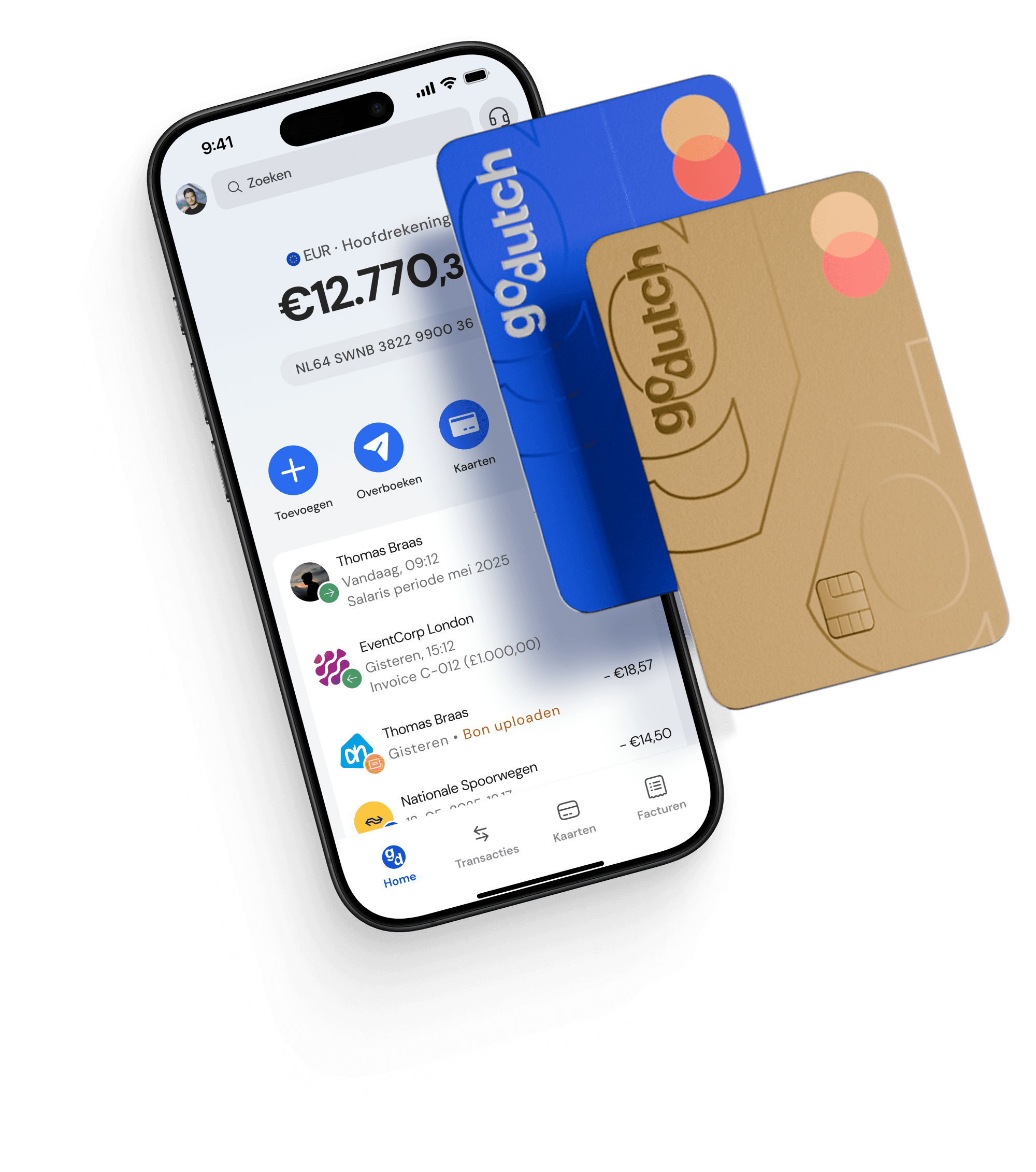
We built GoDutch for exactly that moment. You apply for the account in 3 minutes and have your IBAN and your Debit Mastercard within 1 day, even if your BV is still in formation. A BV is welcome on every plan, including the free starter plan with no fixed monthly fees.
You connect your bookkeeping to the app, scan your receipts in seconds and get unlimited cashback on your card spending. If something gets stuck, we are there for you 24/7 via chat, email and phone.
GoDutch is not a bank, but an all-in-one business account, and your money is covered by deposit protection up to € 100,000 through GoDutch's regulated financial partner. Have you just started your BV and want to get going quickly? Then take a look at the GoDutch business account, opened in 3 minutes.
FAQ
Frequently asked questions about the BV
What is the difference between a BV and an NV?
The difference between a BV and an NV (public limited company) lies in the shares and the starting capital. In a BV, the shares are registered and not freely transferable, so transfers go through a civil-law notary. In an NV, the shares are freely transferable and you must pay in at least € 45,000 in capital.
Can you set up a BV on your own?
You can perfectly well set up a BV on your own. You are then the sole shareholder and director at the same time, and therefore also the only UBO you register in the register. A second founder or co-director is not required anywhere. You do, however, set out in the articles of association how things work if someone joins later.
How much starting capital do you need for a BV?
The minimum starting capital for a BV is one euro cent. That minimum has applied since 2012, when the € 18,000 requirement was dropped. In practice you usually deposit a bit more, so the BV can pay its first costs straight away. The real threshold lies in the notary fees and the registration with the KVK.
What is a BV in formation?
A BV in formation is a BV whose notarial deed has not yet been finalised, abbreviated as bv i.o. You can already register the bv i.o. with the KVK and make agreements on its behalf. You are, however, personally liable for those agreements until the BV exists and ratifies them. At GoDutch you can already open an account at this stage.
What is a besloten vennootschap called in English?
In English, a besloten vennootschap is called a private limited company, also known as a private limited liability company. In international contracts you usually just keep the Dutch designation BV after the company name, with the English term in brackets as an explanation. That way it stays clear which legal form applies legally.
Can you transfer money from your BV to your personal account?
You may transfer money from your BV to your personal account, but never just like that. It goes via salary, via dividend or via a loan that you record in a current account relationship with your BV. The Dutch Tax Administration keeps a close eye on that last route, so put agreements and interest in writing.