How does a credit card work?


You hear the term everywhere, but how exactly does a credit card work? You might be wondering how a credit card differs from your debit card, whether you pay interest on it, and what all those numbers on the card mean. In this article, you will read how a credit card works, how you pay with it, what types there are, what it costs, and what to look out for before you apply for one.
What is a credit card?
A credit card is a payment card with which you buy something and only pay the amount later. The card issuer advances the amount to the seller, allowing you to take your purchase with you immediately and only pay at the end of the period.
This makes a credit card payment essentially a short-term, personal loan: you temporarily use the card issuer's money and pay it back as soon as the bill arrives. Unlike with a debit card, the limit on your card is not determined by the balance in your account, but by your financial capacity.
The issuer sets a spending limit based on your income and any debts, and checks your creditworthiness before you receive the card. Credit cards are issued by banks, but also by bank-independent parties such as ICS and the ANWB. The card itself runs on a network like Mastercard, Visa or American Express, which enables the payment worldwide.
How does a credit card work step by step?
A credit card works in a few fixed steps, from your payment to the settlement at the end of the month. Four parties are involved in these steps: you as the cardholder, the merchant, your card issuer, and the network that processes the transaction. This is how such a payment works step by step.
Step 1: you pay with your credit card
You pay with your credit card in a shop or online store, after which the issuer assesses the payment. They check whether your card is valid and if there is sufficient spending limit, and authorise the transaction. The payment only goes through after this approval.
Step 2: the issuer advances the amount
The issuer advances the amount to the merchant, so that they get paid immediately. You take your purchase with you straight away, while the amount remains on your card as an outstanding balance. At that moment, you are temporarily using the card provider's money.
Step 3: your expenses are listed on a monthly statement
Your expenses are collected on a single statement during the month. This lists all the transactions you made with the card during that period. At the end of the month, you can see in one go what you have spent in total.
Step 4: the amount is debited from your account
The total amount is usually automatically debited from your linked current account. This is done via a direct debit, often within a period of around 21 days after the statement. If you pay within this interest-free period, the advance costs you nothing.
Step 5: you choose to pay back in full or in instalments
You choose whether to pay back the full amount in one go or to repay it in instalments. If you pay everything immediately, the card remains interest-free. If you choose to pay in instalments, you will pay interest on the outstanding balance, which in the Netherlands is roughly 12 to 15 percent per year.
How do you pay with a credit card?
Paying with a credit card can be done in two ways: in a physical store and online. In both cases you authorise the payment, but the verification process is slightly different. Below you can read how it works in-store and on the internet.
Paying in-store with your credit card
In stores, you pay with your credit card using a PIN or contactlessly. For smaller amounts, usually up to 50 euros, you hold the card against the payment terminal without a PIN. Above that amount, or after a number of contactless payments in a row, the terminal will still ask for your PIN.
At a hotel or car rental company, you often see a pre-authorisation: an amount is reserved on your card as a deposit, which is not yet debited but does reduce your credit limit. In some countries, such as the United States, you may still encounter the combination of a magnetic stripe and signature.
Paying online with a credit card
Online you pay with the details on the card, not with the physical card itself. You enter your card number, expiration date and the CVC code. Many web shops add an extra verification step via 3D Secure, where you confirm the payment with a code on your phone or in your app.
This step makes online credit card payments a lot safer and helps prevent fraud. If you return a product, the amount is refunded via your credit card, and in many cases of non-delivery, you can have the payment reversed.
What is on a credit card?
A creditcard contains a card number, your name, an expiry date and a security code. The card number consists of sixteen digits and forms the identification number of your card; a creditcard does not have an IBAN like a regular account. The expiry date indicates until when the card is valid, and after that you will receive a replacement card. In addition to this information, there is a chip in the card, often still a magnetic stripe and an antenna for contactless payment.
What is the CVC code on a creditcard?
The CVC code on a creditcard is the security code you enter during online payments. For Visa and Mastercard, this consists of three digits on the back of the card, for American Express, four digits on the front.
You will encounter the same code under the names CVV and CCV, and it always refers to the same number. The code proves that you physically have the card in your possession and thus forms an additional check on top of the card number.
What is the difference between a credit card and a debit card?
The difference between a credit card and a debit card lies in whose money you are spending. With a credit card, you pay with borrowed money that is only debited from your account later, whereas with a debit card, you spend your own money, which is debited immediately. As a result, you do not build up debt with a debit card, there is no credit check, and no registration with the credit registry. Consequently, a debit card is easier and quicker to obtain, also for start-up entrepreneurs who do not yet meet income requirements.
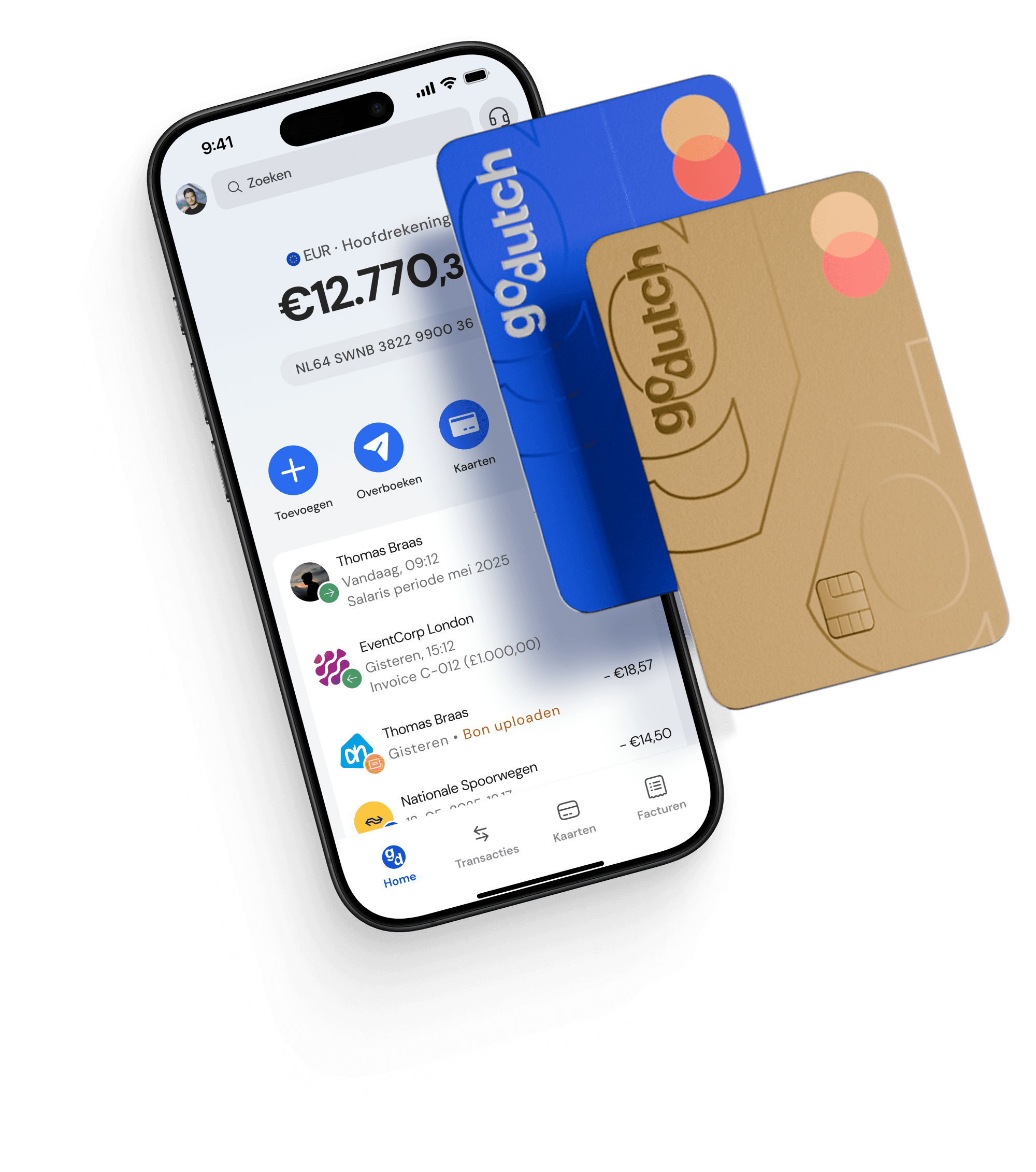
The old argument that only a credit card works worldwide is increasingly outdated. Debit Mastercard and Visa Debit are replacing the older Maestro and V Pay cards, allowing you to use a modern debit card outside Europe and in international webshops as well. For this reason, GoDutch operates with a Debit Mastercard and virtual Mastercard with which you can pay worldwide without needing a credit product.
What types of credit cards are there?
There are roughly three types of credit cards, which differ significantly in practice. The main distinction lies in whether you are actually drawing credit or not:
Charge card or deferred card: you defer payment until the end of the month and then settle the full amount in one go, without interest. This is the most common type in the Netherlands.
Revolving credit card: you are allowed to pay off the outstanding balance in instalments and then pay interest on the remainder. This type is being phased out in the Netherlands; ABN AMRO, for example, has no longer offered instalment payments since 1 October 2024.
Prepaid credit card: you top up the card in advance with your own money and never spend more than that. No credit and no BKR registration check are required.
In addition, there are virtual credit cards: digital cards without a physical card, which are particularly handy for online purchases and subscriptions. Which variant suits you best depends on how and where you want to use the card.
What is a prepaid credit card?
A prepaid credit card is a card without a credit facility, which you top up yourself before making a payment. Because you only use your own funds, there are usually no income requirements and no BKR registration check is performed. This makes the card accessible, even for those with a less robust financial situation. There is a catch, however: prepaid cards are not accepted everywhere. Problems may arise at hotels and car rental agencies, as they often require a fully-fledged credit card for security deposit purposes.
How much does a credit card cost?
A credit card has fixed and variable costs, most of which you only pay if you use the card in a certain way. These are the cost items you need to watch out for:
Card fee: a fixed annual fee for holding the card, which is higher for premium and business variants.
Interest: only applicable for spread or late payments, roughly 12 to 15 percent per year in the Netherlands. If you pay within the interest-free period, you pay no interest.
Withdrawing money: withdrawing cash often costs around 4 per cent with a minimum of a few euros, and interest starts running immediately from the withdrawal.
Exchange rate markup: if you pay outside the eurozone, a markup is added on top of the exchange rate, usually around 2 percent and on some cards 2.5 percent.
Particularly that exchange rate markup stands out if you often pay in foreign currencies or do business internationally, whereas when paying internationally with GoDutch you see exactly what a transfer costs in advance in the app. This prevents the costs from surprising you afterwards.
What are the benefits of a credit card?
The benefits of a credit card revolve mainly around wide acceptance, security, and handy extras. The most important ones at a glance:
Worldwide acceptance: you can pay with it almost anywhere in the world, including in countries and web shops where a regular debit card does not work.
Convenience while travelling: a credit card is often useful or required for car rental and hotels, as an amount can be reserved as a security deposit.
Extras and insurance: many cards offer rewards programmes, discounts, or built-in travel insurance.
Strong fraud protection: steps such as 3D Secure and the quick response of card companies often intercept suspicious transactions in time.
Quick replacement: in the event of loss or theft abroad, you usually receive a replacement card quickly.
Especially those who travel a lot or buy online abroad will notice these benefits the most.
What is insured with a credit card?
With many credit cards, purchases are automatically insured against damage, loss or theft, often for 180 to 365 days after purchase. More expensive cards sometimes include comprehensive travel insurance, with assistance abroad.
Precisely what is insured varies by card, so checking the terms and conditions is always wise. In addition to that purchase insurance, secure payment at GoDutch revolves around verification in the app and real-time notifications for every transaction.
What are the disadvantages of a credit card?
Set against the benefits are costs and risks that must not be overlooked. The main disadvantages are:
Costs of use: withdrawing cash is expensive and the exchange rate mark-up adds up when used abroad.
Interest on spread payments: if you do not pay off everything at once, interest accumulates on the outstanding amount.
BKR registration: if you use credit, the card is registered as a loan with the BKR, which affects other loans.
Risk of debt: because you pay with borrowed money, your debt grows with every expenditure that you do not repay on time.
Susceptibility to fraud: credit card details are more vulnerable online than a debit card.
With the business account from GoDutch, it actually works the other way around, because instead of paying interest, you get a portion of your income back with unlimited cashback on your business expenses.
How do you apply for a credit card?
Applying for a credit card is done online, but conditions apply because you are taking out credit. You must be at least eighteen years old, must not have a negative BKR registration, and will be subject to an income assessment. Often you also need a current account with the same provider. For a business credit card, you are usually registered with the Chamber of Commerce (KVK) for at least a year, and as a sole trader you will also be checked with the BKR.
If you do not yet meet the income requirement, for example as a starter, a debit card or a business account for starters is often a more logical choice. The same conditions regarding BKR and income apply if you are considering a business account with a credit card, where the account and card are arranged together.
What often carries more weight for an entrepreneur than credit is oversight. You want to see who spends what, be able to issue cards to your team, and prevent your administration from piling up. With the real-time management of your business expenses you keep control of every transaction, and with the instant transfer of money, a payment is ready in no time.
Smart payments with the GoDutch business account
GoDutch is not a credit card and not a bank, but a provider of a smart business account for entrepreneurs. You apply for your account in three minutes and have your IBAN and card within 1 day, including a physical Debit Mastercard and a virtual Mastercard. You manage everything in one app: payments, cards, invoices, and your expenses, without having to take out a credit product.
In addition, GoDutch takes admin off your hands instead of letting it pile up. Via the integration with your accounting software, your transactions automatically end up in the right place, and with the automatic payment of invoices, you process incoming bills without manual work. If you run into anything, you get 24/7 help from real people, no bots or queues. All of that comes together in the GoDutch business account, built to save you time and money.
FAQ
Frequently asked questions about credit cards
Do you pay interest on a credit card?
You only pay interest on a credit card if you do not pay on time or do not settle the balance in full. If you pay the entire amount within the interest-free period, often around 21 days after the statement, the credit costs you nothing. You only pay interest in the case of spaced payments or late payment, which in the Netherlands is roughly between 12 and 15 per cent per year.
Is a PIN always required with a credit card?
A PIN is not always required with a credit card. For smaller amounts, usually up to 50 euros, you pay contactlessly without a PIN. For larger amounts or after a series of contactless payments, the terminal will still ask for your code. Online, instead of a PIN, you use your card number, expiry date and the CVC code, often with an additional confirmation via 3D Secure.
What is the difference between Mastercard and Visa?
The difference between Mastercard and Visa lies mainly in the network and the associated terms and conditions, not in the way you pay. Both are accepted worldwide and work almost identically in shops and online stores. The differences lie in details such as additional services, insurance, and exchange-rate markups, which vary by issuer.
Can you use a credit card without taking out credit?
Using a credit card without credit can be done in two ways. With a charge card, you pay off the full amount every month, so you never actually borrow. With a prepaid card, you load your own money in advance and only spend that balance. In both cases, you do not build up debt and you pay no interest.
How many people in the Netherlands have a credit card?
The number of Dutch people with a credit card is lower than in many other countries, although estimates range from about a third to over half of adults, depending on the source. More important than ownership is usage: most payments are made via debit card and iDEAL, and the credit card is mainly used for travel, online purchases and deposits.
Does a credit card affect your BKR registration?
A credit card only affects your BKR registration if there is a credit facility attached to it. With a card that allows you to pay in instalments, the credit is recorded as a loan with the BKR. If you pay off the full amount every month or use a prepaid card, there is no credit and therefore no registration.