VAT reverse charge


There is an invoice on your desk without VAT, carrying only the words "VAT reverse charged". Do you now have to pay that VAT yourself? And if you want to send an invoice like that, are you simply allowed to? The VAT reverse charge means that you do not report the VAT to the Dutch Tax and Customs Administration, your customer does.
That sounds simple, but the scheme only applies in a limited number of situations and the wording on the invoice has to be exactly right. In this article you will find when the reverse charge is mandatory, what belongs on the invoice, which box you report it in and what to do when it goes wrong.
What is the VAT reverse charge?
The VAT reverse charge means the liability shifts from the supplier to the customer. Normally you charge VAT on your services or products, collect it from your customer and pay it over. With the reverse charge you skip that step: you invoice without VAT and your customer reports the VAT amount in their own return.
If they are fully entitled to deduct it, they deduct that same amount in the same return and pay nothing on balance. The official name is the reverse-charge scheme. You will also come across the terms reverse charging VAT and reverse-charged VAT: they all mean the same thing.
Important to understand: the reverse charge is not a choice you make yourself. In the situations where the scheme applies, using it is mandatory. And in all other cases you are specifically not allowed to.
Reverse charge, 0% VAT or exempt?
None of the three invoice types shows a VAT amount, but for tax purposes they are different things. With the VAT reverse charge the supply remains taxable, only your customer files the return. With the 0% rate you remain the party liable to report and you declare the turnover yourself, just at zero per cent.
With an exemption the supply is kept outside VAT altogether, for example for certain healthcare or education, and you have no right to deduct the VAT on the related costs. Do not mix them up: it determines which box the turnover ends up in.
Why does the reverse-charge scheme exist?
The scheme exists mainly to counter VAT fraud. In a normal chain the supplier collects the VAT and pays it over, while the customer reclaims it. If the supplier disappears before paying, the treasury loses the money while the customer still deducts.
That went on for years in sectors with many links and fast resale, such as construction and the electronics trade. By placing the liability with the customer, VAT no longer moves back and forth between parties who can both offset it.
For you as an entrepreneur that has a practical side effect. If you reverse charge VAT, no VAT amount arrives in your account that you have to pay over later. That is convenient for your bookkeeping, but it also means the buffer many entrepreneurs are used to building up out of VAT received simply never appears on those invoices.
When is VAT reverse charged?
The Dutch Tax and Customs Administration identifies nine situations in which the reverse-charge scheme applies:
Doing business abroad
Subcontracting and hiring out staff
Waste and scrap materials
Mobile phones, chips, games consoles, laptops and tablets
Immovable property
Forced sales
Supply of gas and electricity certificates
Sale of gold
Transfer of emission rights
The scheme also applies to telecommunications services supplied in the Netherlands between businesses that provide these services themselves. For the vast majority of entrepreneurs only the first four are relevant, and in practice mainly the first two.
Doing business abroad
If you supply a service to a business in another EU country, in most cases the service is taxable in your customer's country and you reverse charge the VAT to them.
If you buy a service from another EU country yourself, the same happens in reverse and you report the VAT here. You can also encounter the reverse charge with businesses outside the EU.
One situation that is often missed: if you buy goods that are already in the Netherlands from a seller who is not established here and has no fixed establishment here, the VAT is reverse charged to you as well.
Your invoice then shows a Dutch supply without VAT, and you report it. Before you reverse charge to a foreign customer yourself, you check their VAT identification number. How to do that is explained in looking up a VAT number via VIES.
Subcontracting and hiring out staff
If you work as a subcontractor or hire out staff in construction, shipbuilding, the cleaning sector or landscaping, you reverse charge the VAT to the contractor or the hirer. This is the most common form of reverse charging within the Netherlands.
The scheme only applies to physical work on immovable property or ships, such as building, demolishing, installing, maintaining, repairing and cleaning. Design work by architects, draughtsmen and naval architects does not fall under it, and neither do security and rental.
There are two exceptions to watch out for:
Work in your own workshop: you carry out the work wholly or largely, meaning more than half of it, in your own workshop
Work on goods you sold: you work on goods that you, as subcontractor, sold to the main contractor
In both cases you do not reverse charge and you invoice with VAT as normal. Also mind the materials: if you reverse charge the VAT on your hours, that applies to the whole job including the materials you supply with it. So you do not split a reverse-charged invoice into one part with and one part without VAT.
If you work with a foreign subcontractor without a fixed establishment in the Netherlands, you fall under the cross-border rule and not under this one.
Phones, chips, games consoles, laptops and tablets from 10,000 euros
If you supply these goods to another business in the Netherlands for 10,000 euros or more excluding VAT per type of goods per supply, the reverse charge is mandatory. That amount is a threshold per type of goods, so an order of 6,000 euros of laptops and 6,000 euros of tablets stays below it.
The detail that catches most entrepreneurs out: if you push the order above 10,000 euros but split it across several invoices so that some invoices stay below the threshold, the reverse charge still applies to the whole order. You then put "VAT reverse charged" on every single invoice.
A few further boundaries apply. Accessories only count if they are supplied in one package with the device, phones supplied together with a calling contract fall outside the scheme, and chips are only covered as long as they have not yet been built into an end product. If the goods leave the Netherlands on supply, the reverse-charge scheme does not apply.
In which other cases is VAT reverse charged?
Besides cross-border trade, subcontracting and the electronics rule, six situations remain. Most entrepreneurs rarely encounter them, but it is useful to know they exist so you recognise an invoice without VAT if you ever run into one.
Waste and scrap materials: this covers metal residues and semi-finished products and materials intended for reuse, plus their processing. If you supply waste to a private individual, you do not reverse charge.
Immovable property: normally the supply of real estate is exempt, but buyer and seller can jointly opt for a taxable supply. In that case the VAT is reverse charged to the buyer. That option is only available if the buyer uses the property at least 90% for business purposes.
Forced sales: if a mortgagee or pledgee sells a movable or immovable asset to recover a debt, the VAT shifts to the buyer.
Gas and electricity certificates: if you supply these sustainability certificates to an entrepreneur who passes them on in turn, you reverse charge the VAT. If your customer is the end user, the scheme does not apply.
Sale of gold: for investment gold, buyer and seller may jointly decide whether the supply is taxable. For other gold or semi-finished products the reverse charge applies from a purity of 325 thousandths.
Transfer of emission rights: if you transfer the right to emit CO2 to another entrepreneur, you reverse charge the VAT to that customer.
VAT reverse charge on your invoice: what has to be on it?
If you reverse charge the VAT, you charge no VAT and leave the VAT amount blank. Three things are mandatory on the invoice:
The words "VAT reverse charged": literally like that on the invoice, with no VAT amount next to it
Your customer's VAT identification number: including the country code in front, for example NL or DE
The consideration per VAT rate: the amount that would apply if the VAT had not been reverse charged
On top of that comes a hard requirement many entrepreneurs overlook. The Dutch Tax and Customs Administration has to be able to establish from your records who your customer is.
If it cannot, for example because you have not recorded a valid VAT identification number, the reverse charge has been applied incorrectly and the VAT can still be assessed against you.
So check the number before you invoice and keep the evidence. The other mandatory invoice details still apply; you will find those in what has to be on an invoice.
Example of an invoice with VAT reverse charged
Say you are a subcontractor and you invoice 8,000 euros of labour and 2,000 euros of materials to the main contractor. Your invoice then shows no VAT amount, but it does show the consideration and the reverse-charge wording. The lines on your invoice look like this:
Labour: 8,000 euros
Materials: 2,000 euros
Subtotal (consideration at the 21% rate): 10,000 euros
VAT: reverse charged
Total payable: 10,000 euros
Underneath that you state "VAT reverse charged" together with your own VAT identification number and that of the main contractor. You may add the statutory basis, for example "VAT reverse charged pursuant to article 24b of the Turnover Tax Implementation Decree 1968". That is not mandatory, but it prevents questions from the bookkeeper on the other side.
VAT reverse charge in English and German
If you invoice abroad, you put the wording in a language your customer understands. The common formulations are:
English: reverse charge, or in full "VAT reverse charge, customer to account for VAT"
German: Steuerschuldnerschaft des Leistungsempfängers
With a legal reference for EU services: VAT reverse charged under article 196 of Directive 2006/112/EC
That last variant is handy if you invoice the same EU customers regularly, because it makes the basis for the reverse charge clear straight away.
Reverse-charged VAT in your VAT return
This is where things go wrong most often in practice, because the box depends on the direction. Are you reverse charging, or has VAT been reverse charged to you? Each side has its own place in the return. The full filing process, including periods and deadlines, is set out in filing a business VAT return.
You have reverse charged the VAT
You only enter the turnover, no VAT amount. If you reverse charge to a Dutch customer, the turnover goes into box 1e, "supplies and services taxed at 0% or not taxed at your end".
If you reverse charge to an entrepreneur in another EU country, you enter the turnover in box 3b, "supplies to or services in countries within the EU". For installation or distance sales within the EU it belongs in box 3c.
VAT has been reverse charged to you
Now you enter both the consideration and the VAT amount, which you calculate yourself on the basis of the invoices received. For a reverse charge within the Netherlands that goes into box 2a, "supplies and services where the VAT has been reverse charged to you".
For supplies from abroad it belongs in box 4a or 4b, depending on whether your supplier is inside or outside the EU. If you are entitled to deduct, you enter that same amount as input VAT in box 5b. On balance you then pay nothing.
A worked example with the invoice above: you receive 10,000 euros without VAT, report 21% of that as VAT payable and deduct that same amount as input VAT. If you forget that second part, you pay VAT you were perfectly entitled to offset.
ICP declaration when reverse charging to an EU business
If you reverse charge to an entrepreneur in another EU country, you are required to submit an intra-Community transactions declaration alongside your VAT return. In it you specify the VAT number and the amount per customer.
The total of that declaration has to match exactly what you entered in box 3b over the same period. If you skip the declaration while there is turnover in 3b, you first receive a reminder with a deadline.
If you do not respond to that, a default penalty follows. For intra-Community services you generally submit the declaration each quarter; for supplies of goods there is a separate period rule that depends on the volume.
Applying the reverse charge as a freelancer
As a freelancer you usually encounter the reverse charge in two ways. If you work in construction or cleaning and invoice a main contractor, you reverse charge the VAT to them.
And if you work as a freelancer for clients in other EU countries, for instance as a developer, designer or consultant, you reverse charge the VAT to your client and also file the ICP declaration.
The thing freelancers run into most often is cash flow. On reverse-charged invoices no VAT comes in that you can hold on to temporarily. Entrepreneurs who are used to paying their VAT bill more or less out of the VAT they have just received need to take that into account on a large reverse-charged assignment.
What helps: you can still deduct the VAT you pay on your own costs as normal. If you work through a sole trader business, a separate business account for freelancers helps keep those flows apart.
Reverse-charged VAT while you use the KOR
If you take part in the Small Businesses Scheme and VAT is reverse charged to you, the picture changes. You have to file a one-off VAT return for that reverse-charged VAT, and you may not deduct it as input VAT.
The reverse-charged VAT is then not an accounting pass-through but a real cost. If you buy a service from a supplier in another EU country, for example, you end up paying that VAT yourself.
The other way round there is good news: a supply where the VAT has been reverse charged to you does not count towards the KOR turnover threshold. What the scheme involves exactly and when taking part makes sense is explained in the Small Businesses Scheme explained.
Forgot to apply the reverse charge? Here is how to fix it
If you should have reverse charged but charged VAT instead, you still have to report and pay that VAT. You cannot simply leave it because it was "not actually due": VAT you state on an invoice is VAT you owe.
You correct it by sending a credit note for the original invoice and issuing a new invoice with the right wording.
If you are the customer and you received an invoice with VAT while the reverse-charge scheme applied, you may not deduct that VAT as input VAT. Ask your supplier for a corrected invoice before you process it.
If you have already filed a return in either case, you correct it with a supplementary return. Do that as soon as possible: the sooner you put it right, the smaller the chance of an additional assessment with a penalty.
And note that even when the VAT has been reverse charged to you, your supplier remains jointly responsible for applying it correctly, so if in doubt discuss it together rather than solving it one-sidedly.
What reverse-charged VAT does to your bookkeeping and cash flow
Reverse-charged invoices ask something extra of your bookkeeping. You need your customers' VAT numbers and proof that you checked them, your turnover is split across different boxes, and the VAT reverse charged to you has to be calculated by you rather than copied from an invoice.
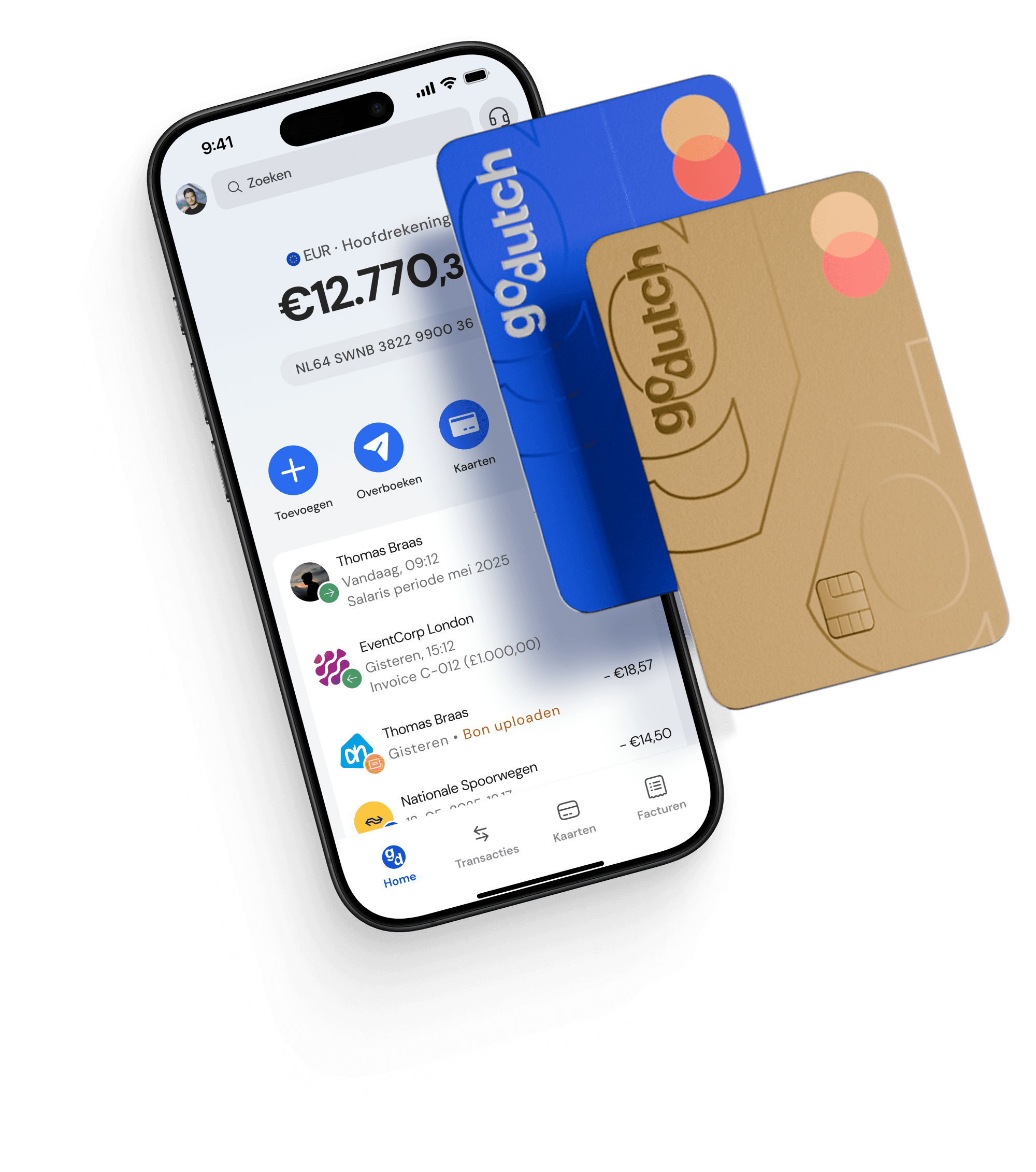
That works fine as long as your invoices, costs and payments sit together and feed straight through to your bookkeeping. That is where GoDutch helps. GoDutch is not a bank, but a business account that brings your account, cards, invoices and expenses together in one app, with a connection to your bookkeeping software so every transaction lands in the right place immediately.
You see in a single overview what is coming in and what still has to be paid over, including on assignments where no VAT reaches your account. And if you run into something, you get a real person on the line 24/7.
Get started with an account that keeps your books up to date
Want to line up your business finances and your VAT administration better? You apply for a GoDutch business account in 3 minutes and have your IBAN and card within 1 day.
From that moment your transactions feed through to your bookkeeping automatically, so at your next return you do not have to hunt for what belongs where.
FAQ
Frequently asked questions about the VAT reverse charge
What does VAT reverse charge on an invoice mean?
VAT reverse charge on an invoice means the supplier does not charge VAT and the customer reports the VAT to the Dutch Tax and Customs Administration themselves. The supply is still taxable; the obligation to report simply sits with the recipient of the invoice.
Can you reverse charge VAT to a private individual?
No, you cannot reverse charge VAT to a private individual. The reverse charge only works between businesses, because the customer has to be able to report the VAT through their own VAT return. If you supply a private individual, you charge VAT as normal.
Is the VAT reverse charge the same as 0% VAT?
No, the VAT reverse charge is not the same as 0% VAT. With the reverse charge your customer reports the amount; with the 0% rate you remain the party liable to report and you declare the turnover yourself at zero per cent. They also end up in different boxes of your return.
In which box do you report reverse-charged VAT?
The box depends on the direction. If you reverse charge to a Dutch customer the turnover goes into box 1e, and to an EU business into box 3b. If VAT has been reverse charged to you, you use box 2a for a domestic reverse charge and box 4a or 4b for supplies from abroad, with the deduction in box 5b.
Do you have to apply the reverse charge if you use the Small Businesses Scheme?
If you use the Small Businesses Scheme and VAT is reverse charged to you, you have to file a one-off VAT return for it and you may not deduct that VAT. The reverse-charged VAT then becomes a cost. Supplies where the VAT has been reverse charged to you do not, however, count towards the scheme's turnover threshold.
What happens if you forget to apply the reverse charge?
If you forget to reverse charge and invoice with VAT, you still have to report and pay that VAT. You correct it with a credit note and a new invoice carrying the right wording, and adjust your return with a supplementary return if needed.