Open a business savings account


As an entrepreneur, it is wise to set aside part of your business funds in a savings account. A business savings account helps you build a financial buffer, reserve funds for tax obligations, and save with a view to the future.
At the same time, the offering differs greatly between providers: interest rates, costs, terms, and flexibility vary. Anyone wishing to open a business savings account would therefore be wise to compare providers carefully before making a decision.
What is a business savings account?
A business savings account is a savings account specifically intended for entrepreneurs and companies. The money is held in your business’s name and is therefore legally and fiscally separate from your personal assets. You place business funds in it that you do not need immediately for day-to-day operations, but that you still want to have available quickly if needed.
The difference from a regular business current account is that a savings account generally offers a higher interest rate, but is less directly accessible. Some providers apply a notice period or a limit on the amount you can withdraw per period. A business savings account is offered by traditional banks, but also by modern fintech providers and specialised savings services. The account is intended exclusively for business purposes and must not be used as a personal savings account.
What are the advantages of a business savings account?
A business savings account offers entrepreneurs a number of tangible advantages compared with keeping all business funds in a current account. You separate working capital from reserves, earn interest on your balance, and keep your finances more organised. The main benefits are:
Interest on your business balance: you actively put your money to work instead of leaving it in a current account without earning interest.
Overview and structure: by separating business savings from your current account, you maintain a clearer view of your available working capital.
Financial buffer: you build up a reserve for unexpected costs or periods with lower income.
Setting aside tax and VAT: you put amounts aside in advance so you are never faced with unpleasant surprises when filing your tax return.
Discipline in financial management: a separate account helps you handle business reserves more consciously and prevents you from unintentionally dipping into your buffer.
Why open a business savings account?
There are several good reasons to open a business savings account as an entrepreneur. In most cases, it comes down to creating greater financial peace of mind, structure and security within your business. Below, we explain the three most common reasons in more detail why opening multiple business accounts is a smart idea.
A business financial buffer
A business financial buffer is a cash reserve that you keep on hand for unexpected situations. Think of a major client who does not pay their invoice, an expensive machine that suddenly breaks down, or a period in which turnover temporarily disappoints.
By placing this money in an additional business account, you can be sure that you can absorb these costs without putting your business continuity at risk. Experts advise entrepreneurs to keep at least two to six months of fixed expenses as a buffer. A savings account is more suitable for this than a current account, because you consciously keep the money separate while also earning interest on it.
Setting aside tax and VAT
As an entrepreneur, you are responsible for paying income tax, corporation tax and VAT on time yourself. These amounts can add up considerably, especially as your profit grows. By setting aside a fixed percentage of your turnover or profit throughout the year in a business savings account, this money is ready when the tax assessment or return arrives.
This prevents you from unintentionally using this money for other purposes, and in the meantime you also earn interest on the reserved amount. It is a simple yet effective way to avoid financial surprises.
Saving for retirement
For many self-employed people and entrepreneurs, there is no employer who automatically builds up a pension. You are responsible for your own financial future. A business savings account can be a first step in building retirement capital, although specific products are also available, such as an annuity or the tax-advantaged old-age reserve (FOR).
A business savings account offers flexibility: you decide when to contribute and how much. In combination with tax arrangements, this can be an effective way to work on your financial future step by step.
Conditions for opening a business savings account
Before you can open a business savings account, you must meet a number of conditions. These conditions vary by provider, but there are several points that are common almost everywhere. It is wise to prepare well and, if necessary, compare business accounts so that the application process runs smoothly.
KvK registration: your business must be actively registered in the Dutch Chamber of Commerce register.
Active business current account: most providers link a savings account to an existing business current account, usually with the same institution.
Valid proof of identity: a passport, driving licence or identity card of the entrepreneur or director is required for identity verification.
Business documents: depending on the provider, annual accounts, articles of association or an extract from the KvK may be requested.
Minimum deposit: some providers require an initial deposit to activate the account or to qualify for interest.
Accepted legal structure: not all legal structures are accepted by every provider. Check whether your legal structure, such as a BV, sole proprietorship or VOF, is accepted.
Is a business savings account required?
No, a business savings account is not mandatory in the Netherlands. There is no legal requirement for entrepreneurs to keep business reserves in a separate savings account. You are free to manage your business funds as you wish, including keeping them in a regular current account.
However, opening a business savings account is a sensible choice for most entrepreneurs. Structuring your business finances, setting aside funds for tax obligations, and building up a buffer are all matters that contribute to healthy business operations. A separate savings account helps you do this in a practical and clear way. It is not mandatory, but it is certainly recommended for any entrepreneur who wants to stay in control of their finances.
Compare business savings accounts
Anyone wishing to open a business savings account would be wise to compare the different providers thoroughly. The terms and conditions can vary considerably, and the best choice depends on your specific situation and objectives. When comparing, be sure to look at the following factors at the very least:
Interest rate: the most obvious point of comparison. Also check whether it is a fixed or variable rate, and whether interest is paid on the full balance or only part of it.
Costs and fees: some providers charge monthly management fees or transaction fees. Include these in your calculation to determine the net return.
Notice period and flexibility: does your money have to be locked away for a fixed period, or can you withdraw it freely at any time? Greater flexibility generally comes with lower interest.
Minimum and maximum balance: check whether a minimum threshold applies for opening the account or receiving interest, and what the maximum balance is on which the provider pays interest.
Link to current account: many providers require you to also hold a business current account with them. Take the total costs of that package into account.
Legal form and accessibility: check whether your legal form is accepted and whether the application process is fast and fully online.
Deposit guarantee: verify whether and to what extent your balance is protected in the event of the provider's insolvency.
Interest on a business savings account: is this covered by the Deposit Guarantee Scheme?
The deposit guarantee scheme (DGS) is a protection mechanism that provides savers with certainty if a bank goes bankrupt. In the Netherlands, balances up to €100,000 per account holder per bank are covered by this guarantee. However, an important exception applies to business savings accounts: in principle, the DGS applies only to private individuals and small businesses that qualify as micro-enterprises. A micro-enterprise has fewer than 10 employees and an annual turnover or balance sheet total of no more than €2 million.
In most cases, larger companies fall outside the protection of the DGS and are therefore more vulnerable in the event of a bank failure. In addition, the guarantee applies only to balances held with banks supervised by De Nederlandsche Bank (DNB) and affiliated with the DGS. If you use a business savings account with an institution that does not operate as a recognised bank, such as an electronic money institution (EMI) or a certain type of fintech company, the protection may differ or be entirely absent. Therefore, explicitly check with each provider which guarantee arrangements apply before making a choice.
Business savings account in box 1 or box 3?
Business savings usually fall under box 1. This applies to sole proprietorships and self-employed professionals who classify their savings account as business assets, but also to director-major shareholders (DGAs) with a private limited company (BV). In box 1, the return on your savings is taxed as part of business profit, at the standard tax rate applicable to your situation.
Private savings, by contrast, fall under box 3. In this category, a tax-free allowance of €57,000 per person applies. Fiscal partners jointly benefit from an allowance of €114,000. Above that threshold, a deemed return is calculated on which wealth tax must be paid. For that reason, it is very important to keep business and private assets clearly separated, both for a correct tax return and for clear bookkeeping. Are you unsure about the correct classification of your savings? If so, seek advice from an accountant or tax adviser.
Open a business savings account with GoDutch
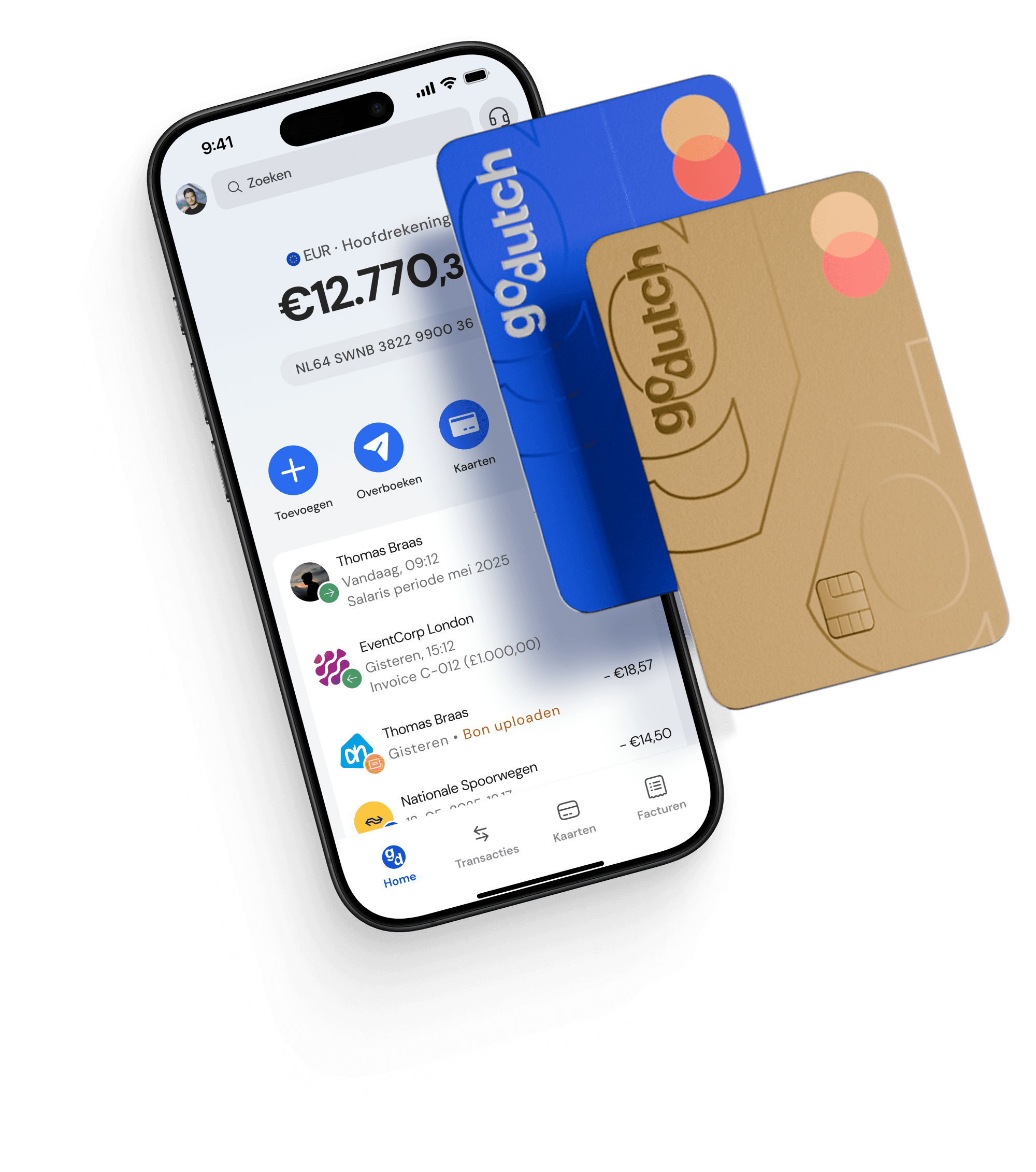
GoDutch is a modern business account for entrepreneurs who want to stay in control of their finances and save time on administration. With a Dutch IBAN received within 1 day, smart payment features and a seamless integration with popular accounting software, you have everything you need to manage your business cash flows clearly. GoDutch is available for various legal forms, from sole proprietorship to BV, and offers a user-friendly platform for both you and your team.
Do you want to structure your business finances better and lay a solid foundation for your company? Then start with a business current account at GoDutch and discover how simple professional financial management can be. Open an account today via godutch.com and experience the difference.
FAQ
Frequently asked questions about business savings accounts
Can I open a business savings account without a current account?
In most cases, no. The majority of providers require you to have an active business current account with them before you can open a savings account. This is related to identity verification and the linkage needed to transfer money between your current and savings accounts.
There are exceptions, such as specialised savings services that operate independently of a current account, but these are relatively rare. Compare several providers to see which option best suits your situation.
Is online business savings really safe?
Yes, online business savings are safe, provided you choose a reliable provider that holds a licence from a recognised financial regulator, such as De Nederlandsche Bank (DNB) or a foreign equivalent within the EU.
Always check whether the deposit guarantee scheme applies to your situation and use strong login credentials in combination with two-factor authentication to secure your account.
What is the best business savings account?
There is no universal answer to that question, because the best business savings account depends on your specific situation. The interest rate, the flexibility to withdraw money, the additional costs, and the conditions related to your legal structure all play a role.
Compare multiple providers based on your priorities and choose the one that best matches the size and purpose of your business reserves.
How much does it cost to open a business savings account?
Opening a business savings account is free with most providers. However, monthly or annual management fees may apply, as well as charges for carrying out transactions.
Also take into account the possible costs of the business current account that you need to link to it. Read the provider’s tariff schedules carefully to get a complete picture of all costs.
How much can I save for my business?
In the Netherlands, there is no legal maximum on the amount you may save for business purposes. In principle, you can put as much money into a business savings account as you like. However, note that some providers apply a maximum balance on which interest is paid.
Above that amount, you will no longer receive any interest. Check your provider’s product terms and conditions if you want to deposit large sums.
What is the difference between business and personal savings?
The main difference lies in the tax treatment and ownership of the money. With business savings, the balance is in your company’s name and in most cases falls under box 1, where the return is taxed as business profit.
With personal savings, the money is in your name as a private individual and falls under box 3, with a tax-free allowance of €57,000 per person. In addition, business savings are intended solely for business purposes. Mixing business and private assets is not recommended, both from a tax perspective and for clear administration.