Multiple business accounts


As an entrepreneur, there is a lot to consider when managing your company’s finances. A good structure in your banking matters is essential. More and more entrepreneurs are choosing to open multiple business accounts to keep their cash flows clear and organised. Whether you have a sole proprietorship, general partnership or private limited company, using different accounts can help create insight, control and efficiency within your financial administration.
Maintaining multiple business accounts is not only a practical choice, but also a strategic one. It ensures that you can plan better, analyse and make decisions based on clear financial data. In this article, you will read why entrepreneurs use multiple business accounts, what you need to pay attention to, and how to keep an overview when dealing with different business accounts. We also look at the rules and guidelines that apply, so that as an entrepreneur you know exactly what is and is not permitted.
Why entrepreneurs use multiple business accounts
For many entrepreneurs, using multiple business accounts is a logical step in professionalising their financial organisation. It helps to manage income and expenditure clearly and ensures that different cash flows are clearly separated from one another. This enables you to manage liquidity, cost control and profitability more effectively. It also gives entrepreneurs greater control over their administration, which is essential for sound business operations.
Better insight into income and expenditure per project or department
By using multiple business accounts, you can easily distinguish between different projects, departments or activities within your company. This gives you more insight into where your income comes from and which costs are associated with it. As a result, you can see more quickly which parts are profitable and where improvements may be needed. This transparency helps you make better-informed decisions and optimise the financial health of your business.
Separating VAT, salary, profit and costs
The separation of cash flows for VAT, salary, profit and business expenses is essential for a clear financial structure. By using a separate business account for each category, you avoid tax money or wage payments being confused with operating expenses. This makes it easier to make provisions and meet obligations on time. It also provides peace of mind and clarity, because at a glance you can see how much money is actually available for investments or profit distribution.
Fewer errors in administration and faster bookkeeping
When you use multiple business accounts, transactions are automatically separated and organised more effectively. This reduces the chance of mistakes when processing payments or allocating costs. Your bookkeeping remains clearer, meaning you spend less time correcting errors. Your accountant can also work more efficiently, which not only saves time but often also leads to lower administrative costs and faster financial reporting.
Possible points of attention
Each additional business account may come with extra banking charges, such as monthly subscription fees or transaction fees.
Managing multiple accounts requires more administrative attention and discipline to maintain an overview.
Not every bank offers the same level of flexibility or automatic integrations with accounting software for multiple accounts.
Too many accounts can lead to fragmented funds, making it harder to maintain a clear overall view of your liquidity.
Opening multiple accounts may require extra verification procedures or identity checks at some banks.
Rules and legislation regarding multiple business accounts
Although opening multiple business bank accounts is very common for entrepreneurs, there are a few rules and guidelines you need to take into account. Both banks and the Tax and Customs Administration impose requirements regarding transparency, record-keeping and accountability for business cash flows. It is important that each account is demonstrably linked to the business activities and that all transactions are processed correctly in the accounts. This prevents problems during an audit or when preparing the annual accounts.
Is it allowed to have multiple business accounts?
Yes, it is entirely permitted to have multiple business accounts for one business. Both sole traders and private limited companies and general partnerships may open multiple accounts at different banks or within the same bank. This gives entrepreneurs the freedom to organise their financial administration in the way that best suits their business operations. It is important, however, that the accounts are genuinely used for business purposes and do not become mixed up with private transactions, so that the accounts remain clean and auditable.
What does the Tax and Customs Administration say?
The Tax and Customs Administration has no objection to the use of multiple business accounts, as long as these accounts are correctly included in your business records. It is important that each transaction is clearly traceable and that business payments are not mixed with private expenses. The Tax and Customs Administration expects you to be able to provide the financial data of all your business accounts when asked. A clear set of accounts with separate accounts also makes it easier to file VAT, income tax or corporation tax returns accurately.
What rules apply to business payments and transparency?
All business payments must be traceable and recorded in the company's financial records.
The account holder's name must match the business name registered with the Chamber of Commerce.
When making payments to suppliers or employees, it must be clearly visible from which business account the payment was made.
Transactions between business accounts of the same company must be accounted for to maintain a complete financial picture.
Upon request from the Tax and Customs Administration, the records must provide full insight into all business accounts used.
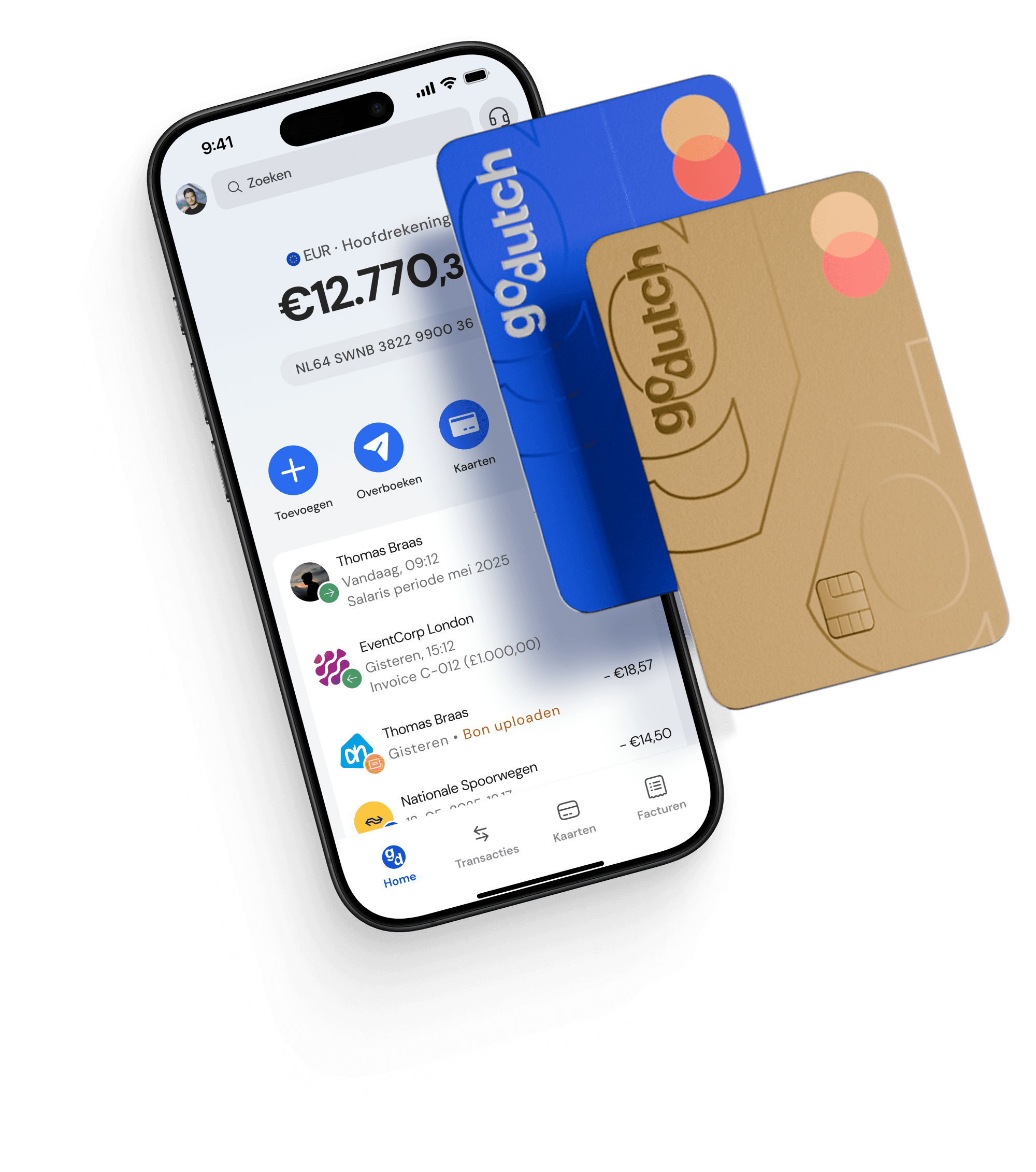
Open a business account with GoDutch
A business account with GoDutch is designed for entrepreneurs who value simplicity, speed and transparency. Within minutes you can open an account and receive your own IBAN and debit card, often within just 1 day. With GoDutch, you manage your finances smartly and efficiently: from payments and invoices to team expenses, all clearly organised in one app. What's more, you benefit from automatic integrations with your accounting software, unlimited cashback on card spending and 24/7 personal support.