What is the difference between a business account and a personal account?


Have you started trading and are you wondering whether you should open a separate account for your business? Or are you unsure whether you can use a personal account for business transactions? With the right information to hand, you will not only save yourself a lot of administrative hassle, but also avoid being faced with unexpected costs or restrictions. By making sure you are well informed, you lay a solid financial foundation for your business.
Is a business account mandatory?
For most business forms, such as a sole proprietorship, there is no legal requirement in the Netherlands to open a business account. Nevertheless, it is wise to consider whether a separate account for your business is the best choice.
A business account makes it easier to separate your company’s finances from your personal expenses. It also gives you greater insight into your financial administration, which can be useful when filing your tax return and in any inspections by the Tax and Customs Administration.
Using a private account for business purposes
If you have a sole proprietorship, in principle you may use your personal account for business purposes. There is no law that explicitly prohibits this. Still, it is often not the most sensible choice. Many banks state in their terms and conditions that a personal account is intended solely for personal transactions. If you breach these terms, in the worst case this could lead to your account being closed or other restrictions.
Additionally, it can become unclear when you process your business payments through your personal account. You then lack a clear separation between personal spending and business expenses, making your bookkeeping unnecessarily complicated very quickly. It can also be difficult to explain any ambiguities to the tax authorities. If you want to come across professionally and keep the administration in order, a separate business account is much more convenient. That way, you keep your finances clear and avoid confusion, both for yourself and for your customers and suppliers. In addition, it is not permitted to use a personal account for a holding or private limited company.
All the differences between a business account and a personal account
There are several differences between a business and a personal account that can affect your entrepreneurship. Although both accounts are suitable for depositing money and receiving payments, a business account is about much more than transactions alone. For example, there can be differences in costs, service and tax advantages. Aspects such as professionalism and ease of use also play an important role. In the following sections, we will go through these various points step by step, so that you can determine for yourself which account best suits your situation.
1. Clear separation of finances
One of the most important differences between a business and a personal account is the clear separation of your business finances. If you choose a business account, you keep all business transactions separate from your personal spending. This makes it much easier to account for costs and determine profit, which is especially useful when completing your tax return and in the event of any checks.
For an entrepreneur, this offers both convenience and peace of mind. By structuring the administration clearly, you prevent personal transactions from becoming mixed up with business activity. That saves time, reduces the chance of errors and also gives a professional impression. One drawback can be that opening a separate account brings extra costs. Still, that investment often outweighs the time saved and the clear financial insights you get in return.
2. A business account is more expensive
Another clear difference is that a business account generally involves higher costs than a personal account. Banks often charge extra for business services, such as monthly subscription fees, transaction fees and sometimes charges for applying for payment cards or additional features. These costs can vary by provider, but are usually higher than for a personal account.
Despite the higher price, a business account can quickly pay for itself because you can work more efficiently and gain more insight into your business finances. Many entrepreneurs also find that the extra functionality and professional appearance are worth the money. You are investing in clear administration and a stronger position for your business, which can contribute to growth and success in the long term.
3. Tax benefits
As an entrepreneur, you benefit from tax advantages with a business account. The tax authorities can, for example, more easily see which expenses and income belong to your business. By clearly separating private and business matters, it also becomes easier to prevent errors or irregularities in the accounts. This can have a positive effect on the speed and smoothness of tax inspections and reduces the risk of additional assessments or fines.
For you as an entrepreneur, this means more overview and less hassle when identifying business or personal expenses in one and the same account statement. The time you save can be put back into your business. One drawback can be that there are extra costs associated with using a business account, but in return for those costs there is often the efficiency and convenience of filing returns, preparing for inspections and processing the accounts.
4. A business account looks more professional
A business account contributes to the professional appearance of your business. When customers or suppliers receive or make payments to a business IBAN, it immediately shows that your business is serious and reliable. This can strengthen trust, making you more likely to be seen as a trustworthy party in the market.
For you as an entrepreneur, this also has practical advantages. Business correspondence looks consistent, and you send a clear signal that your business stands for professionalism and quality. A possible drawback is that there are extra costs associated with a business account, but the professional image and trust you build with it may well prove more than worth the investment.
5. Better creditworthiness
A business account can make a positive contribution to your business's creditworthiness. When your bank sees that you have a professional payment account and maintain clear financial records, this increases the chance of a favourable assessment when applying for a loan or credit, for example. It shows that you handle your business finances seriously and keep track of your income and expenditure properly.
For an entrepreneur, this means more opportunities to invest in growth when needed. Think, for example, of expanding your stock, taking on extra staff or starting new projects. Although the monthly costs for a business account may be higher than for a personal account, the benefit of improved creditworthiness often outweighs the extra investment.
6. Business accounts offer extra services and features
Many banks and financial institutions offer extra services and features within their business packages that you would not normally find with a personal account. Think, for example, of more extensive accounting integrations, tools for expense management or the option to issue multiple payment cards to employees. These facilities can make administration much more efficient and give you, as an entrepreneur, more insight into your cash flow.
The advantage of this is that you get a complete package to manage your business finances centrally, which can save time and money. It also gives you a professional impression to customers and suppliers, because you have resources specifically tailored to business use. On the other hand, you often pay a higher monthly fee and may not need certain services every day. Still, the investment can be worthwhile, as it provides a future-proof foundation for further growth and professionalisation of your business.
Smart investing with GoDutch
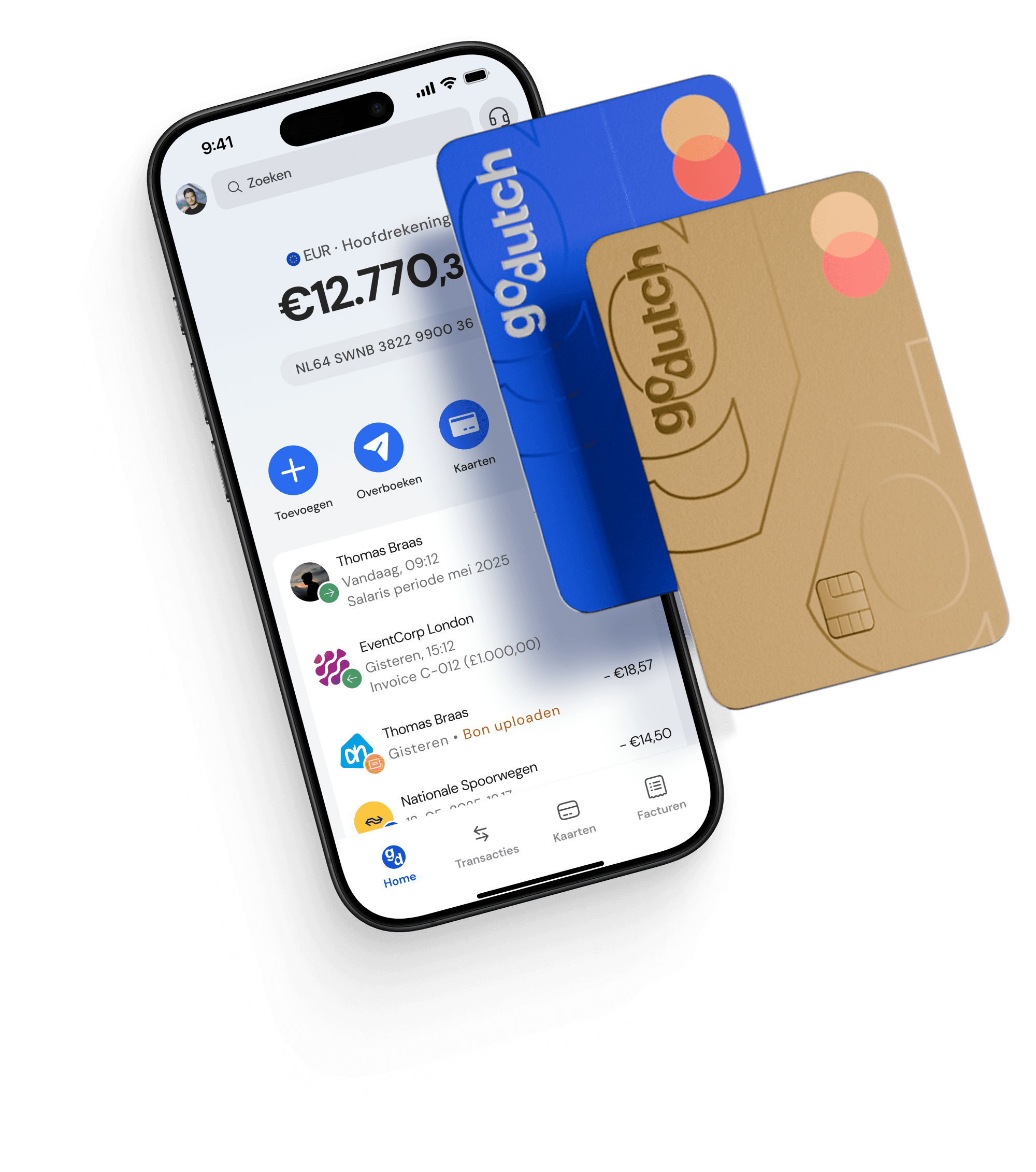
With GoDutch, if you want, you can open multiple accounts for each specific purpose within your business. With this flexibility, you retain control over your different cash flows and can organise your financial administration efficiently. Whether you want multiple IBANs for separate business activities or simply want to work together with your accountant, GoDutch makes it possible to manage all of this from one user-friendly platform.
Thanks to advanced technology and smart automations, you can save up to 50–70% on administrative work, freeing up more time to grow your business further. You also benefit from real-time insight into your income and expenses, a professional appearance and quick onboarding. With GoDutch, you can therefore not only easily create multiple accounts, but also keep a close eye on your costs, payments and invoicing, saving you both time and money in the long term.