What is a SEPA direct debit?

A SEPA direct debit is a standardised European payment method that allows an organisation to automatically debit an amount from a customer's account with their consent. This consent is recorded in a mandate, and the direct debit can be one-off or recurring. There are two variants: a core direct debit for consumers and businesses, and a business-to-business direct debit that only works between businesses.
How does a SEPA direct debit work?
A SEPA direct debit works in fixed steps: the customer provides a mandate, you pre-notify them of the debit, and then you submit a collection order. This order goes via the creditor's bank to the debtor's bank, after which the amount is debited and credited to your account.
If the debit is unsuccessful, you will receive a notification. To be able to collect as a business owner, you need a business account with a provider that supports direct debit, plus a direct debit contract with your own Creditor ID.
You submit the collection orders per variant and per sequence type, so separately for one-off and recurring direct debits. You register the first debit of a recurring sequence separately, after which you process each subsequent debit as a recurring order.
You send the pre-notification to your customer at least 14 days before the debit, including the amount and the date. If something goes wrong, for example due to insufficient funds or a chargeback, the bank processes this as a separate failed transaction and you will not receive the amount or it will be reversed.
The types of SEPA Direct Debit
The types of SEPA direct debit fall into two schemes and two sequence types. The scheme determines who you can collect from and whether refunds are possible; the sequence type determines whether you collect as a one-off or on a recurring basis. Below are the standard variant, the business variant and the difference between a recurring and a one-off direct debit.
Standard SEPA Direct Debit (Core)
The standard SEPA direct debit, also called Core, can be used for both consumers and businesses. The customer retains protection: they can request a refund for an incorrect debit up to 8 weeks after the date without giving any reason. This makes Core the most commonly used variant for subscriptions and recurring invoices to private individuals.
Business SEPA Direct Debit (B2B)
The business SEPA direct debit, also called B2B, works exclusively between businesses. Refunds are not possible here, which gives you more certainty about the payment. This is offset by extra administration: your customer must also register the mandate with their own bank before you can collect.
What is a recurring SEPA direct debit?
A recurring SEPA direct debit is a mandate that allows you to collect multiple times, for example every month or every year. With a one-off direct debit, you collect only once and the mandate expires afterwards. Choose recurring for fixed contracts and subscriptions, and one-off for a single payment.
What is a SEPA direct debit mandate?
A SEPA Direct Debit mandate is the recorded consent with which a customer authorises you and their bank to debit amounts.
Without a valid mandate, you are not allowed to collect payments, and the customer can have a debit without a mandate reversed up to 13 months later via an Unauthorised Direct Debit Notification. According to the Dutch Payments Association (Betaalvereniging Nederland), the mandate must meet fixed requirements and be stored digitally in your administration.
You record the mandate on paper or via an approved digital direct debit mandate with your bank. A simple checkbox on a website does not count as legally valid consent, so ensure you have a physical signature or the digital equivalent.
What must be included on a SEPA mandate?
A SEPA mandate always contains the same mandatory information, clearly separated from the rest of the form. The most important components are:
Title with SEPA: the heading states the type, for example recurring or one-off SEPA mandate.
Creditor Identifier and mandate reference: your unique Creditor Identifier plus a reference of up to 35 characters that is unique per mandate.
Customer details: the name, the address where required, and the IBAN of the account holder you are debiting.
Consent text and signature: the standard text authorising the debit, with place, date, and signature.
What is a Creditor Identifier?
A Creditor Identifier is the unique number that identifies you throughout the SEPA area as a party authorised to collect direct debits. For Dutch companies, it consists of 19 characters and is derived from your Chamber of Commerce (KvK) number.
You receive the Creditor Identifier when you sign a European direct debit contract with your bank or payment provider, and you submit it with every direct debit instruction.
How do you get started with SEPA Direct Debit yourself?
You start with SEPA direct debit by first arranging the collection with your bank or payment provider and then collecting mandates. The most important steps at a glance:
Arrange a direct debit contract: request a European direct debit contract from your bank or provider and receive your creditor identifier.
Set up a mandate: create a mandate form that meets the SEPA requirements and have your customer sign it.
Send the pre-notification: inform your customer at least 14 days in advance of the amount and the date.
Submit the direct debit order: send the order via your provider or accounting software, separated by variant and sequence type.
If you are currently using another provider, a switching service will take your ongoing direct debits with you when switching to another business account. This way, your debits will continue and you will not have to set up existing payment agreements again.
Can you reverse a SEPA direct debit?
Reversing a SEPA direct debit means having a debit refunded, and with the standard variant, this can be done within 8 weeks without giving a reason. This 56-day period applies to Core direct debits; the amount is then returned to the account the next working day.
A business B2B direct debit cannot be reversed: you can only refuse it in advance or stop it on the day of the debit. If the customer believes there was no valid mandate, a longer period of 13 months applies via a Notification of Unauthorised Direct Debit.
SEPA Direct Debit for recurring payments
SEPA Direct Debit is particularly suitable for recurring payments, where you collect the same or a variable amount from regular customers. Think of subscriptions, service contracts, rent, tuition fees and periodic invoices to regular buyers.
Associations and foundations also make plenty of use of direct debit: an association collects contributions from a business account for your association and a foundation collects donations from a business account for your foundation. You do not have to wait for someone to transfer the money themselves, which makes your cash flow more predictable and simplifies your debtor management.
Benefits of SEPA Direct Debit
The benefits of SEPA Direct Debit revolve around certainty, time savings and less manual work in your administration. As a creditor, you initiate the payment yourself, making your income more predictable and collection a fixed, professional agreement with your customer. The main benefits of a SEPA Direct Debit at a glance:
Grip on timing: you decide when you collect, so payments are received on time and you have to chase invoices less.
Less administration: you no longer check manual bank transfers and have fewer payment backlogs.
Works across the SEPA zone: you collect from a customer in Germany or Belgium in the same way as in the Netherlands.
Set up SEPA Direct Debit with the GoDutch business account
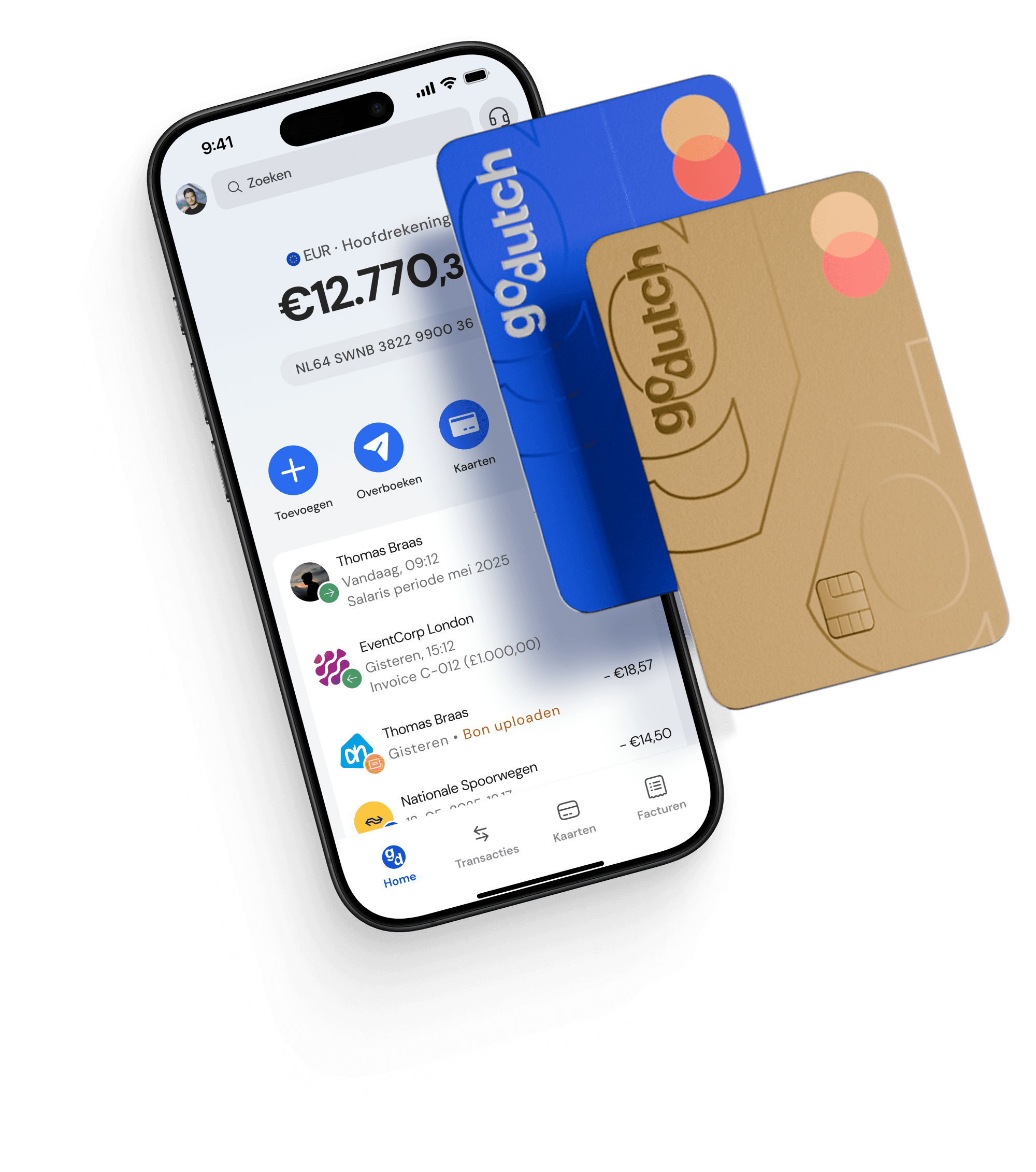
With the business account from GoDutch, you can manage SEPA direct debits directly from your account. You can initiate both standard Core direct debits and business B2B direct debits, and pay incoming direct debits from the same account. This way, you manage your incoming and outgoing payments in one place, without needing a separate direct debit package.
You can apply for the account in 3 minutes and have your IBAN and card within 1 day. The app links with your accounting system, automatically matches transactions, and tracks your expenses in real-time, bringing direct debits and invoices together in the same overview.
If you operate from a private limited company (bv), the business account for your company integrates seamlessly with business-to-business direct debits, featuring shared access for your team.
Getting started with your business account at GoDutch
Want to get started with a business account that combines direct debits, cards and your bookkeeping? GoDutch sets up your account quickly, with a free starter package with no fixed monthly costs and 24/7 service from real people. You open an account for free and expand as your business grows.
FAQ
Frequently asked questions about SEPA direct debit
What does SEPA stand for?
SEPA stands for Single Euro Payments Area, the uniform European area for payments in euros. Within this area, the same rules apply to transfers and direct debits in all participating countries, such as the Netherlands, Germany and Belgium. As a result, collecting from a foreign customer in euros is just as easy as collecting from a Dutch one.
How far in advance do you need to announce a SEPA direct debit?
You must pre-notify your customer of a SEPA direct debit at least 14 days before the debit takes place, including the amount and the date. You may agree on a shorter period with the customer, but this must be confirmed in writing. This pre-notification applies to both one-off and recurring direct debits.
How long does a SEPA direct debit mandate remain valid?
A SEPA Direct Debit mandate remains valid as long as you use it, but expires if you do not submit a direct debit collection for 36 months. After that, you can no longer collect on that mandate and you must ask the customer for a new one. Keep the mandate digitally in your administration for as long as you collect.
Can you stop a SEPA direct debit?
As an account holder, you can always cancel a continuous SEPA direct debit, so that an organisation can no longer debit amounts. You can arrange this via your account provider or online banking. You do not have to pay an unjustified debit; you still owe a justified bill and must settle it in another way.
Do you need a business account to collect payments yourself?
Yes, direct debit collections are not possible from a personal account: you need a business account and a direct debit contract. That contract gives you the creditor ID with which you can submit orders to the bank. You can arrange this via an account provider that supports direct debit, or via a payment provider that works with its own creditor ID.
What happens if a SEPA direct debit fails?
A SEPA direct debit usually fails due to insufficient funds in the customer's account. The bank reports the failed debit and the payment does not go through. The claim remains outstanding: you may attempt the direct debit again or agree on how the customer will pay, and sometimes the bank charges a fee for the failed direct debit.