Applying for a VAT number

Applying for a VAT number works differently in the Netherlands than most starters expect: you don't submit a separate application, but receive your VAT number automatically after registering with the Chamber of Commerce (KVK).
The Dutch Tax Administration (Belastingdienst) assesses for itself whether you are an entrepreneur for VAT purposes and then sends you your numbers by post. Below you can read how that process works, what you need to have ready in advance, how long it takes and what you can do if you cannot register with the KVK.
How do you get a VAT number?
You get a VAT number by registering your business in the KVK Business Register (Handelsregister). The KVK passes that registration on to the Dutch Tax Administration, which assigns you the number.
So there is no separate application form for entrepreneurs who can simply register. During your registration, you state which legal form you choose and what you will be doing, and that information is enough for the assessment.
You also don't need to report to the Dutch Tax Administration yourself. The KVK forwards your details automatically, after which the letter with your numbers simply lands on your doormat.
This also means you cannot speed up the process by calling the Dutch Tax Administration. The order is fixed: first the registration, then the assessment, then the letter with your numbers.
What do you need before you get a VAT number?
Before you get a VAT number, your registration with the KVK must be complete. You prepare that registration online and complete it during an appointment at a KVK office, where an employee checks your details and your proof of identity.
Make sure you have the following ready before you start:
A valid proof of identity: a passport, Dutch identity card or driving licence that is valid on the day of your appointment.
A DigiD: you use this to log in and fill in the online preparation.
A business address: the address at which your business is registered, even if you don't receive customers there.
A trade name: check in advance in the Business Register whether the name you want to use is still available.
A start date: the date on which you start your activities or enter into your first obligations.
A business description: based on this, the KVK employee determines the appropriate SBI code together with you.
That business description is more important than it seems. The Dutch Tax Administration uses your activities to determine whether you are an entrepreneur for VAT purposes, so a vague or too narrow description works against you.
Who gets a VAT number from the Dutch Tax Administration?
You get a VAT number from the Dutch Tax Administration if, in its view, you are an entrepreneur for VAT purposes. That test is separate from your KVK registration: being registered in the Business Register does not automatically make you liable for VAT.
The Dutch Tax Administration looks at, among other things, whether you work independently, whether you generate revenue regularly and whether you bear business risk. If in doubt, the Dutch Tax Administration will contact you before a decision is made.
If you work in a sector that is exempt from VAT, such as healthcare, education or childcare, you usually do get a number. You just don't charge VAT, don't file VAT returns and cannot reclaim the VAT on your purchases.
From the moment you are registered, the Dutch Tax Administration sees you as an entrepreneur. If you had no revenue in a quarter, you simply file a nil return instead of nothing.
Which two VAT numbers do you get as an entrepreneur?
As an entrepreneur, you get two VAT numbers: a VAT identification number (btw-identificatienummer) and a VAT tax number (omzetbelastingnummer). They often arrive in two separate letters and each has its own purpose.
Your VAT ID is the public number. You put it on your invoices, your letterhead and your website, and you use it when trading within the European Union. It consists of the country code NL, nine digits, the letter B and two check digits.
You only use your VAT tax number with the Dutch Tax Administration, for example in your tax return or when calling the BelastingTelefoon (the tax information line). If you have a sole proprietorship (eenmanszaak), keep that number to yourself: your citizen service number (BSN) is incorporated in it.
That distinction has existed since 2020 and was introduced for precisely that reason. For sole proprietorships, the old VAT number was derived directly from the citizen service number, which made every invoice a privacy risk.
For a BV, foundation (stichting) or general partnership (vof), both numbers are derived from the legal entity's RSIN. The same division of roles applies: the VAT ID for the outside world, the VAT tax number for the Dutch Tax Administration.
What is the difference between your VAT number and your KVK number?
Your VAT number and your KVK number say different things about your business and come from different authorities. The KVK number proves that you are registered in the Business Register, the VAT number that you are an entrepreneur for VAT purposes.
You get your KVK number immediately upon registration and it consists of eight digits. Your VAT ID follows later, comes from the Dutch Tax Administration and always starts with NL.
Both belong on your invoice. Customers use your KVK number to check that your business exists and your VAT ID to see that you are allowed to charge VAT.
How long does it take to receive your VAT number?
It usually takes two weeks for your VAT number to arrive, counted from the start date you gave the KVK. You receive it by letter, together with an explanation of your VAT obligations.
So if you register well before your start date, you will wait longer than two weeks for the letter. The Dutch Tax Administration counts from the moment your business officially starts operating, not from your KVK appointment.
If that letter goes missing, you don't need to arrange anything again. You can find your number in Mijn Belastingdienst Zakelijk under the heading Btw, and this article on looking up a VAT number explains step by step where to look.
As long as you don't have a number yet, you may not put VAT on your invoices. So wait with invoicing until the letter has arrived, or agree with your client that you will send the invoice shortly after you start.
How does your legal form get a VAT number?
The route your VAT number takes depends on your legal form. The assessment by the Dutch Tax Administration is the same for everyone, but the moment the registration comes in differs per legal form.
VAT number for a sole proprietorship
For a sole proprietorship (eenmanszaak), it goes through your own registration with the KVK. You fill in the online preparation, make an appointment and complete the registration there.
The KVK then forwards the details and you receive two letters from the Dutch Tax Administration: one with your VAT ID and one with your VAT tax number. An owner can only have one sole proprietorship, but can have several trade names and activities under that same number.
VAT number for a BV
For a BV, registration goes through the civil-law notary who incorporates the company. The civil-law notary registers the BV in the Business Register, after which the same route follows: the Dutch Tax Administration assesses entrepreneurship and sends the numbers by post to the business address.
If you have a holding structure, each BV in principle gets its own VAT ID. If they together form a fiscal unity (fiscale eenheid) for VAT, they share one VAT tax number while each BV continues to use its own VAT ID on invoices.
VAT number for a general partnership or professional partnership
You register a general partnership (vof) or professional partnership (maatschap) with the KVK yourself, with the details of all partners. Here too, the letter from the Dutch Tax Administration usually follows within two weeks.
The VAT ID and the VAT tax number are derived from the RSIN of the partnership. The number therefore belongs to the vof itself and not to the individual partners, who also keep their own income tax position.
VAT number for a foundation or association
A foundation (stichting) or association (vereniging) gets a VAT number if the Dutch Tax Administration considers its activities to be entrepreneurship. Many non-profit associations fall outside this and then don't get a number.
If the Dutch Tax Administration is in doubt, it contacts the board before anything is assigned. If your organisation carries out both exempt and taxable activities, you do get a number and only charge VAT on the taxable part.
Applying for a VAT number without registering with the KVK
You can apply for a VAT number without registering with the KVK using the Dutch Tax Administration's form Opgaaf startende onderneming (registration of a new business). That route only applies if you genuinely cannot register, not if you would rather not have a KVK number.
The Dutch Tax Administration lists a limited number of situations for this:
Silent partnerships (stille maatschappen): forms of collaboration without a business in the Business Register.
Informal associations: associations that are not registered with the KVK.
Sole proprietorships outside the business criteria: activities that do not constitute a business according to the Business Register.
Foreign legal forms: businesses without an establishment in the Netherlands.
Mutual funds (fondsen voor gemene rekening): a separate category named by the Dutch Tax Administration itself.
Owners of solar panels who feed electricity back to their energy supplier also fall under this route. They are entrepreneurs for VAT purposes without a business being listed in the Business Register.
If you do meet the KVK business criteria and still don't register, you are in breach of the Trade Register Act (Handelsregisterwet). That is a criminal offence under the Economic Offences Act (Wet Economische Delicten), so skipping registration is not an alternative route to a VAT number.
What does applying for a VAT number cost?
Applying for a VAT number costs nothing. The Dutch Tax Administration charges no fee for assigning your VAT ID or your VAT tax number, and no party is allowed to make you pay for it.
What you do pay is the KVK's one-off registration fee when registering your business. That rate is set annually, so check the current amount on kvk.nl before you make an appointment.
If you set up a BV, the civil-law notary's fees come on top of that. Since 2013, the KVK no longer charges an annual contribution for sole proprietorships and general partnerships, so there are no ongoing fixed costs after registration.
So if you come across an online service offering to arrange your VAT number for a fee, you are paying for something you get for free when you register.
When do you not need a VAT number?
You don't need a VAT number if your revenue stays below the registration threshold for small businesses. That threshold is 2,200 euros per calendar year: if you stay below it, you don't need to register as a VAT entrepreneur.
If you exceed it during the year, you register after all. From the date you receive your VAT tax number, you invoice with VAT and file returns for the periods after that.
If your revenue stays below 20,000 euros per year, you can opt for the small business scheme (kleineondernemersregeling, KOR). You then simply get your numbers, but don't charge VAT and don't deduct VAT either.
That choice is not without commitment. If you sign up for the scheme, you are in principle bound to it for three years, unless you exceed the revenue limit earlier.
Applying for an additional VAT number for a new activity
You can apply for an additional VAT number if you start a new activity alongside your existing business. Think of a second branch or a service that falls under a different VAT rate.
You apply for that second number with the Dutch Tax Administration and also receive an additional VAT tax number with it. From then on, you keep separate books for that activity and file a separate VAT return.
Also report the new activity to the KVK, so that your registration matches what you do in practice. Discuss with your bookkeeper whether a second number makes sense in your situation, as it also creates extra work.
If your legal form changes, for example from sole proprietorship to BV, you will get new numbers anyway. Update your invoices, your website and your business communications in good time.
Received your VAT number? Here's how to keep your VAT separate with GoDutch
Once your VAT number is in, the real work begins: the VAT you collect is not yours. Without a clear separation between your revenue and the VAT you have to pay, the return comes as a surprise every quarter.
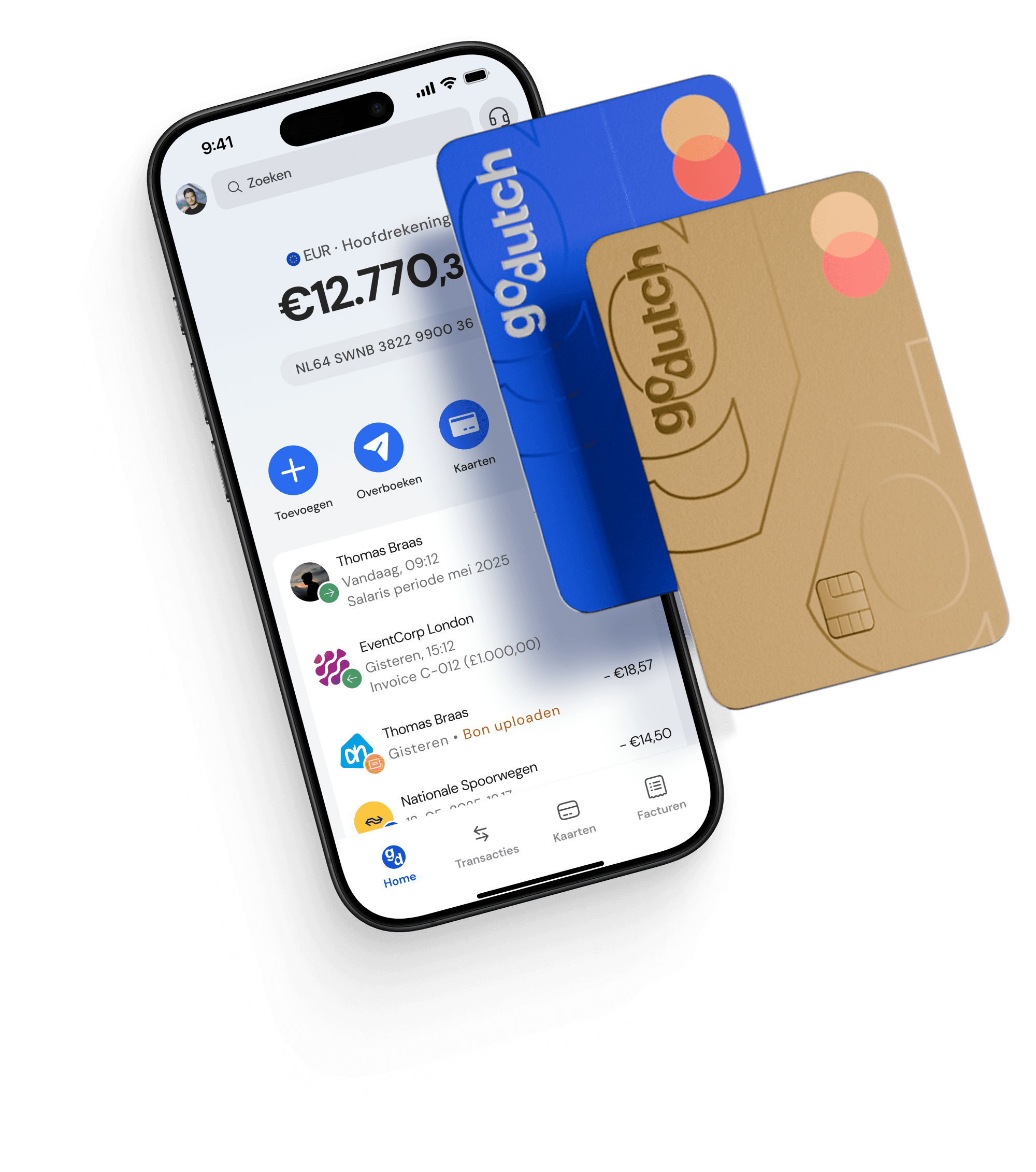
GoDutch is not a bank, but an all-in-one business account with which you make exactly that separation. You set your VAT aside in a separate pot, scan your receipts in the app and connect your bookkeeping, so that for each return you can see what is ready.
If you're just starting, you can move quickly: you apply to open a business account in 3 minutes and have your IBAN and card within 1 day. If you run into anything, a real person is available 24/7.
Have you received your VAT number or is the letter on its way? Then this is the moment to set up your business finances properly right away.
See what GoDutch arranges for you and set your VAT aside from your very first invoice, without the hassle of separate tools and spreadsheets.
FAQ
Frequently asked questions about applying for a VAT number
Can you apply for a VAT number as a private individual?
As a private individual, you cannot apply for a VAT number. A VAT number belongs to a business, not to a person. If you work independently and meet the business criteria, you register with the KVK. If that is not possible, you use the Dutch Tax Administration's form Opgaaf startende onderneming.
How much does a VAT ID cost?
A VAT ID costs nothing. The Dutch Tax Administration assigns the number free of charge after you have registered and been assessed as an entrepreneur for VAT purposes. The only costs you incur are the KVK registration fee and, for a BV, the civil-law notary's fees.
What does a Dutch VAT identification number look like?
A Dutch VAT identification number starts with the country code NL, followed by nine digits, the letter B and two check digits. For a sole proprietorship, those nine digits are chosen at random, so that your citizen service number (BSN) does not appear in it. For other legal forms, the number is derived from the RSIN.
Do you have to state your VAT number on your invoices?
You are required to state your VAT number on your invoices, and also on your website if you sell products or services there. Always use your VAT ID for this, never your VAT tax number. If you are exempt or use the small business scheme, different invoice requirements apply.
What happens to your VAT number when you stop trading?
When you stop, your VAT number lapses along with your business. You deregister with the KVK, which passes the deregistration on to the Dutch Tax Administration. Processing can take a while, so sometimes you still file a VAT return for the past period after your last working day.
Can you register for the KOR before your VAT number has arrived?
You can only register for the KOR once your VAT number has arrived, because the Dutch Tax Administration links your registration to that number. So wait for the letter and register afterwards. In this article on the small business scheme you can read which conditions and consequences apply.