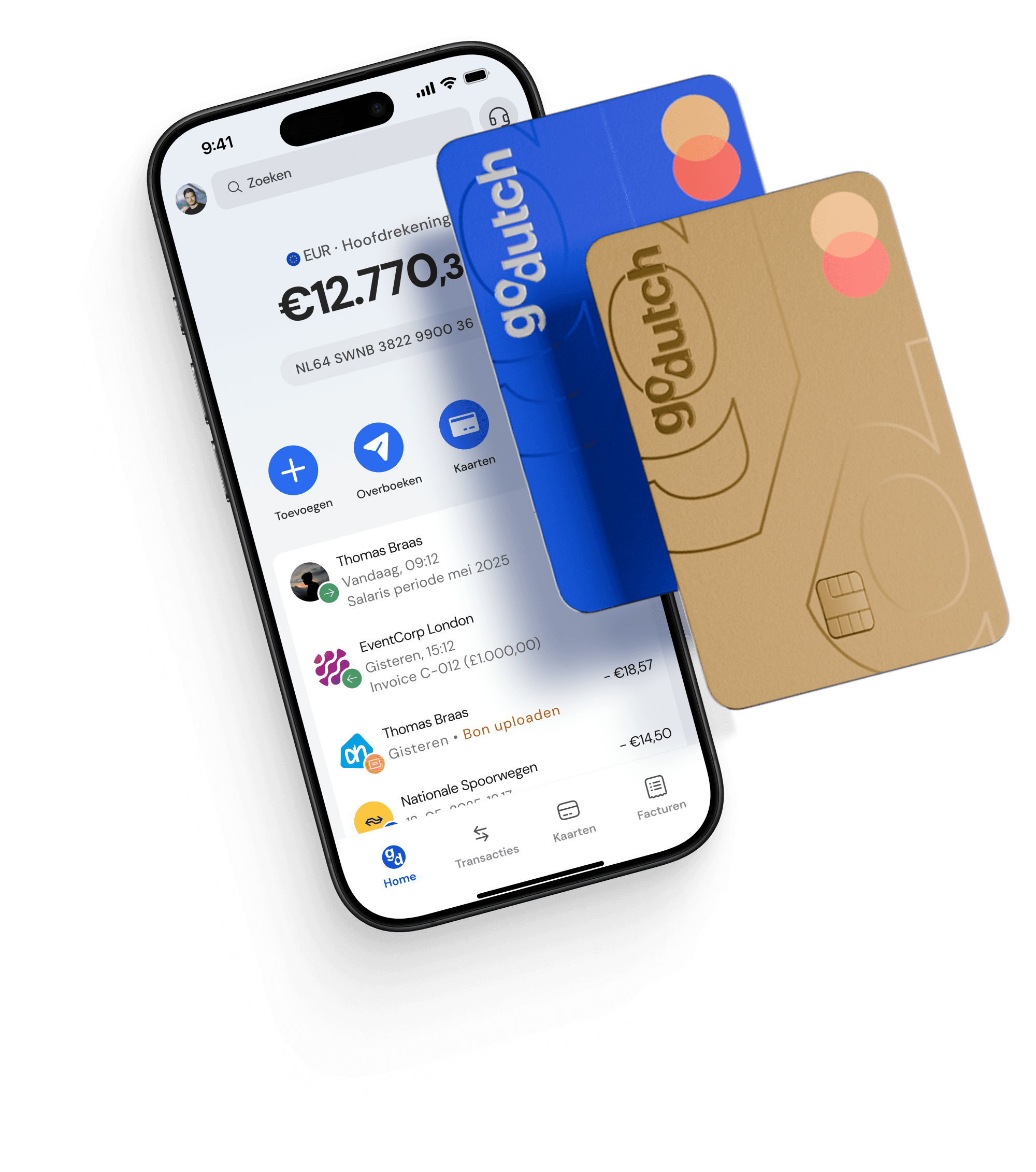
Debit Mastercard

The Netherlands is in the middle of the largest debit card replacement in thirty years. Since 1 July 2023, no new Maestro cards are being issued, and by July 2027 at the latest, Mastercard will stop supporting them completely. Instead, millions of consumers and entrepreneurs are receiving a Debit Mastercard, a card that combines the convenience of a debit card with the worldwide acceptance of the Mastercard network. Research by myPOS shows that 39 percent of the Dutch population does not know the difference between the old debit card and the new variant.
What exactly is a Debit Mastercard, how does it work, where can you pay with it, and what is changing compared to Maestro? In this overview, you will find the answers to these practical questions, plus how the Debit Mastercard works with the GoDutch Mastercards for entrepreneurs and self-employed professionals in 2026.
What is a Debit Mastercard?
A Debit Mastercard is a debit card that is directly linked to your account, similar to a regular debit card, but with the features and worldwide acceptance of a Mastercard. Every payment is immediately debited from your balance, you spend what is in your account and no more. This distinguishes the card from a credit card, where you pay afterwards.
Visually, you can recognise a Debit Mastercard by several features: a 16-digit card number on the front, an expiry date, a CVC security code on the back, and the Mastercard logo. Since 2023, new cards also feature a hologram against counterfeiting and a physical notch for the visually impaired, two adjustments that make the card more secure and accessible. The Debit Mastercard is available as a physical card and as a virtual card in an app.
How does a Debit Mastercard work?
A Debit Mastercard works identically to a debit card for the user, but the technology behind it runs via the Mastercard network. That is why you can also use it to pay online and outside Europe, whereas a Maestro card could not. The steps for an average transaction are as follows:
In a shop or restaurant: hold your card or phone (with virtual card) near the payment terminal, enter your PIN if necessary, and the amount will be debited from your account immediately.
Online: enter the 16-digit card number, expiry date and CVC code on the checkout page, and confirm the payment where necessary via 3D Secure in your banking app.
Contactless via Apple Pay or Google Pay: link your card in the wallet app of your phone, and pay with a tap against the terminal or via Face ID and Touch ID.
At an ATM: use the physical card and your PIN to withdraw cash, both in the Netherlands and outside Europe at locations with the Mastercard logo.
Each transaction is processed in real-time and is immediately visible in the app of your bank or provider. With a business account, each expense appears linked to the correct category, which is useful for your bookkeeping and VAT return.
Difference between Debit Mastercard and Maestro
For a long time, Maestro was the standard debit card technology in the Netherlands. Since 1 July 2023, no new Maestro cards are being issued, and by July 2027 at the latest, Mastercard will completely stop supporting it. Maestro was developed in the 1990s, for a time when online payments barely existed, and ran into its limits in the era of e-commerce.
The Debit Mastercard solves a number of limitations. Online payments work directly via your card number and CVC code, without iDEAL as a detour, and international webshops accept the card as standard. Worldwide acceptance covers more than 100 million locations, including countries such as the United States where Maestro often did not work. Pre-authorisations at hotels and car rentals are now successful, as are structural debits for subscription services. And in security terms, Debit Mastercard offers 3D Secure, tokenisation and Mastercard Zero Liability against unauthorised transactions, all layers that Maestro lacked.
Difference between Debit Mastercard and credit card
The greatest confusion surrounding Debit Mastercard lies in the difference from a credit card. Both cards operate on the Mastercard network, both have a 16-digit card number and a CVC code, and both are accepted worldwide. However, the way you pay is fundamentally different.
With a Debit Mastercard, the amount is debited directly from your account balance. With a credit card, you are granted credit: the credit card company pays first, and you settle the bill afterwards. This distinction has consequences for the spending limit, the costs, the risks, and the additional services you receive.
Feature | Debit Mastercard | Credit Card |
Payment timing | Directly from account | Settle afterwards |
Spending limit | Account balance | Agreed credit limit |
Interest | None | Depending on payment schedule |
Annual cost | Usually none or low | Often a fixed annual fee |
BKR registration | Not required | Above 250 euro credit limit |
Purchase protection | Limited | Often included |
Pre-authorisations | Yes | Yes |
Acceptance worldwide | Mastercard network | Mastercard network |
For most business owners and consumers, a Debit Mastercard is sufficient for daily use. A credit card primarily adds value for large business expenses, travel coverage with purchase protection, or temporarily bridging the gap when you prefer to settle the amount later.
Where can I pay with a Debit Mastercard?
The Debit Mastercard works at more than 100 million acceptance locations worldwide, including countries where the old Maestro card was not accepted. In the Netherlands itself, acceptance is nowadays virtually universal, also on terminals that previously only accepted Maestro, following a mandatory software update rolled out by banks together with payment service providers.
In practice, the Debit Mastercard works in almost all places where you pay daily. In-store and hospitality purchases are contactless or via your PIN, online payments function at Dutch and international webshops such as Amazon, eBay and streaming platforms, and subscription services can debit continuously without you having to grant a separate authorisation. Pre-authorisations at hotels, car rental companies and parking ticket machines run smoothly, as do cash withdrawals at ATMs at home and abroad. Travelling by public transport is possible with the card's public transport function, and payments in foreign currencies are automatically converted at the Mastercard reference exchange rate.
For entrepreneurs with international clients or suppliers, this is a godsend. Where Maestro stopped at the European border, you can now do business in the United States, Asia and Latin America with the same card. For entrepreneurs with international cash flows, worldwide payments with GoDutch also offers transparent insight into exchange rates and any costs before you confirm a transaction.
Difference between a physical and virtual Debit Mastercard
Virtually every provider that issues a Debit Mastercard offers both a physical and a virtual variant. Both operate via the same Mastercard network and are linked to the same account, but their practical application differs.
Physical Debit Mastercard
The physical Debit Mastercard is the card you keep in your wallet. It has a chip, an NFC antenna for contactless payments, and a magnetic stripe for terminals that do not support a chip reader.
Following the application, the card is sent in a blocked state and you activate it with a first PIN transaction or via your banking app. For public transport and places without cellular coverage, a physical card remains practical.
Virtual Debit Mastercard
A virtual Debit Mastercard exists solely within your bank or provider's app, linked to Apple Pay or Google Pay. For online purchases, this is a fast, secure route, as the card number the merchant sees is typically a token and not your actual card number.
For entrepreneurs and teams, virtual cards can also be created on a one-off basis for specific expenses (SUVC, single-use virtual card), which reduces the susceptibility to fraud for subscriptions and online purchases.
Mobile wallets and Debit Mastercard
The link between Debit Mastercard and mobile wallets has become the standard way of paying for most users as of 2026. Both Apple Pay and Google Pay accept a Debit Mastercard within seconds of linking: you open the wallet app, add the card via a scan or by entering the details, and confirm with an SMS code or via the banking app.
From that moment on, you pay contactlessly with your phone, smartwatch or tablet. For the merchant, it is identical to a physical card payment, for you it is faster and safer because the phone authorises your transaction with Face ID, Touch ID or a PIN instead of the card chip. Furthermore, the wallet shares a single-use token with each payment, not your actual card number, which virtually rules out unauthorised use.
How secure is a Debit Mastercard?
A Debit Mastercard is one of the most secure payment methods on the market in 2026. In addition to the standard chip and PIN security, Mastercard builds in multiple layers of protection to make fraud virtually impossible. For the average user, these layers work in the background, but it is good to know how you are protected.
The main security layers surrounding a Debit Mastercard in 2026:
3D Secure: For every online payment above a certain amount, you receive a verification request in your banking app, which you confirm using biometrics or a PIN.
Tokenisation: For linked mobile wallets and some webshops, your actual card number is replaced by a unique token, meaning your real details are never stored by third parties.
Mastercard Zero Liability: In the event of unauthorised transactions that are not due to your negligence, you are not liable for the damage.
Real-time fraud monitoring: Your provider monitors unusual patterns 24 hours a day and blocks suspicious transactions immediately, sending you a notification.
Customisable limits: In the app, you can adjust daily and weekly limits, temporarily freeze the card when lost, and enable or disable payments in specific regions.
For business owners, this combination also makes the Debit Mastercard suitable for cards that you share with team members or use for travel and expenses. With real-time expense management in GoDutch, you can also see every transaction instantly in the app, linked to the correct category and user.
Apply for a Debit Mastercard
Applying for a Debit Mastercard is largely digital with almost every modern provider. You go through an online onboarding process (KYC check, identification via passport or driving licence, linking to your account), after which you receive your physical card in the post within a few working days. The virtual version is usually available in the app immediately after activation.
At GoDutch, you automatically receive a virtual Mastercard in addition to your IBAN, and from the Starter package onwards, you can also add a physical card to your account. For teams and businesses with multiple employees, additional cards are available, with adjustable limits per user and category. View the GoDutch packages and prices for the option that suits your business situation.
For sole traders, general partnerships, private limited companies and holdings, a Debit Mastercard is available as standard via a GoDutch business account, with cashback on your spending on every card transaction depending on the package.
FAQ
Frequently asked questions about Debit Mastercard
Does a Debit Mastercard work worldwide?
Yes. A Debit Mastercard works wherever the Mastercard logo is accepted, in more than 100 million locations across over 200 countries. This is a significant expansion compared to the old Maestro card, which was often not accepted outside Europe.
Can I withdraw cash with a Debit Mastercard?
Yes. With your physical card and your PIN, you can withdraw cash from ATMs in the Netherlands and abroad, at locations with the Mastercard logo. The costs vary by provider and by location, especially for withdrawals outside the SEPA zone.
Does the Debit Mastercard replace my Maestro debit card?
Yes. As of 1 July 2023, no new Maestro cards are being issued. Existing Maestro cards will continue to work until their expiry date, and support will head to a complete stop by July 2027 at the latest. From that moment on, all Dutch current accounts will have a Debit Mastercard or a Visa Debit.
Is a Debit Mastercard the same as a credit card?
No. Both operate on the Mastercard network and have a 16-digit card number and CVC code, but the payment timing is fundamentally different. With a Debit Mastercard, the amount is debited directly from your account, whereas with a credit card, you pay afterwards.
How do I apply for a Debit Mastercard at GoDutch?
Open an account in three minutes via the GoDutch website, complete the identification process using your passport or driving licence, and your virtual Mastercard will be ready in the app the very same day. A physical card can be requested from the Starter package upwards and will arrive in the post within a few working days.