Deposit cash

Depositing cash in 2026 works completely differently than it did ten years ago. From 2019, the major banks gradually removed their own ATMs and transferred the network to Geldmaat, a joint initiative of ABN AMRO, ING and Rabobank.
By now, there are over 4,700 Geldmaat ATMs spread across the Netherlands, but not every machine accepts deposits. At the same time, the share of cash payments in shops is falling to around 15 per cent, and new rules regarding cash payments have been in force since 1 January 2026.
For entrepreneurs who regularly receive coins or banknotes, depositing cash remains a practical question. What does it cost at ING, ABN AMRO or Rabobank? Where can you go for coins or notes? And from what amount does your bank have a reporting obligation?
Where can I deposit cash?
Since Geldmaat took over all remaining ATMs from the three major banks in October 2021, almost every cash deposit in the Netherlands has been routed through that single network. However, this does not mean that every business owner or private individual can deposit cash anywhere. Which deposit points are available depends on which bank you hold an account with and what type of banknotes or coins you want to deposit.
In practice, there are four main routes to deposit cash into your account:
Geldmaat deposit machines: the primary network for customers of ABN AMRO, ING, Rabobank, SNS, ASN and RegioBank. Not every Geldmaat has a deposit function, so check beforehand via the Location Guide (Locatiewijzer).
Geldmaat coin machines: separate machines for depositing coins, available at a more limited number of locations. Not all deposit banks accept coins via this route.
GWK Travelex via Mr. Pay: a third party that allows you to deposit cash into any Dutch IBAN, regardless of your bank. It costs 3 per cent with a minimum of €9.95, up to a maximum of €10,000 per year.
Bunq via Paysafe Cash: for bunq customers, a free route for the first €100 per month, with paid deposits above that via a supermarket partner.
For most people in the Netherlands, a Geldmaat deposit machine is the logical choice, provided your bank is connected. Customers of online banks that are not connected, such as Knab, cannot deposit directly and often use a workaround via an account of a major bank.
Depositing cash nearby: how to find a deposit point
Not every Geldmaat ATM has a deposit function. Roughly a third of the machines in the Netherlands accept deposits, and coin machines are even scarcer. Anyone who walks to a Geldmaat without preparation often comes home empty-handed.
The fastest way to find a suitable deposit point is via the Location Finder on geldmaat.nl. There, you can filter by location and by function (depositing banknotes, depositing coins, sealbag deposit). You can also see the opening hours per machine, because deposit machines are often located in Bruna, Primera or The Read Shop stores, with different opening hours than the bank branches of the past.
For entrepreneurs who regularly hand in cash, it is smart to map out two or three deposit points in the immediate vicinity. Although the Geldmaat network guarantees that there is a machine within five kilometres, peak times and malfunctions make a single fixed deposit point vulnerable.
Difference between depositing banknotes and coins
For the user, depositing a twenty-euro note feels the same as depositing a handful of coins, but at Geldmaat these are two separate processes. Note deposit machines are located in significantly more places than coin machines, and the fees and limits differ by type.
Depositing bank notes
You deposit bank notes via a Geldmaat note deposit machine. Per deposit, the machines generally accept 200 notes at a time, in denominations from €5 to €500. The deposit is credited immediately or within one business day, depending on your bank.
ING and Rabobank credit immediately, while ABN AMRO can take up to two business days. For entrepreneurs depositing cash for business purposes, ING also supports advance booking, which places the amount in the business account on the same business day.
Depositing coin money
Coin money is more labor-intensive. Not every Geldmaat deposit machine accepts coins, and coin machines themselves are located in a limited number of places (often in DIY stores like Gamma and Karwei). For larger quantities, separate limits apply: ING accepts a maximum of 5 kilograms of coins per deposit, with a limit of 5,000 coins per day.
Customers of Rabobank and ABN AMRO can make a combined deposit of notes and coins up to €2,500 and €3,000 per day respectively, provided the machine has a coin tray. Customers of SNS and ASN Bank cannot deposit coins via Geldmaat.
What does it cost to deposit cash?
For a long time, depositing cash was free, but that is rarely the case anymore in 2026. Almost all banks apply a free annual limit and charge a flat fee or percentage per deposit thereafter. Below is an overview of the current rates at the largest Dutch banks (checked in January 2026):
Bank | Free limit | Rate above limit | Maximum per deposit |
ING | 4 deposits per year | €6 per deposit | €3,000 per day |
ABN AMRO | 12 deposits per year | €5 per deposit | 200 banknotes per time |
Rabobank | €3,000 per year | 0.5% of deposited amount | €2,500 per deposit |
Knab | Not possible | Not possible | Not possible |
SNS | 4 deposits per year | €3 per deposit | No coins |
ASN Bank | Free via Geldmaat | €5 per deposit after limit | €2,500 per deposit |
For business customers, higher limits and adjusted rates often apply, particularly for sealbag deposits that go through pre-notifications. Companies that structurally collect large amounts of cash, such as hospitality entrepreneurs or market traders, generally conclude separate business deposit agreements with their bank.
How much cash are you allowed to deposit?
There is no absolute legal maximum for depositing cash in the Netherlands, but there are reporting thresholds arising from the Prevention of Money Laundering and Terrorist Financing Act (Wwft). Banks are obliged to report unusual transactions to the Financial Intelligence Unit (FIU). The rule of thumb: from u20ac10,000 per deposit, a report is automatically made, even if you spread the amount over multiple smaller deposits.
In addition, since 1 January 2026, a new ban applies to cash payments of u20ac3,000 or more with traders in goods, art dealers, and pawnshops. This does not mean you can no longer deposit, but the source of the amount is questioned more quickly if the transaction does not logically fit with your business operations.
For entrepreneurs who regularly receive cash, documentation of the source is essential. Sales receipts, cash register records, and sales administration provide the bank with the context so as not to flag large deposits as anomalous. Anyone who comes with large amounts without substantiation can expect questions or, in extreme cases, a temporary block on the account.
Depositing money into your account: in cash or by bank transfer?
In practice, fewer and fewer entrepreneurs use the term "depositing money" for what actually happens. Anyone who receives an invoice and the amount arrives via bank transfer is effectively also depositing money into an account, only digitally. That difference is more than semantic: the way money enters your account determines the speed, the costs, and how instantly you can view it.
With a cash deposit via Geldmaat, the amount is instantly in your account (with ING and Rabobank) or within two business days (with ABN AMRO). With a digital receipt via instant SEPA, the amount is in your account within seconds, 24 hours a day, at no cost to the recipient. For entrepreneurs who have their accounts receivable management well in order, instant receipt effectively replaces the physical deposit entirely.
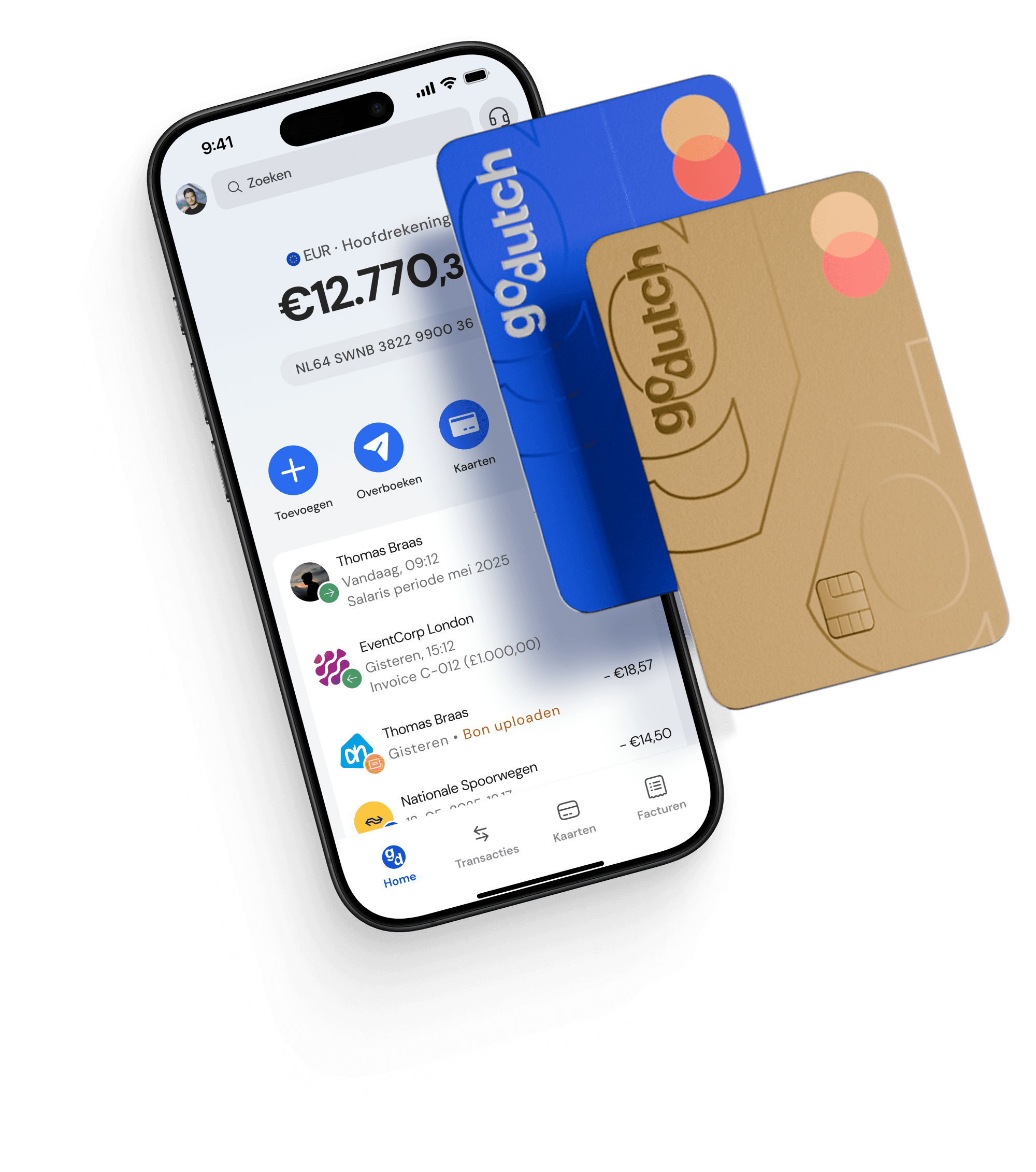
Modern business accounts operate around instant digital receipt. With GoDutch, incoming payments are instantly in your account via instant bank transfers, direct debits, and international receipts in more than 150 countries, without the need for a physical cash register or deposit. For entrepreneurs who do not receive cash, the difference is significant; for those who do work with cash, a traditional bank remains necessary for the time being alongside a digital account.
Depositing cash as an entrepreneur
Approximately 15 percent of in-store payments in the Netherlands are still made using coins and banknotes, Knab estimates based on its own customer research. For hospitality, market traders, hairdressers, taxi drivers, and some retail shops, receiving cash is a regular part of business operations. For those entrepreneurs, little will change in 2026: deposits will continue through Geldmaat, with separate business deposit agreements for larger volumes.
What is changing rapidly is what entrepreneurs do with the money once it is in their account. More and more entrepreneurs are maintaining a second business account for digital money flows, automated payments, international invoices, and cashback on card spending, in addition to a traditional bank for cash processing. This combination offers both the physical infrastructure of a major bank and the digital speed and transparency of a fintech.
For entrepreneurs who do not receive cash, things are different. For them, a traditional bank adds little value over an account that only handles digital flows. Those who occasionally need cash for expenses can use ATMs with a Mastercard card from GoDutch, as described in the article on withdrawing money from your business account.
Receiving smart without a deposit: how it works at GoDutch
By 2026, the majority of Dutch entrepreneurs will receive money via bank transfers, direct debits and card payments, not via cash. GoDutch is designed for these entrepreneurs: a fully digital business account with instant receipts, automation and cashback, without physical cash registers or deposit procedures.
Entrepreneurs who do not receive cash benefit from the following at GoDutch:
Instant SEPA transfers: incoming payments are in your account within seconds, 24 hours a day, including weekends, at no cost to the recipient.
Direct debits: collect fixed amounts directly from your customers, with built-in SurePay verification and fraud prevention.
International receipts: incoming payments from over 150 countries via SWIFT, ACH and Fedwire, with no hidden fees on incoming flows.
Real-time insight: every incoming payment is immediately visible in the app and linked to your accounting software.
Intended for entrepreneurs who manage their cash flows digitally, from receipt to payment. For those who still structurally receive cash, a traditional bank remains essential for deposit management, but for all other cash flows, a GoDutch business account is faster, cheaper and more direct.
Open your account within a few minutes and receive your Dutch IBAN within 1 day. View the GoDutch pricing and packages for the option that suits your business.
FAQ
Frequently asked questions about depositing cash
How much cash can I deposit without it being reported?
A bank automatically reports to the FIU for deposits of €10,000 or more. Multiple smaller deposits that together exceed this limit are also reported. For deposits below this limit, it depends on your transaction history: unusual deposits can lead to additional questions even for lower amounts.
Can I deposit money at any Geldmaat?
No. Approximately one third of the Geldmaat ATMs in the Netherlands have a deposit function. Via the Locator on geldmaat.nl, you can filter for locations that accept deposits of banknotes or coins.
Does it cost money to deposit cash into your own account?
Virtually every Dutch bank charges fees above a free annual limit. ING offers 4 free deposits per year (thereafter €6 each time), ABN AMRO 12 deposits (thereafter €5), Rabobank up to €3,000 per year free (thereafter 0.5%). The exact rates vary per account type and are subject to change.
What is the difference between depositing money and receiving money?
Depositing money means physically putting cash into your account via an ATM. Receiving money happens digitally: via transfers, direct debits or card payments. For entrepreneurs who do not receive cash, the term "depositing" has actually been replaced by digital receipt, often instant.
Can I deposit cash at GoDutch?
No. GoDutch is not affiliated with Geldmaat and does not offer cash deposits. The account is designed for digital cash flows: instant SEPA, direct debits, international receipts, and card payments. For entrepreneurs who structurally receive cash, a traditional bank remains necessary.
How can I receive money as an entrepreneur without a physical deposit?
Via transfers (SEPA and international), direct debits from customers or card payments via a payment terminal. A modern business account processes this flow instantly, often within seconds, at no cost to the recipient.