What is SEPA? This is how the Single Euro Payments Area works for entrepreneurs


You transfer money to a supplier in Germany, or you collect a fixed amount every month from customers in Belgium. In the past, this was a hassle, with different rules per country and high costs. Nowadays, these types of payments are a daily occurrence for more and more entrepreneurs, whether you buy across the border or serve customers throughout Europe.
SEPA is the standard there that makes these payments run just as smoothly as a transfer within the Netherlands. But what exactly is SEPA, and what are the benefits for you as an entrepreneur? In this article, you will read what SEPA means, how a SEPA payment works, which types exist and what the system offers you on a daily basis.
What is SEPA?
SEPA stands for Single Euro Payments Area: a single European payment area in which you can make euro payments just as easily as within the Netherlands. It is an initiative of the European Union, managed by the European Payments Council, which harmonises national payment systems. Thanks to SEPA, there is no longer any difference between a domestic and a cross-border payment: you use one IBAN and the same rules everywhere.
Since the transition to the IBAN in 2014, SEPA has been the fixed standard for euro payment transactions in Europe. The system includes not only credit transfers, but also direct debits and card payments, for both consumers and businesses. It is important to know that SEPA only applies to payments in euro.
How does a SEPA payment work?
A SEPA payment works simply: you only need the recipient's IBAN, the amount is in euros, and the money is in the correct account within one business day. If you submit the order before your provider's cut-off time, the amount is often credited the very next business day. In a hurry? With an instant transfer, it takes place within ten seconds, even outside office hours.
In addition to the IBAN, you enter the beneficiary's name and the amount, along with an optional description for reference. You no longer need a BIC within the SEPA area, as this is automatically derived from the IBAN. Only for transfers to countries outside SEPA do you often still need a BIC or SWIFT code in addition to the IBAN.
Which SEPA payments are there?
SEPA has a few fixed payment methods. Which one you use depends on whether you are paying yourself or collecting money, and on how fast it needs to be. All methods operate on the same basis: an IBAN and an amount in euros. The difference lies mainly in the direction of the money and the speed with which it is deposited into the account. Below you can go through the four main methods, so you know which one suits your situation.
SEPA Credit Transfer (SCT)
The SEPA Credit Transfer is the standard transfer for one-off payments. You transfer an amount yourself to an IBAN within the SEPA area, and the money is deposited into the recipient's account within one business day. This is the method you use most often, for example to pay an invoice or a salary. You simply place the order via your online banking environment or app, with the IBAN as the only requirement. For fixed, recurring amounts, you can also set up a standing order, so you don't have to keep worrying about it.
SEPA Instant
SEPA Instant is the direct variant of the credit transfer. The money is deposited into the recipient's account within ten seconds, 24 hours a day and 7 days a week, including weekends. Handy when a payment cannot wait until the next business day.
More and more providers are offering this option as standard, partly due to new European regulations requiring instant payments. For entrepreneurs, this is great for urgent payments to suppliers or for immediately passing on an amount received.
SEPA Direct Debit Core
With a SEPA Direct Debit Core, you collect amounts from another person's account yourself, after that person has given you permission to do so via a mandate. This is ideal for recurring payments such as subscriptions or memberships.
The payer is well-protected: a Core direct debit can be reversed up to eight weeks after debiting without giving reasons. Before you debit an amount, you usually announce this in advance so that the payer knows what is coming. This method is mainly intended for direct debits from private individuals, but you can also use it with businesses.
SEPA Direct Debit B2B
The SEPA Direct Debit B2B is the business variant, intended for direct debits between businesses. With this method, there is no right to refund and the mandate is registered beforehand with the account holder's bank, which provides extra security. Many business service providers choose this for that very reason.
Because the right to refund is absent, you can be sure that a successful direct debit will also remain, making your cash flow more predictable. However, both you and your customer need an account that supports a B2B direct debit for this.
Which countries are covered by SEPA?
SEPA consists of 41 countries, which is more than just the eurozone. In addition to the countries that use the euro as their currency, countries that keep their own currency but process euro payments according to SEPA rules also participate. As a result, the area extends beyond the European Union alone, with participants belonging to it through separate agreements. The payment area includes the following groups:
The 27 EU member states: including the Netherlands, Germany, Belgium, France, and Spain.
Three EEA countries: Iceland, Liechtenstein, and Norway.
Other European countries: Switzerland, the United Kingdom, and Monaco.
The microstates: Andorra, San Marino, and Vatican City.
The Netherlands is therefore included, as are countries that do not have the euro as their currency. Moreover, the list is still growing, as countries outside the EU also join as soon as they meet the criteria. In practice, this means that with a single IBAN, you can pay and collect from customers and suppliers in all of these countries.
What is the difference between SEPA and an international transfer?
The main difference lies in the currency and the scope. A SEPA payment is always in euros and remains within the SEPA countries, whereas an international transfer outside SEPA can be in virtually any currency and to anywhere in the world. The table shows the main differences at a glance:
Feature | SEPA payment | International transfer (non-SEPA) |
Currency | euro | virtually any currency |
Scope | the 41 SEPA countries | worldwide |
Required details | IBAN | IBAN plus BIC or SWIFT code |
Processing time | one business day, instant within ten seconds | a few business days |
Costs | generally no separate transaction costs | often higher, with potential exchange rate markup |
In short, SEPA is faster, cheaper, and simpler within Europe. Do you often work with parties abroad? Then check out how to handle international payments smartly.
What changes with instant payments and name check?
Two developments are making SEPA faster and more secure: instant payments and verification of payee. With the European Instant Payments Regulation, instant transfers will become the norm, with the money appearing in the recipient's account within ten seconds.
In addition, the mandatory name check, also known as verification of payee, applies from 9 October 2025. This checks whether the recipient's name matches the IBAN entered before you pay. You will then see if it is a match, no match, or a close match, allowing you to spot an incorrect transfer or fraud in time. This check should be free of charge.
Furthermore, the name check applies not only to instant transfers, but to all SEPA transfers within Europe. For you as an entrepreneur, this means less chance of an incorrect payment and more certainty that your money ends up with the right party. The introduction will be phased, so not every provider will have switched completely at the exact same time.
What does SEPA mean for you as an entrepreneur?
For you as an entrepreneur, SEPA primarily means less hassle and more control over your financial affairs. The most important advantages at a glance:
Predictable cash flow: with direct debit you know when recurring payments will come in.
No IBAN discrimination: an IBAN from another EU country may not be refused, so you can work freely with customers and suppliers across Europe.
Simpler international payments: one account and one IBAN are sufficient for the entire SEPA area.
Less administration: all transactions run via IBAN, which keeps your bookkeeping clear and saves manual work.
Exactly how much you benefit from this depends on your account. With the right business account, you can reap these benefits all at once.
Automating SEPA payments with GoDutch
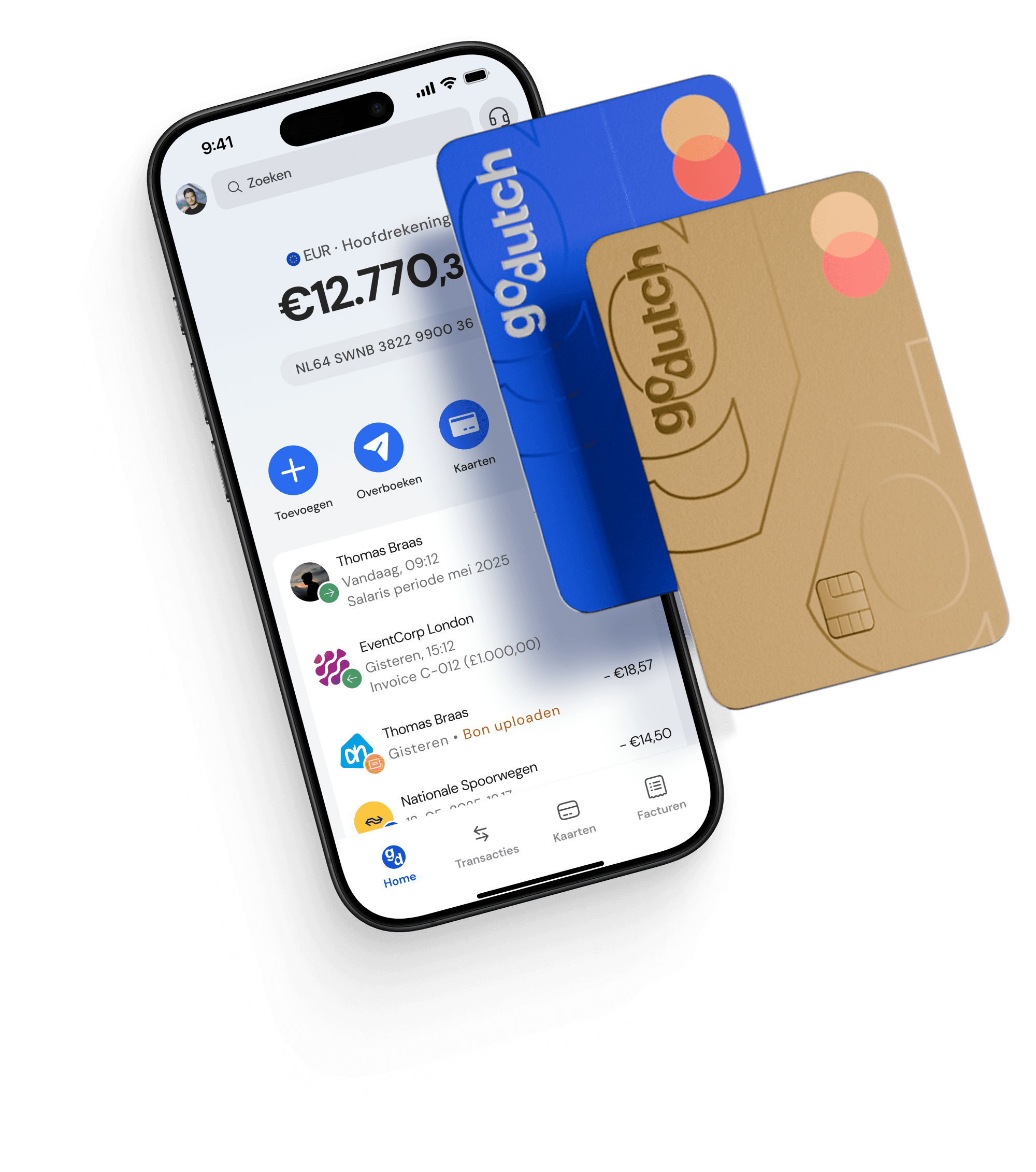
At GoDutch, you arrange SEPA payments from a business account without slow processes or hidden costs. GoDutch is not a bank, but a provider of a smart business account with a regulated financial partner in the background.
You apply for the account in 3 minutes and you have an IBAN and card within 1 day. After that, you make transfers within the entire SEPA area, pay with virtual and physical Debit Mastercards, and link your accounting so that transactions automatically end up in the right place. Would you first like to weigh your options carefully? You can easily compare business accounts before you choose, or immediately see what a GoDutch business account arranges for you.
FAQ
Frequently asked questions about SEPA
How long does a SEPA payment take?
A standard SEPA payment takes a maximum of one business day. If you submit the instruction on time, the money is often in the recipient's account on the same or the next business day. With an instant transfer, it takes place within ten seconds, day and night.
Do I need a BIC for a SEPA payment?
For a SEPA payment, you no longer need a BIC. Within the SEPA area, the IBAN is sufficient, because the corresponding code is automatically derived. Only for transfers to countries outside SEPA will you often still need a BIC or SWIFT code in addition to the IBAN.
Is a SEPA payment free of charge?
A SEPA transfer is free for most entrepreneurs: providers in the Netherlands usually do not charge separate transaction fees for it. With an instant transfer, this can sometimes be different, so check the terms and conditions of your own account.
What is the difference between a SEPA Direct Debit and a SEPA bank transfer?
The difference lies in who initiates the payment. With a SEPA credit transfer, you transfer money to someone else yourself, whereas with a SEPA direct debit, the recipient collects the amount after the payer has given permission via a mandate. A direct debit is particularly useful for recurring amounts.
In which countries can I pay with SEPA?
With SEPA you can pay in 41 countries. These are all 27 EU member states, supplemented by countries such as Norway, Iceland, Switzerland and the United Kingdom. The payment is always in euros, regardless of whether the country itself uses the euro as currency.