

A sustainable bank is becoming an increasingly relevant option for entrepreneurs in the Netherlands, as many banks are active, each with their own characteristics, services, and specialisations, and the impact on people and the environment is becoming more significant. Sustainability therefore plays an increasingly important role in choosing a bank. This makes it important to compare different business accounts.
Sustainable banks distinguish themselves by the way they deal with investments, transparency, and long-term value. They make different choices than traditional players and focus on positive impact alongside financial results. For you as an entrepreneur, this means that you are not only managing your daily finances but also contributing to an economy that is future-proof.
What is a sustainable bank?
A sustainable bank is a financial institution that takes into account the impact on people, the environment, and society in all its activities. This goes beyond simply transferring money abroad. Sustainability is structurally woven into its policies, investment choices, and the way risks are assessed.
Sustainable green banks critically examine where money is directed. Investments in sectors that are harmful to the climate, violate human rights, or exacerbate social inequality are often excluded. Instead, these banks focus on renewable energy, circular business models, social inclusion, and innovation with a positive societal impact.
Transparency plays an important role in this. Sustainable banks clarify how resources are allocated and which criteria are used, with a strong emphasis on governance, ethical management, and legislation.
There are several authoritative sources that assess the sustainability of banks, such as the Sustainable Brand Index and the Fair Bank Guide. These sources compare banks based on various societal and environmental criteria.
Sustainable Brand Index:
The Sustainable Brand Index focuses on how consumers perceive sustainability within brands. The research specifically looks at environmental and social responsibility and maps out which factors influence this perception and how this contributes to sustainable branding.
The Sustainable Brand Index is an annual study on the sustainability of banks based on consumer perception. In 2025, over 80,000 respondents were surveyed about 1,600 brands across 36 sectors in 8 European countries (source: Sustainable Brand Index).
Fair Bank Guide:
The Fair Bank Guide compares banks on themes such as climate, human rights, and social responsibility, thus providing insight into how responsibly green banks in the Netherlands manage their policies and investments (source: Fair Bank Guide).
Features of a sustainable bank
Sustainable banks structurally integrate social and ecological responsibility into their way of working. This translates into the following core characteristics:
Focus on people, the environment, and society;
Responsible investment choices;
Promotion of positive societal impact;
Transparency regarding financial flows and policies;
Ethical and sustainable risk management;
Strong governance and compliance with regulations.
Top 4 most sustainable banks in the Netherlands
The top 4 sustainable banks in the Netherlands are among the leaders in sustainable finance. Different banks have structurally embedded sustainability in their strategy and operations. Which bank is the most sustainable depends on multiple factors such as investment policy, transparency, social responsibility, and risk management.
1. De Volksbank: most sustainable bank
De Volksbank is one of the most leading sustainable banks in the Netherlands and is the parent company of ASN Bank, SNS, and RegioBank. Within this group, sustainability is central to the policy and choices regarding investments, lending, and social engagement.
Additionally, De Volksbank scores highly in the areas of governance and inclusivity. There is a strong focus on ethical governance, long-term value creation, and making financial services accessible. Due to this combination, De Volksbank is often seen as one of the most sustainable banks in the Netherlands.
Sustainability in corporate strategy
Responsible investment criteria
Ethical and transparent governance
Focus on inclusivity
Long-term value creation
2. Triodos Bank
Triodos Bank is internationally known as a pioneer in sustainable finance. The bank focuses exclusively on supporting organizations and entrepreneurs that contribute to a positive societal, cultural, or ecological impact.
An important characteristic is complete transparency regarding investments. Triodos makes clear which projects are financed and why they fit within the sustainable vision, focusing on renewable energy, care, education, and social enterprises, among others.
Only sustainable financing
Full investment transparency
Focus on social impact
Strict exclusion criteria
Sustainability as a core value
3. ASN Bank
ASN Bank has been known for years as one of the most sustainable banks in the Netherlands and is part of De Volksbank. Sustainability forms the core of its identity and guides all investment and financing choices. The bank adheres to strict sustainability criteria and invests exclusively in projects and organizations that contribute to a positive impact on climate, human rights, and biodiversity.
Through its focus on transparency, responsible investing, and long-term value creation, ASN Bank is often seen as a pioneer and leader in sustainable banking.
Strict sustainability criteria
Focus on climate and human rights
Exclusion of harmful sectors
Transparent investment policy
Long-term impact
4. NIBC Bank
NIBC has developed into a bank that increasingly integrates sustainability into its strategy. The focus is on responsible financing, where environmental, social conditions, and governance are structurally considered.
The bank has clear guidelines for investments and supports initiatives that contribute to sustainable innovation, energy transition, and future-proof business models. As a result, sustainability is an integral part of daily decision-making.
ESG integration in policies
Financing of sustainable innovation
Clear investment guidelines
Attention to social and environmental risks
Sustainable decision-making
Why is the sustainability of a bank important?
The sustainability of a bank is important because banks have a large influence on the direction of the economy. Sustainable banks determine which companies receive financing, which innovations are accelerated, and what social impact is created as a result. Therefore, they bear significant responsibility in shaping the future. For entrepreneurs, it is becoming increasingly important to collaborate with parties that look beyond short-term results.
Future-proof economy: sustainable banks stimulate investments in innovative and responsible business models that contribute to long-term economic growth.
Risk limitation: by taking environmental and social factors into account, banks reduce financial risks in the long term.
Social impact: banks play a key role in supporting initiatives that contribute to social equality and environmental protection.
Trust and transparency: a clear sustainable vision provides more insight and trust among entrepreneurs and other users.

Comparing sustainable banks
Comparing sustainable green banks in the Netherlands helps entrepreneurs make a choice that aligns with their values and business operations. By looking at sustainability focus, transparency, and investment direction, you quickly gain insight into the differences between banks.
Bank | Sustainability Focus | Transparency | Investment Direction |
De Volksbank | Strategically anchored | High | Socially responsible |
Triodos Bank | 100% impact-oriented | Very high | Social and ecological |
ASN Bank | Core of identity | High | Climate and human rights |
NIBC Bank | Increasing focus | Average | Sustainable innovation |
Is it easy to switch to a sustainable bank?
Switching to a sustainable bank is very easy nowadays. To ensure that the switching of banks goes as smoothly as possible, it is important that you follow a number of steps yourself. By planning these steps well in advance, you can avoid surprises and ensure that your daily financial matters continue without interruption.
Research: before you switch, it is important to compare different banks and their services. Look at fees, terms and conditions, and sustainability policies to determine which bank best fits your business.
Open a new account: once you have made a choice, open a new account. Make sure you have the necessary documents and identification ready so that this process proceeds quickly.
Set up automatic payments and direct debits: transfer all fixed payments and direct debits to your new account, such as subscriptions, suppliers, and salary payments.
Inform relevant parties: notify your employer and other parties of your new account details so that future payments are processed correctly.
Close your old account: once all payments have been successfully transferred, you can safely close the old account.
How do I switch to a sustainable bank?
Switching to a sustainable bank doesn’t have to be complicated, as long as you approach the process in a structured way. By following the steps below, you ensure that the transition goes smoothly and your financial matters continue without interruption.
Step 1: map your current banking affairs
Start by gathering all information about your current banking affairs. Consider current accounts, savings accounts, direct debits, fixed payments, incoming transactions, and any linked financial services.
Step 2: compare sustainable banks
Research which sustainable banks best suit your personal situation or business. Compare not only the costs and terms, but also look at their sustainability policies, transparency, and the societal impact of the bank.
Step 3: open an account with the new bank
Once you’ve made a choice, you can open a new sustainable account. Make sure you have all the necessary documents, such as identification and business details, on hand to ensure the application process goes smoothly.
Step 4: transfer payments and direct debits
Update your account details with all the parties you do business with. Think of customers, suppliers, subscriptions, and any salary payments, so that all payments are correctly processed through your new account.
Step 5: check and close your old account
For several weeks, check that all payments have been successfully transferred and that no transactions are still coming into your old account. Once everything is functioning correctly, you can safely close your old account.
GoDutch as your sustainable financial service provider?
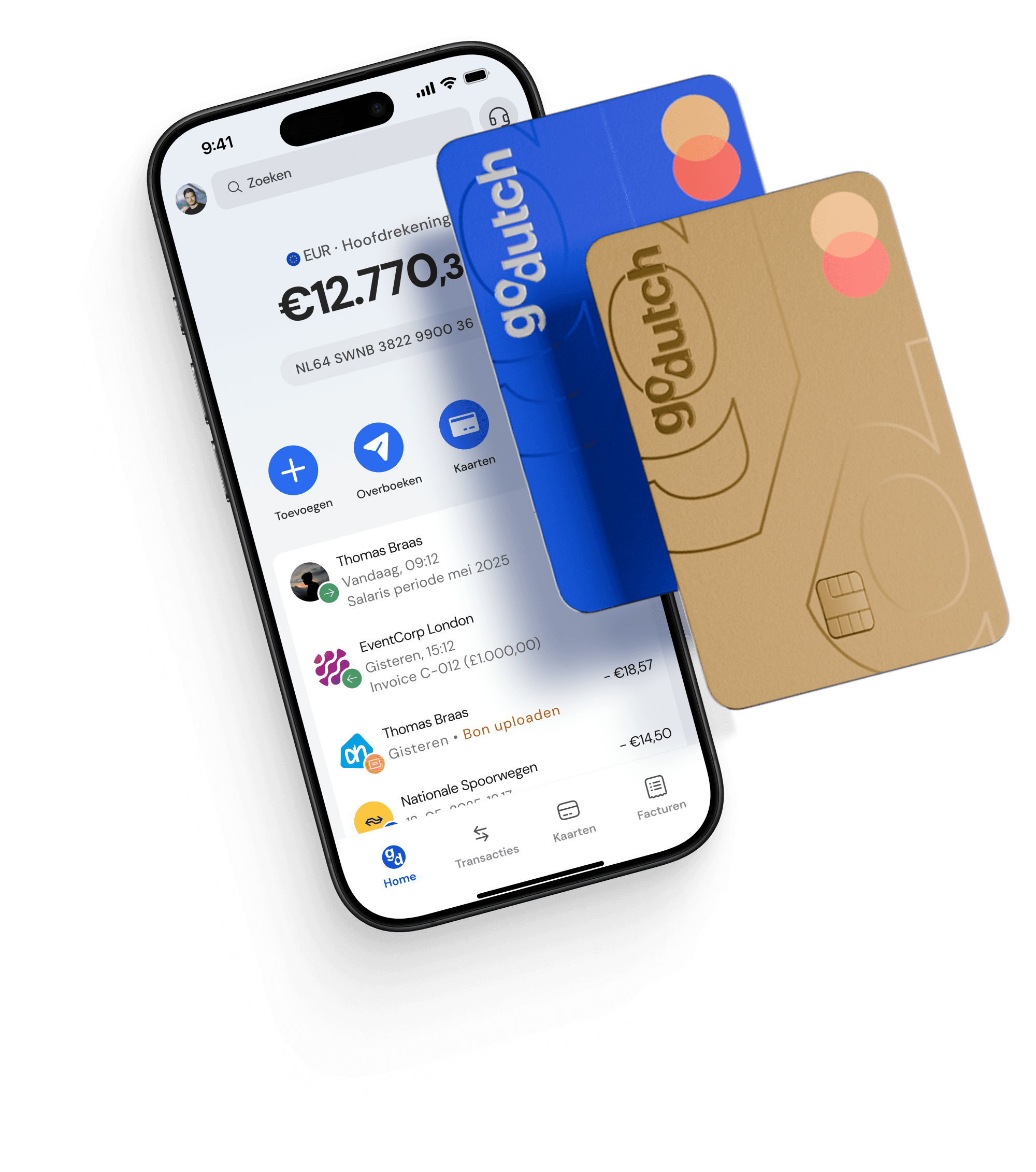
GoDutch is an innovative financial service provider that helps entrepreneurs manage their finances smarter and more efficiently. Sustainability plays an important role in this, among other things through extensive digitisation and automation.
Through the GoDutch app, you can manage payments, collaboration, and administration clearly in one place. This way, you can also easily apply for extra business accounts if you want to. Users also share in revenues through rewards and revenue share, while the KYC team and the AML and risk team ensure safe and responsible processes that comply with legislation and regulations.
How does GoDutch contribute further to sustainability and social impact?
GoDutch contributes further to sustainability and social impact by collaborating with various organisations that are committed to a better and fairer world.
Collaboration with KWF: GoDutch supports KWF in financing groundbreaking scientific cancer research, so new treatments reach patients faster.
Collaboration with War Child: through this collaboration, GoDutch contributes to mental programmes for children growing up in conflict areas.
Collaboration with Justdiggit: GoDutch supports nature restoration projects in Africa, where trees are brought back and biodiversity and local communities are strengthened.
If you want to organise your daily finances with an eye for efficiency, transparency, and impact, discover how the sustainable GoDutch payment account and GoDutch card help you save time and money and engage in future-oriented entrepreneurship.
FAQ