

Your bookkeeping as a self-employed person is rarely the most enjoyable part of running a business. Yet those records determine whether your tax return is correct, whether you claim the deductions you are entitled to, and whether you can stay calm when the Dutch tax authority takes a look.
What exactly do you need to keep? How long do you keep it? And do you do your bookkeeping yourself or outsource it? In this article you will find a complete overview, including the amounts that apply in 2026.
What counts as your self-employed bookkeeping?
Your records consist of all the information about your business that you set down, on paper or digitally. That is more than just your invoices. Anything that supports your figures or is relevant to taxation belongs to it. These are the parts you keep at a minimum:
Sales invoices: every invoice you have sent, with sequential numbering so there are no gaps in the series.
Purchase invoices and receipts: everything you have spent on the business, from software to a parking ticket.
Bank statements: the full transaction history of your business account.
Contracts and quotes: order confirmations, terms and conditions and agreements with clients.
Hours record: the hours you spend on your business, including administration, acquisition and training.
Mileage record: your business trips, certainly if you use a private car for business.
Stock: if you work with goods, the annual stocktake belongs here too.
What many self-employed people do not know: rough notes, diaries and interim calculations formally belong to your records too. They do not have to be tidy, but do not simply throw them away.
Are you obliged to keep records as a self-employed person?
Yes, you are legally obliged to keep and retain records. Your records are the basis of every tax return you file, and the tax authority must still be able to check years later whether you paid the right tax.
There is no prescribed format: how you keep it is up to you, as long as it is complete and verifiable. You keep the basic data of your records for 7 years.
That includes your accounts receivable and payable records, your purchase and sales records and your general ledger. For data on immovable property the term is 10 years. For other data you can agree a shorter term with the tax authority, but for the basic data those seven years are fixed.
Two things are often misunderstood. The 7-year term only starts running once data loses its current relevance: a contract with a four-year term you first keep for that whole term, and only then do the seven years begin.
And if you stop trading within the retention period, the obligation simply stays. If you keep records digitally, make sure your files are usable in an audit. A printout of your digital files is not enough.
Do your bookkeeping yourself or outsource it?
Bookkeeping is compulsory, but how you tackle it is entirely up to you. The choice comes down to a trade-off between time, complexity and how much certainty you want. You are not tied to anything: you can always scale up as your records grow.
Option 1: do everything yourself
You handle your entire bookkeeping yourself, usually with an online accounting package. That costs little, gives you direct insight into your figures and you learn exactly how VAT and deductions work.
This suits you if your records are straightforward, you send a handful of invoices a month and you are happy to do the entries weekly.
Option 2: do it yourself with a periodic review
You keep the day-to-day bookkeeping yourself, but have a bookkeeper look over it periodically or handle your year-end work.
Think of a quarterly check or only a review at the end of the year, with your deductions looked at at the same time. This suits you if you are growing, want to stay in control, but want to avoid mistakes.
Option 3: outsource completely
A bookkeeper or accountancy firm takes over your books and your tax returns. You supply your documents digitally and get reports back.
This suits you if time is scarce, or if your situation is becoming more complex through stock, investments or cross-border work. You pay more for it, but you are buying peace of mind and advice.
What does accurate bookkeeping get you as a self-employed person?
Records that are correct are not only an obligation, they are also worth money. As an entrepreneur for income tax purposes you may deduct a number of items from your profit, and for that you have to be able to show you are entitled to them. These are the amounts that apply in 2026.
Scheme | 2026 | Condition |
Self-employed deduction | € 1,200 | hours criterion of 1,225 hours |
Starters deduction | € 2,123 | hours criterion, 3 times in your first 5 years |
SME profit exemption | 12.70% | no hours criterion |
The self-employed deduction has fallen sharply: in 2025 it was still € 2,470. The tax benefit in 2026 is moreover calculated at a rate of 37.56%.
The deduction is never higher than your profit before entrepreneur's allowance, unless you are entitled to the starters deduction. If you reached state pension age at the start of the year, half the amount applies.
This is exactly why your records matter. You demonstrate those 1,225 hours with your hours record, and those are not only your billable hours: administration, acquisition and training all count. Keep nothing and you cannot demonstrate it, and you miss out on the deduction.
Now that the self-employed deduction is shrinking, every correctly recorded cost and every business kilometre weighs relatively more heavily.
How do you set up your freelance bookkeeping?
Working records are not about perfection, but about rhythm. Anyone who spends half an hour a week is done with the VAT return within an hour at the end of the quarter. These five steps set it up properly:
Separate business and personal: use a separate account for your business, so you do not have to work out every transaction when you do your entries. Whether you have to is covered in the article on whether you need a business account as a sole trader.
Choose how you keep records: an online accounting package takes away most of the manual work, but with a handful of invoices a year a spreadsheet can still do. Only: it is more error-prone and costs you more time later.
Schedule a fixed moment each week: put half an hour in your diary and do all your entries then. That keeps your records current and you see in time whether an invoice has not been paid.
Digitise receipts and invoices immediately: scan or photograph a receipt the moment you get it. The ink on till receipts fades, and receipts paid in cash are harder to verify once scanned.
Track your hours and kilometres: record weekly, not afterwards. A reconstruction in December will not convince the tax authority.
The mistakes that most often lead to a correction are always the same: private spending booked as business, an hours record filled in afterwards, and receipts that have gone missing so you cannot reclaim the VAT. All three are avoidable with the rhythm from step 3.
What changes in 2026 for your records?
Alongside the reduced self-employed deduction there is one development that bears directly on what you record: enforcement on false self-employment. Since 2025 the tax authority has again been actively checking whether you really work as an independent entrepreneur or are in fact in a disguised employment relationship.
In 2026 there are no default penalties yet, but penalties for intent or gross negligence can be imposed, and enforcement will be expanded step by step over the coming years.
For your records that mainly means: document how you work. Keep your assignment agreements, your quotes and your invoices to different clients. The tax authority looks at the practice and not only at the paperwork, but without paperwork you have no case at all.
Multiple clients, your own equipment and setting your own rate are all signals you can back up with your records.
Your bookkeeping starts with a separated money flow
Most administrative work arises after the fact: working out which transaction was business, finding a receipt to match a debit, or retyping by hand what already existed digitally. That work largely disappears if your business spending is separated from the start and your receipts land in the right place straight away.
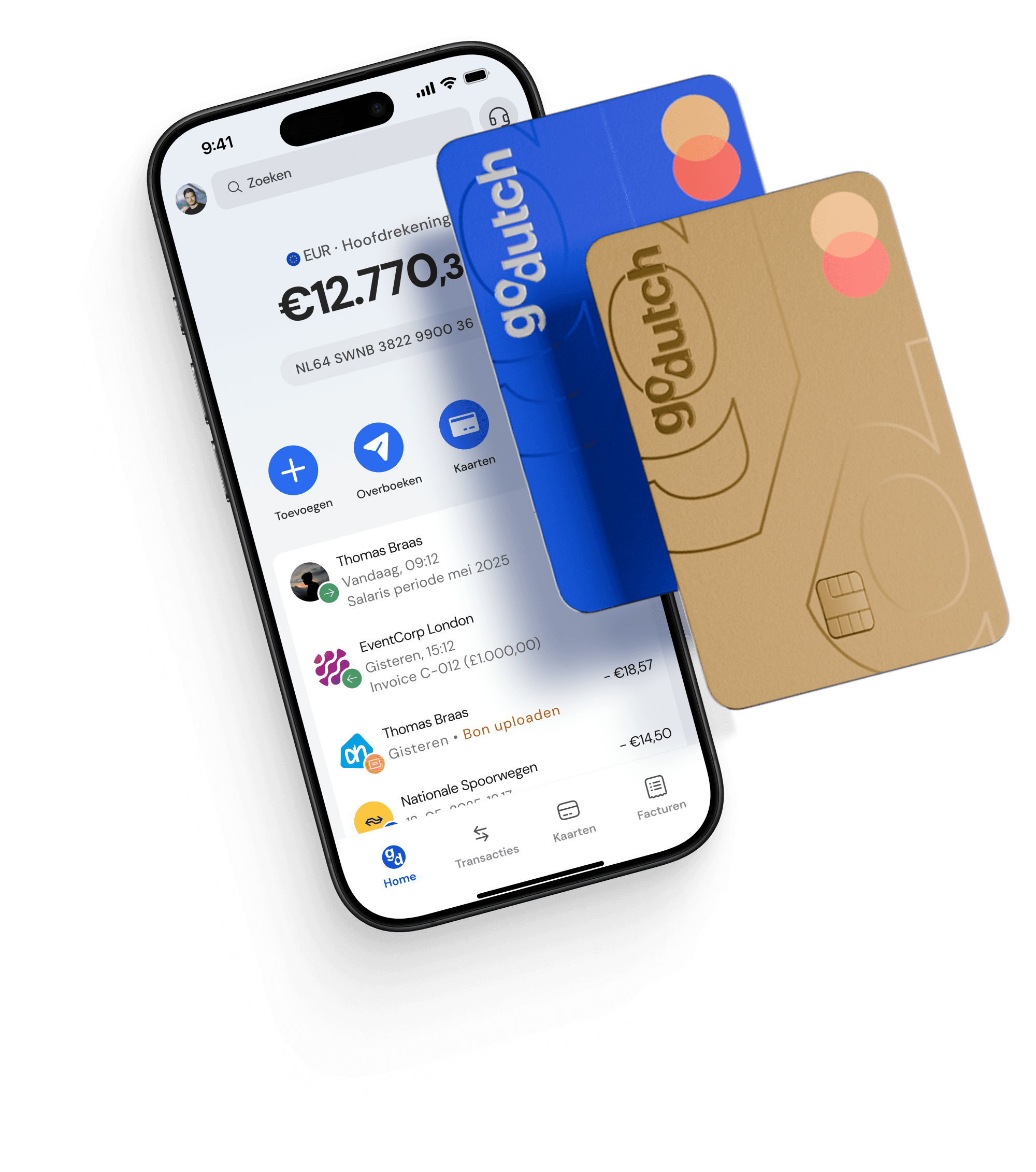
With the GoDutch business account you scan a receipt in seconds in the app or forward an invoice by email. You have real-time insight into your spending, you connect your transactions to accounting software such as Exact, Snelstart, Twinfield, Yuki or Jortt, and you give your bookkeeper access without sending files back and forth. At the end of the quarter your records are ready instead of still having to be made. What that involves is covered on the page about the business account for freelancers and the self-employed.
Get your bookkeeping right from day one
Want your bookkeeping in order without the hassle? Take a look at the GoDutch business account, applied for in 3 minutes and with your IBAN and card within 1 day. From your first invoice your business money flow sits separately from your personal account.
FAQ
Frequently asked questions about self-employed bookkeeping
Are you obliged to have a bookkeeper as a self-employed person?
As a self-employed person you are not obliged to have a bookkeeper. The law only requires you to keep and retain records. Whether you do that yourself, partly outsource it or hand it over completely is up to you, based on your time and the complexity of your business.
How long do you have to keep your records?
You keep your records for 7 years as a rule. For data on immovable property a term of 10 years applies. For other data you can agree a shorter retention period with the tax authority, but for the basic data those seven years always apply.
Can you keep your bookkeeping in a spreadsheet?
You may keep your bookkeeping in a spreadsheet, because the law does not prescribe a format. It is more error-prone and takes more time than an accounting package, which automates scanning, entries and splitting out VAT. In any case make sure your records stay complete and verifiable.
How often do you file a VAT return as a self-employed person?
You usually file a VAT return quarterly, even if you had no revenue in that quarter. If you take part in the small businesses scheme you charge no VAT and file no VAT return, but then you cannot reclaim the VAT on your business costs either. For income tax you continue to file in both cases.
How much time does self-employed bookkeeping take per week?
For a straightforward business, self-employed bookkeeping takes around half an hour a week. That mounts up quickly if you let it slide, because you then have to work out afterwards where transactions belong. A fixed weekly moment is therefore almost always faster than a quarterly catch-up.