
You send an invoice out or one comes in, and then the question is: does this fall under receivables or under payables? Many entrepreneurs mix the two up, while you come across them in almost every entry.
In this article you will read what accounts receivable and payable are, where they sit on the balance sheet, which payment terms apply and how to keep track of them without your cash flow suffering.
What is the difference between accounts receivable and payable?
Accounts receivable are customers who still have to pay you. Accounts payable are suppliers you still have to pay. That is the whole difference, and it is one of the first things you come across as soon as you start keeping your own bookkeeping and records.
What makes it confusing is that it is not fixed to a person or a company. It depends on which side of the transaction you are on. Your customer is your debtor, but at that same moment you are that customer's creditor.
And the other way round: your supplier is your creditor, while you are a debtor to them. Every business therefore has receivables and payables at the same time, just not in the same relationship.
The trick for telling them apart
Remember it by the direction of the money. With receivables the money is coming to you: you receive. With payables the money is leaving: you pay. If that does not work for you, use the balance sheet as a reminder. Receivables sit on the debit side, payables on the credit side.
What are accounts receivable?
Accounts receivable are your customers with an outstanding invoice. You have delivered, the invoice has been sent, but the money is not yet in your account. From the moment you send that invoice the customer is a debtor, and as soon as they pay that stops. A customer who pays in advance or settles immediately therefore never becomes a debtor.
All outstanding sales invoices together form your receivables balance. That is money legally already due to you but which you cannot yet use, and that is exactly where the risk sits: you have already incurred the costs and declared the VAT, while the income is still to come.
In annual accounts you will also come across the term trade receivables. Those are the claims arising from your ordinary business activities, so from products or services delivered. Claims outside that, such as a loan to a business partner, do not fall under it.
What are accounts payable?
Accounts payable are your suppliers and service providers with an invoice you still have to settle. You have already received the goods or the service, but you pay at a later moment. As long as that invoice is outstanding, that supplier is your creditor.
Working on account is the norm in business, and that is in effect a form of credit. As long as you have not paid a purchase invoice, you are temporarily using another entrepreneur's money.
That gives you financial room, but it takes discipline: they remain debts with a due date, and paying late earns you interest, collection costs and a damaged relationship.
The total of your outstanding purchase invoices is called your payables balance. If that is structurally much higher than your receivables balance, that is a signal to look at your liquidity. Your obligations are then rising faster than what is coming in.
Where do receivables and payables sit on the balance sheet?
Receivables sit on the left of the balance sheet, on the debit side, under current assets. It is an asset: money you expect to receive within a foreseeable time. Payables sit on the right, on the credit side, under short-term liabilities. That is what you have to pay within a year.
You see the same in the entry. When you send a sales invoice, you book receivables on the debit side and your revenue plus the VAT payable on the credit side.
When the payment comes in, the receivables item disappears again and the amount sits in your account. With a purchase invoice it works the other way round: the costs and the input VAT go on the debit side, the payables item on the credit.
Debiting and crediting are something else
Debiting and crediting resemble receivables and payables, but they mean something quite different. They are verbs from double-entry bookkeeping: debiting is booking an amount on the debit side of a ledger account, crediting on the credit side. Every entry always has both, and the two sides are equal in total.
So you can perfectly well credit a creditor without any debtor being involved. The terms refer to the party, the verbs to where you put the amount.
What is an accounts receivable and payable ledger?
Alongside your general ledger you keep two sub-ledgers. Your receivables ledger shows per customer which invoices are outstanding, what the due date is and what has already been paid. Your payables ledger shows the same for your purchase invoices.
Together they add up exactly to the two balance sheet items, and they tell you what the balance sheet does not: from whom you get what, and when. The instrument you get out of that is an ageing analysis.
You split your outstanding invoices by how long they have been open: up to 30 days, 30 to 60, 60 to 90 and more than 90 days. That way you see at a glance which customers are just a little late and which are becoming a real problem. In most accounting packages that analysis is available as standard.
What do receivables and payables mean for your cash flow?
Your profit says little about the money in your account. You can have an excellent year on paper while being squeezed, simply because your customers pay slowly and your suppliers do not. Two ratios make that visible.
The first is DSO, days sales outstanding, the average number of days you wait for your money. You calculate it by dividing your receivables balance by your revenue and multiplying by the number of days in the period. On € 250,000 of annual revenue with an average of € 30,000 outstanding, you arrive at 44 days. The mirror image is DPO, days payable outstanding: the same sum, but with your payables balance and your purchase value. With an average of € 8,000 outstanding on € 100,000 of purchases, you pay after 29 days yourself.
The difference between those two is your working capital gap. In this example you are financing fifteen days of revenue out of your own pocket, every month again. The bigger your business grows, the bigger that gap becomes. That is why shortening your DSO is often more effective for your liquidity than bringing in extra revenue.
Update: that pressure is increasing. The Payment Study North Europe 2026 by Altares Dun & Bradstreet shows that a quarter of invoices in the Netherlands are not paid within the agreed term, against 23.9 percent a year earlier.
It is the first deterioration since 2021. The Order to Cash Monitor 2026 by Windesheim University of Applied Sciences shows that the average lead time from order to payment now stands at 59 days, and that revenue therefore only becomes available money after more than eleven weeks.
Which payment terms and rules apply?
Your receivables and payables are not separate from the law. Maximum payment terms apply, you may charge interest and costs if someone is late, and a claim does not remain enforceable forever. So always put the agreed term on your invoice, along with all the other mandatory details on an invoice.
The statutory payment term
If you agree nothing, a term of 30 days applies automatically. How far you may deviate depends on who you are doing business with:
Between SMEs: a maximum of 60 days, provided you set it down in writing and the term is not unreasonable for the party receiving the money.
From a large company to an SME or freelancer: a maximum of 30 days, without exceptions. This rule has applied since 1 July 2022 and exists to stop large parties abusing their position.
From government to businesses: 30 days, since 2013.
To consumers: no statutory maximum, only the requirement that the term is reasonable. In practice 14 or 30 days is usual.
Pay close attention to when that term starts running: not on the invoice date, but on the day after the invoice is received. In a dispute about late payment that difference can be decisive.
Statutory commercial interest and collection costs
If a business customer pays late, you may charge statutory commercial interest from the day after the due date. You do not need a reminder or a notice of default for that; that obligation only applies towards consumers. The percentage is set every six months and currently stands at 10.4 percent.
In addition, with a business customer you are entitled to at least € 40 in collection costs, even without having done anything to collect. If you want to charge more, you have to include the statutory scale in your terms and conditions, because that scale is only binding for consumers.
With consumers there is the further rule that you must first send a free reminder with a fourteen-day term before you may charge any collection costs at all.
When does an invoice become time-barred?
An invoice to a business customer becomes time-barred five years after the payment term has expired. If you sell a product to a consumer, that is already after two years. After that you can no longer enforce payment.
You can restart that term by interrupting it. You do that with a written, preferably registered, reminder in which you state that you still claim the amount. If your customer makes a partial payment or asks for a payment arrangement, they thereby acknowledge the debt and the term starts again too.
How do you approach receivables management?
Receivables management is nothing more than staying on top of it consistently. Customers rarely pay faster than you ask them to, so it pays to keep a fixed rhythm rather than improvising case by case. A workable plan looks like this:
Check your outstanding items weekly: put a fixed moment in your diary and go through your ageing analysis, so you do not discover after three months that someone never paid.
Send a reminder straight away: if the due date has passed, do not wait. Often the invoice has simply been left lying or ended up with the wrong person.
Call after the second reminder: a phone call achieves more than a third email and you hear immediately whether there is a substantive problem with the invoice.
Book a provision when payment becomes doubtful: from around 90 days outstanding a debtor is doubtful. You then record the claim excluding VAT as a provision, so your balance sheet is not too rosy.
Reclaim the VAT when it becomes irrecoverable: you simply process that in your business VAT return; a separate request is usually not needed.
That last point has a hard deadline. A claim counts as irrecoverable no later than one year after the agreed final payment date, and you then have to reclaim the VAT in the period in which that term expires.
If it is clear earlier that your customer is not going to pay, for example in a bankruptcy, you do it straight away. Wait too long and the tax authority can refuse the refund. If your customer pays later after all, you pay the VAT on that amount again.
How do you keep your payables in order?
On the payables side it comes down to two things: checking what comes in and paying on time what is correct. Go through every purchase invoice for the details, the amount and the question of whether you actually received the goods or service.
Fake invoices for subscriptions you never took out and spoof invoices copied from an existing supplier are common, and the difference is sometimes only a different account number.
Then schedule fixed payment moments rather than handling invoices one by one. That way you keep an overview of what leaves your account and when, and you stop an invoice falling through the cracks.
If you process your purchase invoices via automatic invoice payment, the amount, the due date and the payment sit together straight away and you no longer have to retype anything.
There is a tax side to it too. If you have already deducted the VAT on a purchase invoice but still have not paid that invoice a year after the final payment date, you have to repay that VAT to the tax authority.
If you do pay afterwards, you may deduct it again. It is the same rule as for irrecoverable receivables, only this time to your disadvantage.
Tracking receivables and payables without separate tools
Most of the hassle around receivables and payables does not come from the accounting rules, but from fragmentation: invoices in one tool, payments in another, receipts in a folder. The more links in the chain, the later you notice something is outstanding.
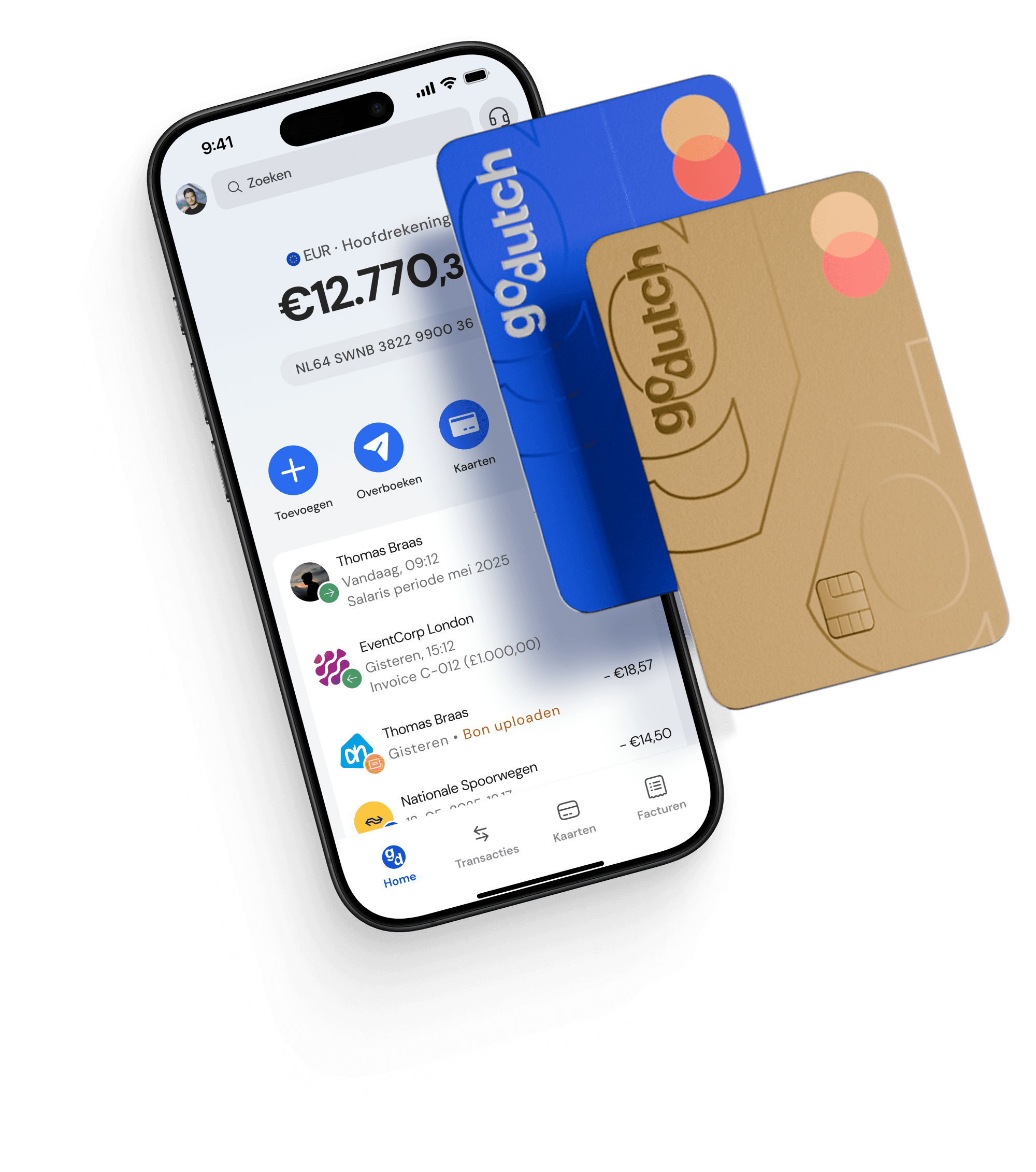
GoDutch is not a bank, but an all-in-one business account in which you have payments, cards, expenses and your accounting link together.
You see in real time what comes in and what goes out, you connect your records to your accounting software so transactions land in the right place automatically, and you process and pay incoming invoices from a single overview.
That way your receivables and payables position is no longer a monthly search, but something you simply see.
Open your GoDutch business account today
Opening a business account with GoDutch takes you a few minutes. You apply online, you have your IBAN and card within 1 day, and you connect it directly to your bookkeeping. If you run into something, someone is there for you 24/7.
FAQ
Frequently asked questions about accounts receivable and payable
Is a customer a debtor or a creditor?
A customer is a debtor, as long as they have an invoice from you outstanding. To that customer you are the creditor at that moment, because you are the party still due to receive money. If they pay in advance or immediately, they never become a debtor.
What does a debtor number on an invoice mean?
A debtor number is the customer number a company uses to link your invoices and payments together. It says nothing about arrears or a debt. If you quote that number with your payment, the sender can process it faster.
What are trade receivables?
Trade receivables are the claims arising from your normal business activities, so from products or services you have delivered. Other claims, such as a loan or a subsidy still to be received, fall outside that and sit separately on the balance sheet.
How long do you have to keep invoices?
You keep invoices for seven years, as part of your records. For invoices relating to immovable property, such as land or business premises, ten years applies. Keeping them digitally is allowed, as long as it is a complete and accurate representation of the original.
What happens to your claim if a customer goes bankrupt?
If a customer goes bankrupt, you file your claim with the trustee and book it in your records as doubtful. You do not have to wait out the year: as soon as it is established that no more will be paid, you reclaim the VAT in your next return.