GoDutch vs Qonto
We have listed the main differences for you, so that you can make the best choice.
€0 fixed costs per month
NL IBAN active in 1 day
Up to 1% cashback on every payment, unlimited
24/7 real people on the phone
Which one should you choose?
Are you looking for the right business account between Qonto and GoDutch? I founded GoDutch because entrepreneurs are better off with a local provider than with Qonto: fixed monthly costs, no cashback, limited Dutch integrations. With GoDutch, as a modern entrepreneur, you get a business account in 1 day, free, with cashback and automatic bookkeeping. Below, I compare both providers for your business.

Account
Dutch IBAN
Extra (virtual) IBANs
Free card
Free customer and company research
Open account / onboarding
Fully digital registration process
Registration time
Processing time KYC/KYB
Costs
Fixed costs p/m (starting price)
Cost per SEPA payment
Cost of additional payment account (IBAN)
Cost of additional payment card
Features
Real-time balance insight
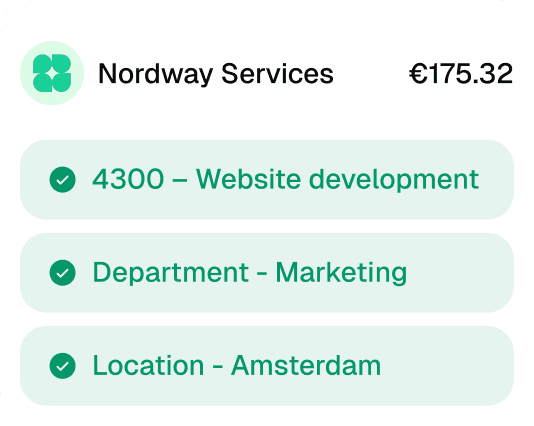
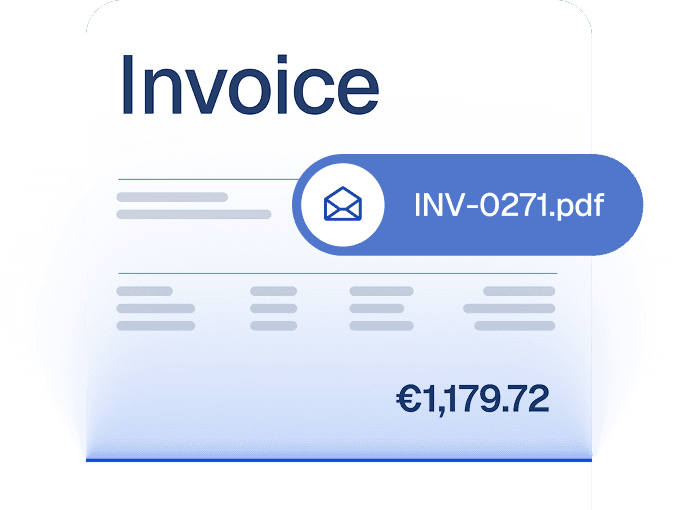
Automated invoice processing
Automatic VAT recognition
Access for accountant / bookkeeper
Accounting integrations
Team card and expenditure management
International
Currency exchange at mid rate
Countries available
Currencies available
Security & Support
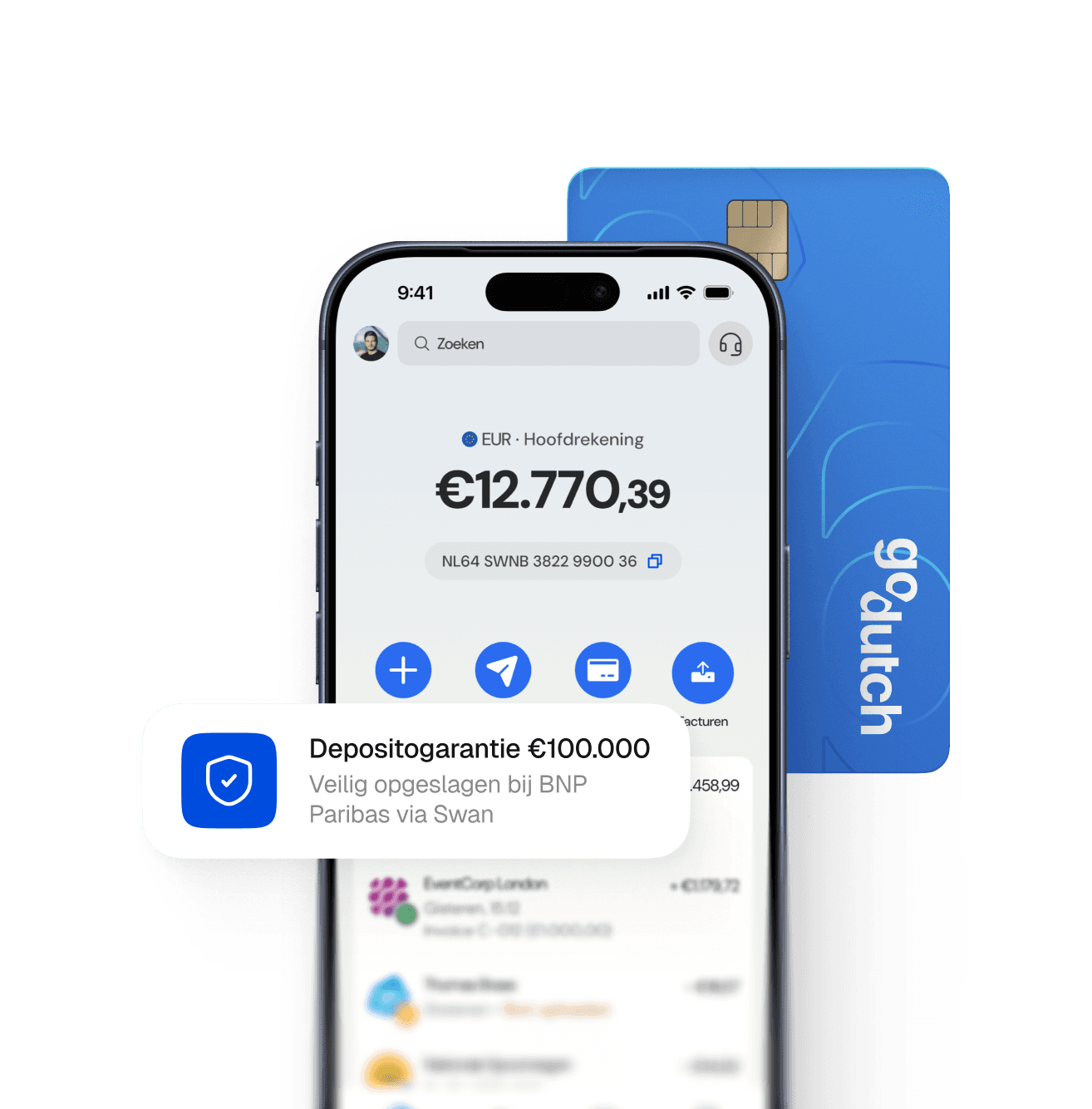
Deposit guarantee (covered up to)
24/7 telephone support
Multilingual customer support
Rewards
Cashback on card transactions
Up to 50
3 minutes
1 day
€0
€0.12
Included from Starter
Free
At cost
160+
20+
€100,000
Max up to 1.0%
 Up to 4.37% return
Maximum 25
Virtual free; physical from Basic
10 minutes
Within 24 hours
€0 (Starter)
€0.20 after 5 free p/m
Only via a higher plan
€5 per month per additional One Card
From Smart (€23 p/m)
From Smart (€23 p/m)
From Essential (€59 p/m)
0.56–2% markup (min. €5)
150+
30+
€100,000 via FGDR (FR)
Chat 24/7, call on request
NL/EN
Up to 0.8%, paid card only
1.5% from Smart (up to €50k)
This comparison is based on publicly available information as of 12 October 2026. Prices, features and terms may change. Always check the provider's website for the most up-to-date information.
Useful features
More than just a payment account
Everything you need to smartly manage your finances as an entrepreneur, from payments to insights.
FAQ
Frequently asked questions
Discover answers to frequently asked questions about our products and services.
What are the main differences between GoDutch and Qonto for Dutch entrepreneurs?
The main differences between GoDutch and Qonto for Dutch entrepreneurs lie in regulation, the pricing model, the rewards programme and the accessibility of customer service. Both providers are modern digital providers with a Dutch IBAN, automated bookkeeping functionality and mobile apps; the underlying legal and commercial set-up differs.
GoDutch is a Netherlands-oriented provider with a focus on the Dutch business market, a Dutch IBAN and a deposit guarantee of up to €100,000 per account holder. Qonto is a French payment provider supervised by the Autorité de Contrôle Prudentiel et de Résolution (ACPR), with customer funds held at partner bank Crédit Mutuel Arkéa and coverage under the French FGDR deposit guarantee scheme (also €100,000).
At cost level, GoDutch starts from €0 per month with an unlimited number of IBANs and free debit cards, cashback of up to 1% on all card spending and 24/7 customer service in Dutch and English. Qonto starts from €9 per month for the entry package, with 30 included transactions, a conditional rewards programme of up to €360 per year and customer service 5 days per week. For entrepreneurs who want an easy entry with unlimited cashback and 24/7 support, GoDutch offers a more direct route; for entrepreneurs who value specific features such as tap-to-pay, overdraft credit or interest on balances, Qonto may offer additional value.
Under which banking licence does Qonto fall compared with GoDutch?
Qonto is subject to French regulation: the organisation is supervised by the Autorité de Contrôle Prudentiel et de Résolution (ACPR), part of the Banque de France. Customer funds are held with partner bank Crédit Mutuel Arkéa, separate from Qonto's own company finances. Qonto balances are covered by the French Fonds de Garantie des Dépôts et de Résolution (FGDR) up to €100,000.
GoDutch works with a Dutch IBAN and offers deposit guarantee up to €100,000 per account holder. The service, customer service, accounting integrations and operational setup of GoDutch are fully tailored to the Dutch business market, with Dutch-language support and Dutch legal forms as core principles.
For most entrepreneurs, the difference in the DGS route makes little practical difference as long as the balance remains below €100,000; in absolute terms, both regimes offer comparable protection. For entrepreneurs who particularly value a locally rooted provider with Dutch-oriented services, GoDutch aligns more closely with Dutch business practice than Qonto's French-regulated structure. More details about Qonto's structure can be found on the page about the Qonto business account.
Do I get a Dutch IBAN with Qonto, just like with GoDutch?
Yes, since 2025 Qonto has been offering Dutch IBANs (NL prefix) to Dutch entrepreneurs, comparable to the Dutch IBANs that GoDutch has provided since launch. In this way, both providers meet the practical expectations of Dutch customers, suppliers and direct debit systems that work with NL account numbers.
At Qonto, IBAN provision runs via the Dutch branch in Amsterdam, opened in 2024. For entrepreneurs who opened a Qonto account before 2025, a French or Italian IBAN may still be active; these can be swapped on request for a Dutch IBAN. At GoDutch, a Dutch IBAN has been standard since the start of the service.
Both providers also support sub-accounts or virtual IBANs. Qonto offers up to 25 sub-accounts per account; GoDutch offers unlimited additional IBANs on the Max package and 10 on Pro. For entrepreneurs who work with multiple projects, clients or tax reserves within one business, GoDutch offers greater flexibility on the higher packages; for entrepreneurs who stay within the 25-sub-account limit, the difference in practice is negligible.
How long does it take to open an account with Qonto compared with GoDutch?
With GoDutch, your account is operational within three hours of the digital application; registration itself takes three minutes and KYC processing is completed within one working day. With Qonto, registration takes about ten minutes and KYC processing is usually completed within 24 hours. Both providers offer fully digital onboarding without physical visits or paper documents.
With Qonto, the process goes as follows. You register online on the Qonto website, submit company documents and identification via the app, and wait for the automatic plus partly manual verification. For most sole traders and private limited companies with simple structures, the account is active within one working day. With more complex structures or international shareholders, processing can take several working days longer.
With GoDutch, KYC is fully automated via passport or driving licence identification in front of the camera, with automatic verification within three hours as standard. The Dutch IBAN and virtual Mastercard are active immediately afterwards. For entrepreneurs who want to be able to invoice or make payments on the same day, GoDutch offers a faster turnaround than Qonto, although both providers are significantly faster than traditional Dutch banks.
How much does a Qonto business account cost compared with GoDutch?
Qonto starts from €9 per month for the Basic package, with 30 included SEPA transactions per month. On top of that, you pay transaction fees above the included amounts from €0.20 to €0.40 per SEPA payment (depending on the package), plus additional charges for extra cards, international payments and add-ons. GoDutch starts from €0 per month on the Free package, with €0.12 per SEPA payment from the first transaction and without an add-on structure.
The four GoDutch packages compared with the Qonto entry-level packages:
GoDutch Free (€0 per month): no free Qonto equivalent; Qonto starts from €9 per month
GoDutch Starter (€12 per month) without cashback: versus Qonto Basic (€9 per month) without cashback and with 30 included transactions
GoDutch Pro (€29 per month) with 0.5% cashback and 10 team cards: versus Qonto Smart or Premium
GoDutch Max (€49 per month) with 1% cashback, unlimited users and a dedicated account manager: versus Qonto Business or Enterprise
For business owners with low to medium transaction volumes and a focus on cashback rewards, GoDutch is structurally more favourable than Qonto. For business owners who value specific Qonto features such as overdraft facility, advanced reporting or integrated cash flow management, the higher price may be justified. The full GoDutch pricing overview is available transparently online without hidden modules or add-ons.
What cashback does GoDutch offer compared with Qonto?
GoDutch offers unlimited cashback up to 1% on all card spending, with no conditions or annual caps, on the Pro (0.5%) and Max (1%) packages. Qonto offers a conditional rewards programme of up to €360 per year, only on specific card subscriptions and only with at least five eligible transactions per month.
In practice, this means that for an entrepreneur with €4,000 in monthly card spending via GoDutch Max, cashback of €480 per year (1% × €48,000). At Qonto, the maximum on that same spending volume is €360 per year, provided the conditions are met and the correct card type is selected. For entrepreneurs with higher card spending (from €5,000 per month), the difference increases further in GoDutch's favour, because the Qonto programme is capped while the GoDutch cashback model continues without an upper limit.
For a GoDutch business account for limited companies where a lot of business spending goes through the card (software, hardware, travel costs, online advertising), the unlimited cashback alone can compensate for a significant part of the subscription costs. The structural difference in cashback structure (unlimited versus capped and conditional) clearly works in GoDutch's favour on an annual basis, especially for entrepreneurs with outgoing card spending above €2,500 per month.
What automations does Qonto have besides GoDutch's?
Qonto and GoDutch both offer modern automation for Dutch bookkeeping: automatic invoice processing, VAT recognition, accounting integrations and real-time balance insights are standard features with both providers. The main difference lies in the revenue model: Qonto often positions advanced features as paid add-ons, whereas GoDutch includes these in the base package without separate module fees.
Specific Qonto add-ons outside the base package:
Cash flow management Plus: €29 per month (annual billing), forecasts up to four years ahead with Google Sheets real-time sync
Accounts payable Plus: €29 per month (annual billing), expanded supplier management with payment workflows
Sales invoicing and automation: €35 per month (annual billing), quote-to-payment process with recurring invoices
Advanced team roles and permissions: available from higher-tier plans
Current account credit: available upon approval at an APR of 13%
With GoDutch, real-time balance insights, automatic invoice processing, VAT recognition and accounting integrations are standard parts of all packages, with no separate add-on costs. For business owners who want to use basic automation without stacking up monthly extra costs, GoDutch offers a more straightforward package. For business owners who specifically need cash flow modelling or advanced reporting, the Qonto add-on structure can add value. A full overview is available on the page with GoDutch integrations with accounting software.
How does GoDutch’s customer service differ from that of Qonto?
GoDutch is available 24/7 via chat, e-mail and phone from its own staff, in both Dutch and English. Qonto offers customer service 5 days per week via chat, phone and e-mail in six languages (Dutch, English, French, German, Spanish and Italian). Both providers offer multilingual support; the main difference lies in availability at weekends and in the evenings.
For entrepreneurs with daily operational card transactions, availability at weekends and outside office hours is a practical difference. A blocked card on Saturday evening, a failed payment on Sunday or an urgent question about a transaction late in the evening can be resolved directly with GoDutch, while Qonto customers in the same situation have to wait until Monday or work around the issue via the chatbot.
GoDutch combines digital ease of use with traditional accessibility: Pro and Max customers receive priority support, and Max customers additionally get a dedicated account manager. Qonto is known in reviews for quick responses during opening hours via chat and phone. For entrepreneurs who also want to ensure operational continuity at weekends, GoDutch is a better fit for the realities of Dutch entrepreneurship than Qonto's 5-day model.
How international is Qonto compared with GoDutch?
Qonto supports international payments via its own payment infrastructure and via integration with Wise for specific exchange transactions, with 30+ currencies and reach in 150+ countries. The exchange-rate markup at Qonto can rise to around 1.5% depending on the currency pair and package. GoDutch supports 20+ currencies in 60+ countries for outgoing transfers and 150+ countries for incoming transfers, at the official mid-market rate without markup.
For entrepreneurs with substantial international foreign-currency traffic, the difference in exchange-rate markup can be significant. On an exchange transaction of €10,000, the difference between 0% (GoDutch mid-market rate) and 1.5% (Qonto maximum) means a direct cost of €150 per transaction. At ten such transactions per month, the annual difference rises to €18,000 in GoDutch's favour.
Qonto does offer a broader currency range (30+ versus 20+) and handy features such as integrated payment links for international invoicing. For entrepreneurs who work structurally in exotic currencies or want integrated invoicing, Qonto can offer additional functionality. For a business account for GoDutch holdings with international operating companies, the combination of Dutch IBAN, broad country coverage and mid-market-rate model offers a structural cost advantage over Qonto's exchange-rate model.
Which legal forms does Qonto accept compared with GoDutch?
Qonto accepts sole traders, private limited companies, public limited companies, general partnerships, holding companies, foundations, associations and cooperatives via fully digital onboarding. GoDutch accepts the same legal forms plus owners' associations, with a special 0% VAT rate on the subscription for non-profit legal forms (foundations, associations, owners' associations). Both providers are therefore broadly applicable, with the main differences being the owners' association offering and VAT treatment.
For boards of non-profit organisations, GoDutch offers a practical advantage. A business account for foundation boards via GoDutch falls under the 0% VAT regime, whereas Qonto applies standard VAT rates to all package costs and add-ons. On a Pro plan at €29 per month, that saves €73 per year in VAT on an equivalent Qonto package.
In addition, GoDutch offers dedicated functionality for specific legal forms, such as self-service management of board member changes for owners' associations and equal access for general partnership partners without extra modules. For general partnership entrepreneurs, a business account for general partnership entrepreneurs at GoDutch provides standard parallel access for both partners. At Qonto, multiple users can be added, but the logic works from a primary-user model rather than equal partner access.
How do GoDutch and Qonto score on cash flow and credit functionality?
Qonto offers a number of cash flow and credit features that GoDutch does not include as standard: an overdraft facility (APR 13% subject to approval), up to 2% interest on the balance of the Qonto account (on specific plans) and advanced cash flow management via the Cashflow Plus add-on. GoDutch, by contrast, offers unlimited cashback of up to 1% on card spending, unlimited sub-accounts for budgeting on Max and standard VAT overview.
For business owners who regularly operate with a negative balance or want a fixed credit line, Qonto offers a direct option within the same app. The APR of 13% is in line with market-rate business credit, but substantially higher than a traditional bank loan or supplier credit. For business owners with stable cash flow, this credit is rarely needed and offers no practical added value.
For entrepreneurs working from a self-employed or SME perspective with a focus on cashback rewards and real-time visibility, a business account for self-employed professionals with GoDutch offers direct value through unlimited cashback and standard VAT management without add-on fees. For entrepreneurs specifically seeking credit and cash flow functionality within one platform, the integrated Qonto offering may be complementary. The choice depends on whether you are structurally in credit (Qonto advantage) or want your spending rewarded without conditions (GoDutch advantage).
What is Qonto’s add-on structure for extended functionality?
The Qonto add-on structure is a modular model in which advanced features are taken out as separate monthly subscriptions on top of the basic package. Unlike an integrated model with all-inclusive packages, the Qonto customer only pays for specific functionality, with separate monthly rates per add-on.
The main Qonto add-ons outside the standard packages:
Cash Flow Management Plus: €29 per month (annual billing), forecasts up to four years ahead with Google Sheets real-time sync
Accounts Payable Plus: €29 per month (annual billing), advanced supplier management with payment workflows and approval routes
Sales invoicing and automation: €35 per month (annual billing), full invoicing and quotation workflow with recurring invoices
Advanced team roles and permissions: available from higher-tier packages
Overdraft facility: available on approval, APR 13%
In practice, for an entrepreneur using the three main priced add-ons, that comes to €87 per month on top of the package price, excluding transaction fees and additional services. A background analysis of the total cost structure in the business banking market is available in the background on transaction costs for business accounts. With GoDutch, all basic automation is included free of charge in the Free package or built into the Pro or Max package, without separate add-on fees.
How do I switch from Qonto to GoDutch?
Switching from Qonto to GoDutch is arranged in four steps. Within three hours you will have an operational account with GoDutch, and you only close your Qonto account as the final step, so you can switch over calmly without missed payments or double subscription costs.
Step-by-step plan for the switch:
Open your account with GoDutch: complete the online application (three minutes), identify yourself with a passport or driving licence, and wait for the KYC processing (three hours). Your Dutch IBAN and virtual Mastercard are active immediately afterwards, with deposit protection up to €100,000.
Inform contacts about your new IBAN: send customers and suppliers a short email with your new Dutch account number. In the GoDutch app, download a bank statement with your IBAN for your records and any connection to the Transfer Service.
Move direct debits and subscriptions: adjust recurring payments for software subscriptions, suppliers and periodic invoices. Do not forget to cancel any active Qonto add-ons (Cashflow Management Plus, Accounts Payable Plus) in good time to avoid double subscription costs.
Close your Qonto account: transfer the remaining balance to GoDutch and close your Qonto account via the Qonto app under account settings or by contacting Qonto customer service. A detailed route and key points are set out in the step-by-step guide on closing a Qonto account.
Keep both accounts running in parallel for the first month so that any forgotten direct debits are not rejected and the notice period for any Qonto add-ons continues. If you have any questions during the switch, the GoDutch support team will help you 24/7, including at weekends and in the evenings. Ready to switch to a provider with €0 set-up, unlimited cashback and Dutch-focused services? You can open an online business account with GoDutch straight away and get started today.
Published 28 Nov 2025 · Updated 12 Oct 2026

The account that saves you time and money
